November 2025: Thanksgiving on the Pirate Island of Tobago

Why We Chose Tobago

With a free week over Thanksgiving, Paula, Indie, and I decided to spend the holiday on a Caribbean island I’d been wanting to visit for years. My first trip to Trinidad—where I watched steel-pan musicians rehearse in their pan yards for Carnival—left me fascinated by the country, but I never had time to explore its other main island: Tobago.

Trinidad and Tobago may share a name, but they feel like two completely different worlds. Trinidad is busier, more urbanized, and struggles with a high crime rate. Tobago, by contrast, is slow, relaxed, quiet, and deeply rooted in an older Caribbean rhythm that has disappeared from much of the region.

Tobago’s Old Caribbean Vibe

Unlike many islands in the Caribbean, Tobago has largely avoided the wave of mega-resorts and mass tourism. Much of the northern part of the island remains wild and pristine, with thick rainforests cascading toward the sea, coral reefs hugging the coastline, and scattered fishing villages tucked between jungle-covered hills.

Part of this preservation is tied to Tobago’s relationship with its southern neighbor. Thanks to Trinidad’s oil and gas wealth, Tobago has benefited from generous social programs, heavy government employment, and a stronger public safety net than many standalone island economies. Because of this financial backing, Tobago has not been forced to sell off its coastline and land to mega-resorts or foreign developers in the same way many other Caribbean islands have. Tourism exists here, but it feels supplementary rather than desperate.

In that sense, Tobago reminded me a lot of Dominica—lush, rugged, and nature-first—but with better beaches.

A Real Pirate Stronghold

It’s also the kind of landscape that feels straight out of Pirates of the Caribbean—remote coves, rugged shores, and untamed forest. And there’s a historical reason for that cinematic familiarity.

During the 1600s and 1700s, Tobago’s secluded northern bays were genuine pirate hideouts. Infamous figures like Blackbeard and Captain Morgan used these coves to shelter their ships, ambush Spanish treasure vessels, and disappear into the island’s steep, uninhabited coastline. With its strategic position near major shipping routes and constant political tug-of-war between European powers, Tobago was an ideal base for piracy.

A Week of Nature With Indie

For our family, Tobago promised exactly what we wanted: quiet nature, uncrowded beaches, rainforests to explore, clear water for snorkeling, and a peaceful atmosphere that felt perfect for traveling with Indie. It was the Caribbean as it once was—and still is, if you know where to look.


Geopolitics on the Edge of Paradise

Proximity to Tension

Tobago might feel like a carefree tropical escape, but geography has a way of reminding you that paradise is never completely isolated. Only eight miles to the south lies hectic Trinidad, and just twenty miles east is Venezuela—a nation embroiled in tense geopolitics in recent years. With the U.S. military reportedly preparing to intervene to remove Maduro over alleged drug trafficking, small boats near Trinidad being targeted by the U.S. Navy for suspected smuggling, and Maduro accusing Trinidad of harboring American forces and threatening retaliation, I couldn’t help but feel a flicker of apprehension about bringing my family there.

The Real Risks I Considered

Despite the geopolitical noise, my real concern wasn’t Venezuelan military action. It was the possibility of flights being canceled if a conflict suddenly escalated. Navigating geopolitical uncertainty is nothing new in my travels, and after weighing the situation, I ultimately decided there was no meaningful risk to us by visiting Tobago.

Ground-Level Concerns

The more realistic risks had nothing to do with international politics: certain high-crime areas in Trinidad, unpredictable road conditions, and the challenge of relearning to drive on the left side of narrow, winding mountain roads. These were the concerns that occupied my mind far more than anything unfolding across the sea in Venezuela.

Our base was Speyside in the north of the island


Getting to Tobago

Flying Through Trinidad

To reach Tobago, you first need to fly into Port of Spain in Trinidad. We did so via United Airlines from Houston, which meant traveling very late at night in both directions—a tiring schedule, especially with Indie. Because of the late arrival, we spent the night near the airport in a small, locally run guesthouse before starting the final leg of our journey the next morning.

The Short Hop to Tobago

From Trinidad, travelers connect onward on a small domestic turboprop flight—a hop usually scheduled for 20 minutes. To our surprise, our Caribbean Airlines ATR actually departed 30 minutes early and completed the flight in only 10 minutes, making it one of the best and smoothest flights I’ve ever taken. We were barely buckled in before we began descending over Tobago’s lush hills and coral-fringed coastline.

One thing I’ve always appreciated about Tobago is that it traditionally lacked direct international flights, which helped keep the island small, tranquil, and insulated from the mass tourism that has transformed so many destinations in the Caribbean.

A Surprising Change on the Return Flight

However, on our return journey with Caribbean Airlines, I was stunned to find that our little ATR turboprop had been replaced by a full-size Boeing MAX jet arriving from JFK. The aircraft stopped in Tobago to pick up passengers before continuing onward. Seeing such a large international jet parked on Tobago’s tiny runway felt like an unsettling sign of what the future may hold.

The Inevitable March of Development

Development is inevitable in the Caribbean, and while improved access can bring convenience, it also threatens the quiet character and natural charm that make Tobago such a rare escape.


Arriving in Tobago

Island Time Begins at the Rental Counter

As soon as we landed, we picked up our rental car—and immediately received our initiation into Tobago’s famously slow pace of life. The rental agency clerk spent nearly 45 minutes filling out paperwork and inspecting the car in the slowest manner imaginable. Nothing was rushed; everything moved at a gentle, unhurried rhythm. Welcome to Tobago.

Relearning to Drive on the Left

Once we finally pulled out of the parking lot, I had to quickly retrain my brain to drive on the left side of the road. I also had to remind myself not to drift too close to the shoulder, since many Tobago roads are bordered by steep concrete gutters—deep enough to swallow a tire if you’re not careful. These are the hazards you don’t fully appreciate until you’re staring into one while navigating a blind curve.

The Long, Winding Road North

The drive to our hotel was only about 45 miles, but it took a few hours along steep, twisting mountain roads. We passed through small local villages at first—homes clinging to hillsides, tiny fruit stands beside the road—but as we drove farther north, the villages grew smaller and the rainforest thicker. The coastline became wilder, the hills steeper, and the landscape more dramatic with every mile.

Echoes of Tobago’s Colonial Past

Tobago was once used extensively by European powers for cocoa and sugar cultivation, and remnants of that era still linger across the island. On the property of our hotel stood the ruins of an old sugar plantation, including a weathered stone sugar mill—silent, moss-covered reminders of a very different time in the island’s history.

Old Abandoned sugar mill

Staying at Blue Waters Inn

A Boutique Hotel With Naturalist Roots

We stayed at a beachside boutique-style hotel called the Blue Waters Inn, located on land originally purchased in the early 1900s by a British naturalist who wanted to protect the unique flora and fauna of Tobago’s remote northeast coast. True to those origins, the hotel today still maintains a strong focus on nature, birding, and quiet, low-impact tourism. Set near the small village of Speyside, it feels completely removed from the more developed and crowded parts of the Caribbean.

Wildlife All Around the Property

The hotel sits on a large tract of rainforest and coastline, with trails and wild corners that make it feel more like a nature lodge than a traditional beach resort. Parrots, frigatebirds, and seabirds are constant companions, soaring over the bay or landing in the trees around the property. The most memorable visitor, however, was Tobago’s national bird—the Cocrico or chacalaca—a bush-chicken-like bird with the personality of a mischievous camp raider. A few of them liked to lurk in the trees next to the breakfast tables, waiting for the moment we looked away so they could swoop in and steal scraps of food.

A Landscape Shaped by a Darker Past

Despite its natural beauty, the land also carries a darker and more complicated history. Before it became a nature sanctuary and ultimately a hotel, the property was part of the Speyside sugar plantation. The old stone sugar mill and plantation ruins still stand near the entrance, stark reminders of an earlier era. The plantation dates back to the 1700s and at one point was worked by around 200 African slaves whose forced labor shaped much of Tobago’s early economy.

Speyside sugar plantation ruins

Life at the Hotel

Mornings by the Sea

But our favorite part of staying at Blue Waters Inn was our oceanfront room. I often left the door wide open so the warm sea breeze could drift inside and so we could fall asleep—and wake up—to the hypnotic rhythm of waves rolling into the bay. Every morning became a ritual: opening the door, making a cup of coffee, and sitting in a patio chair with Indie on my lap as we watched the sunrise paint the sky over the water.

A Warm Welcome and a Peaceful Atmosphere

The hotel was quiet, with only a handful of guests, and the Tobagonian staff were incredibly welcoming. From the moment we arrived and were greeted with rum punches, I knew I’d love the place. Fresh fish was almost always on the menu, and the atmosphere was relaxed, friendly, and deeply rooted in the easygoing charm of the island.

Swimming, Sunlight, and Indie’s Hot Tub Corner

We spent a lot of time in the water—first swimming in the calm, blue bay right in front of the hotel, then drifting over to the infinity pool, and finally ending each day in the small, cozy hot tub. The hot tub was Indie’s favorite. She claimed a little corner where the water was shallow and warm, complete with a tiny chair she declared was “for Indie,” and she happily splashed there every evening.

Hard to Leave

Although we explored much of northern Tobago—rainforests, villages, reefs, trails, and remote coves—it was honestly hard to pull ourselves away from the hotel. The peaceful setting, the ocean breeze, the wildlife calls echoing from the trees, and the comfort of our room made it one of those rare places where staying put felt just as rewarding as venturing out.

Indie exploring the beach at our hotel
Waking up in the morning at our hotel
Our favorite infinity pool and hot tub

Exploring the Atlantic and Caribbean Sides of Tobago

Two Very Different Coasts

Speyside sits on the Atlantic side of the island, where the ocean is wilder—windier, with bigger swells—although our little cove was sheltered by a scattering of offshore islands, including Little Tobago. But just over the ridge, the entire mood of the island changes. On the Caribbean side, the sea becomes calm, the air grows more humid, and the coastline feels softer and more relaxed.

A Morning in Charlotteville

This contrast was especially noticeable in the sleepy town of Charlotteville, which we visited one morning to hike to the beach at Pirates Bay. Charlotteville felt unhurried and deeply local: a cluster of brightly painted buildings overlooking the bay, fishing boats bobbing near shore, and people heading to start their day.

Before beginning the hike, I did what any traveler should do in a small Caribbean village—I bought a warm slice of freshly baked banana bread from a market stall and grabbed a hot coffee to fuel the morning. A friendly woman in a tiny shop pointed us toward the trail while a line of young men picked up their breakfasts before heading off to work. There were no tourists around, no hustlers, no pressure—just ordinary island life.

Hiking to a Pirate Hideout

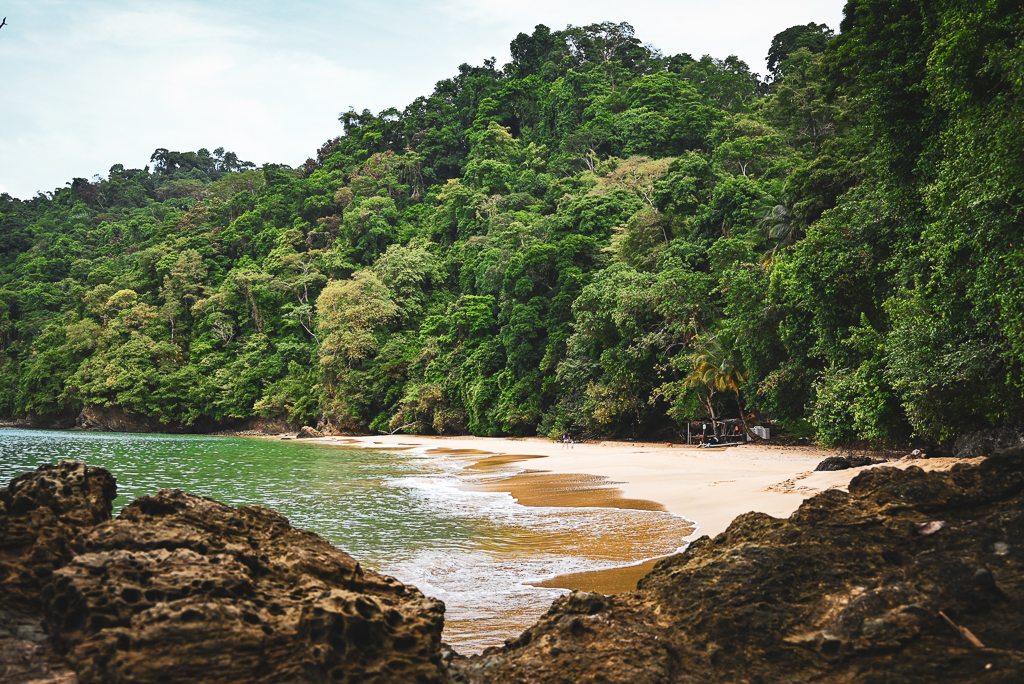
Pirates Bay was one of those places I absolutely had to visit. Anything tied to pirate lore instantly captures my imagination, and this cove is a genuine historical hideout used in the 1600s and 1700s. Not just by any pirates—but by legends like Blackbeard and Captain Morgan, two of the most notorious names in Caribbean history.

Tobago was perfect pirate territory. The island constantly shifted between European powers locked in conflict, and pirates thrived in the instability. Its proximity to Spanish treasure routes made it an ideal ambush point, and the rugged, jungle-clad northern coastline—with its steep cliffs and secluded coves—offered excellent places to hide, repair ships, smuggle goods, and replenish supplies. Pirates Bay became one of the most famous of these hideouts.

Reaching the Cove

The only way to reach the cove is by hiking along a muddy forest pathway and descending steep, slippery stone steps—or by hiring a local fishing boat. We parked the car, I put Indie in the backpack carrier, and we followed the trail through the forest. When we reached the beach, we found it completely deserted. We swam alone in the protected cove, surrounded by emerald water and jungle-draped cliffs, imagining what this place must have looked like during the golden age of Caribbean piracy.

It was one of those rare places where history, landscape, and atmosphere all align—and having it entirely to ourselves made it even more magical.

Coral fringed bay on hike to Pirate Bay
Charlottsville view from hike to Pirates Bay
Pirates Bay Beach
Indie and Paula at Pirates Bay
Pirates Bay Beach
Indie and Paula walking in distance at Pirates Bay

Overlooking Charlotteville

The Old Fort Above the Bay

After our morning at Pirates Bay, we drove up the narrow hillside road to the overlook where Fort Cambleton once stood, perched high above Charlotteville with sweeping views of the twin bays below. The site was originally a small British fortification, positioned perfectly to watch over the harbor and deter enemy ships entering from the Caribbean side.

Views and a Toddler on the Move

Very little remains of the fort today—only a few cannons resting on the hillside and traces of the old foundations—but the views are breathtaking. The turquoise water, the curve of the bay, the fishing boats far below, and the steep green walls of jungle all combine into one of the most beautiful panoramas in Tobago.

What the fort lacked in historical ruins, it made up for in adrenaline. The hillsides were steep, and we spent most of our visit chasing after Indie, who was determined to explore every edge of the overlook with zero awareness of gravity. Keeping her from tumbling off the hillside became the main activity—adding its own element of adventure to the stop.

Fort Cambleton
Paula and Indie looking at Charlottville from Fort Cambleton

Driving the Caribbean Side and Into the Rainforest

A Remote and Rugged Coastline

Another highlight of our trip was driving along the Caribbean side of the island. The road wound high above the bays, with steep drop-offs and sweeping views of turquoise water far below. Villages were sparse and remote, with small clusters of wooden houses tucked into the hillsides. Life felt simple and rural here—the kind of place where time hasn’t sped up the way it has elsewhere.

Entering the Oldest Protected Rainforest in the Americas

From the Caribbean coast, the road climbed over the ridge and carried us deep into the rainforest of Main Ridge Forest Reserve—the oldest legally protected rainforest in the Americas. Remarkably, the forest was first set aside in the 1700s when residents of the island realized that preserving the watershed meant preserving rainfall for their cocoa and sugar plantations. It’s one of the earliest examples of environmental conservation in the Western Hemisphere.

Exploring the Forest With Indie

We drove slowly along the lonely, winding road beneath towering trees and dense green canopy, the air cool and heavy with the smell of wet earth. We stopped at a few points to let Indie experience the rainforest, but the trails were thick with mud after recent rains—true jungle conditions. Even from the roadside, though, the forest was spectacular: ferns glowing in the filtered light, vines hanging like ropes, and the constant background chorus of birds and insects.

Parrots were especially common here—screeching loudly as they flew overhead or landing in the treetops in noisy green flocks. It felt wild, untouched, and ancient, a stark contrast to the beaches and sleepy fishing villages along the coast.

Indie in front of a large forest fern
Indie and paula in the forest
View from top of the forest ridge

Visiting the Hummingbird Reserve

A Family-Run Sanctuary at the Edge of the Rainforest

One of our absolute highlights in Tobago was visiting Shurland James Hummingbird Nature Park, a small, family-run sanctuary perched at the edge of the rainforest. The family has built a rustic treehouse overlooking the jungle canopy and set up feeders that allow visitors to experience the hummingbirds up close.

For a small fee, they provide nectar so you can hand-feed the birds, and they’ll also cook simple local dishes for lunch. We ended up doing both—and loved every minute of it. The setting felt intimate and authentic, more like being welcomed into someone’s backyard than visiting a formal attraction.

Feeding the Hummingbirds

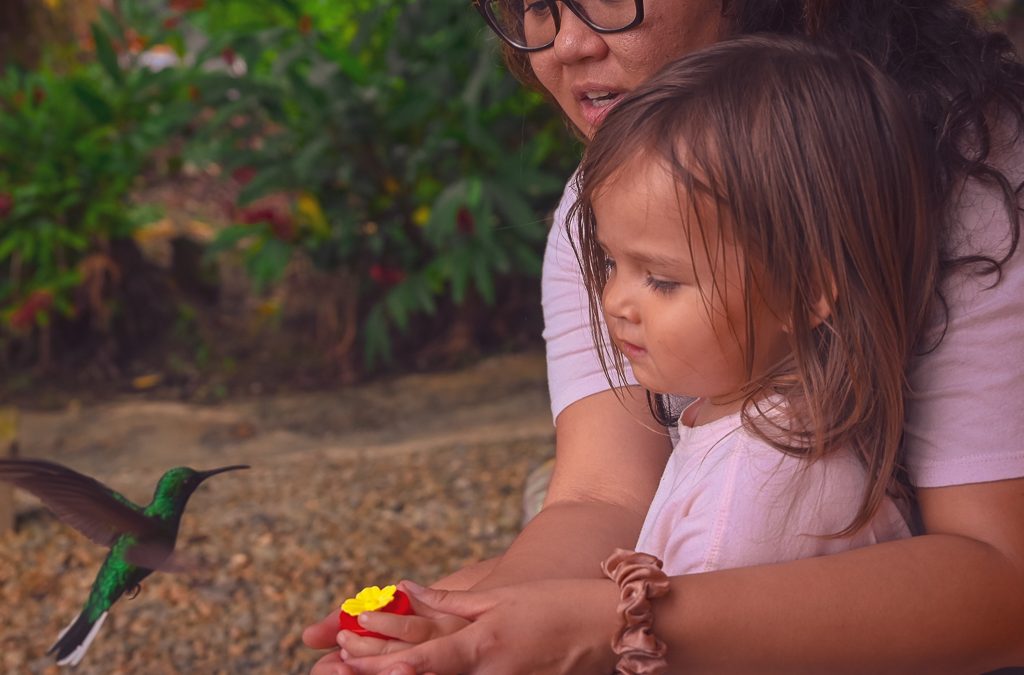
The hummingbirds were colorful, energetic, and completely fearless. Even while we were eating lunch, they zipped past our faces at lightning speed, making that unmistakable swooshing buzz as they darted between trees and feeders. Occasionally they erupted into mid-air skirmishes, tiny wings beating furiously as they chased each other just inches from our heads.

Indie was both fascinated and intimidated by them. Each time one streaked past, she clung a little tighter to me, unsure whether these glittering little missiles were friends or something to be wary of.

When it came time to feed them, the experience was pure magic. The birds landed directly on our hands, balancing delicately as they slipped their long beaks through the tiny hole in the nectar container. Feeling their feather-light feet and hearing the rapid flutter of their wings up close was unforgettable.

A Familiar Memory

The whole scene brought back memories of a hummingbird that used to visit my house in Ocean Beach. It would occasionally fly straight into the living room when I left the door open, hover in front of me as if inspecting what I was doing, and then dart back outside. Once, it even tried to land on my brother Jesse’s head.

Feeding the hummingbirds
Indie and Paula Feeding the hummingbirds

A Rainy Morning and a Hidden Peninsula

A Slow Start to a Stormy Day

One morning we woke to the sound of rain hammering down on the roof, and we decided to stay at the hotel and enjoy a quiet day. It was actually nice to have an excuse to slow down—no driving, no agenda, just watching the rain sweep across the bay. But as soon as the storm calmed, we couldn’t sit still any longer.

Following a Muddy Track Into the Hills

I had noticed a faint muddy track on Google Maps that seemed to snake behind the hotel, cutting up along the mountainside before disappearing into a remote peninsula. Curiosity won out. The track was far too steep and muddy to drive, so I loaded Indie into the backpack carrier and we set off on foot.

The climb was beautiful—slick, muddy, and wild. The trail offered incredible views back toward the bay, the rainforest dripping with the last of the morning rain. We were quickly joined by a small herd of goats that decided to follow us up the hillside, and the air echoed with the loud squawking of parrots flapping between the treetops.

A Secluded Beach and an Unexpected Story

Eventually the trail opened up and revealed a small, secluded beach tucked between cliffs—completely hidden from the rest of the island. Just above the sand was an old ruined house, half-collapsed and overgrown, looking as though no one had lived there in decades.

Later, I learned that the house wasn’t abandoned at all. An elderly sharecropper named Sweetie Pie had lived there for more than 40 years, tending small crops in the forest and raising goats while living in the dilapidated home. Standing on the edge of the peninsula, with the surf pounding below and parrots screeching overhead, it made sense—this was the kind of place where someone could disappear into their own quiet corner of the world.

Hike behind Blue Waters Hotel
Secluded bay

Paula and Indie at the secluded bay

Indie in the backpack carrier that I use to carry her around in our travels 

Secluded Bay
Indie running in front of Sweetie Pies House

Boat Trip to Little Tobago

Setting Out After the Storm

When the front finally passed and the sun broke through the clouds, the island felt refreshed—bright, warm, and washed clean by the rain. We decided it was the perfect moment for a half-day adventure, so we joined a Trinidadian couple from New York on a glass-bottom boat heading toward Little Tobago.

As we crossed the bay, we passed Goat Island, where a derelict house sits perched above the water—its cracked walls and moss-covered verandas giving it the look of a once-dreamy British seaside mansion. Local rumor claims that Ian Fleming, creator of James Bond, once owned or stayed in the house during his visits to Tobago, though no one seems certain of the truth. Today, the abandoned structure belongs to the local government, its empty windows staring out over the sea like a relic forgotten by time.

A Nature Sanctuary With an Unusual Past

Little Tobago itself has a fascinating history. The island was once owned by a British naturalist who eventually bequeathed it to the local government under one condition: that its biodiversity, native wildlife, and bird populations be protected forever. Ironically, during his travels to New Guinea many years earlier, he had introduced birds-of-paradise to Little Tobago—an exotic transplant that thrived for decades. Their brilliant colors and elaborate displays became part of the island’s legend.

But nature has its own cycle. A powerful hurricane in the 1990s decimated the island’s vegetation and wiped out the entire introduced population. Today, Little Tobago remains a sanctuary, but one returned fully to its native species.

Hiking to the Clifftop Lookout

After landing on Little Tobago, we hiked up a steep trail through scrubby forest to reach the lookout at the top. The views were spectacular—waves crashing into the rocky cliffs below, and flocks of tropicbirds, frigatebirds, and boobies riding the rising wind currents with effortless grace. The island felt untouched, wild, and protected in a way that modern tourism rarely allows.

Snorkeling at Goat Island’s Reef

After exploring the island, our boatman took us across the channel for snorkeling at the reef off Goat Island—right beneath the shadow of the old ruin.

The glass bottomed boat we took from our hotel to Little Tobago Island
Indie in her lifejacket
Indie looking at the tropical fish in the reef through the glass bottom of the boat
View of Atlantic from Little Tobago Island

Seabirds of Little Tobago

Life on the Cliffs

We loved watching the frigatebirds and other seabirds soaring effortlessly along the cliffs, riding the strong Atlantic winds as if they were weightless. Many nested on the steepest, most inaccessible ledges, and one nest sat tucked into the thicket just below our lookout—close enough to see the adults swooping in with incredible precision.

As we stood there taking it all in, our local boat guide casually mentioned that we were standing on the very same spot where David Attenborough once stood while filming The Trials of Life, a BBC nature documentary series that aired in 1990. Knowing that one of my lifelong heroes had documented these same seabirds from this exact vantage point decades earlier made the moment feel surreal and deeply meaningful.

A Predator Among the Flock

At one point, peregrine falcons streaked across the sky, diving at incredible speed like fighter jets. In an instant, they picked off pigeons that had ventured too far into open airspace, the entire encounter unfolding so quickly it was almost a blur. Watching the predator–prey drama play out among the cliffs added a raw, wild edge to the otherwise peaceful spectacle of soaring seabirds.

Me pointing out the seabirds to Indie

 Red Billed Tropicbird

 Red Billed Tropicbird Nesting

Abandoned mansion built in the 60s, rumored to once belong to Ian Fleming, James Bond author, now sitting alone on one of the most beautiful locations, with no one to enjoy the view 

A Perfect Day’s End in Speyside

Lunch in a Tree

After a full day of island hopping, we were starving, so we stopped at a small local café in Speyside that only opens for lunch: Jemma’s Treehouse. The restaurant is exactly what it sounds like—a simple wooden structure built into a tree, overlooking the beach below. It felt like something straight out of The Cat in the Hat: whimsical and slightly surreal, with rough-hewn railings, shaded platforms, and uninterrupted views out over the water.

We were the last guests of the day, which somehow made the experience even better. The food was classic Tobagonian home-style cooking—freshly caught fish, simply seasoned and perfectly cooked, served with rice and local sides that tasted like they came straight from someone’s kitchen rather than a menu. We washed it all down with fresh fruit juices—bright, cold, and incredibly refreshing after a long morning in the sun and saltwater.

Everything felt unpretentious and authentic. No rush, no fuss—just good local food eaten slowly in a tree, with the breeze moving through the leaves and the sound of the surf below. 

To the End of the Road

After lunch, we drove up to the very end of the road on Flagstaff Hill at the northern tip of the island, where a World War II–era antenna once stood. The hilltop offered sweeping views across the coastline, with Charlotteville spread out below and the sea stretching endlessly into the distance.

Parrots screeched overhead, and peregrine falcons darted and circled on the wind currents. I had read about abandoned World War II bunkers hidden somewhere in the area, and we spent time searching for them, but came up empty-handed.  

Rum, Waves, and Island Nights

We capped off the night the same way I ended nearly every evening in Tobago: with a rum and Coke at the beach bar back at our hotel. Sitting there with the sound of waves rolling in, the warm night air, and Indie winding down after another adventure-filled day.  

View from the top of the Flafstaff hill overlooking Charlotteville

Our Last Day in Tobago

A Slow Morning and a Scenic Drive

On our final morning in Tobago, we slept in, enjoyed a quiet breakfast, and took our time packing up. After a week of exploring rainforests, coves, reefs, and remote villages, it felt good to have an easy, relaxed drive back toward the airport. We had a short domestic hop to Trinidad before catching our overnight United flight home.

A Stop at the Island’s Largest British Fort

Although we didn’t have enough time to visit Argyle Waterfall, we did make a final stop at Fort King George, the largest and most important British fort on the island. Perched high on a hill overlooking Scarborough—Tobago’s biggest town—the fort offered sweeping views of the harbor and coastline below.

Cannons still line the ramparts, and the restored barracks, prison cells, and guardhouses echo the days when European powers fought bitterly over this small but strategically placed island. It was a fitting final stop: a blend of natural beauty, colonial history, and panoramic views that summed up so much of what makes Tobago unique.

Fort King George

A Quiet Thanksgiving in Transit

Back in Trinidad

When we arrived back in Trinidad, we checked into a cheap airport inn for the night. The room had no windows and felt more like a jail cell than a hotel—functional, claustrophobic, and clearly designed for short layovers rather than comfort.

An Unplanned Thanksgiving

We had hoped to go out for a Thanksgiving meal somewhere nearby, but exhaustion won out. After a long day of travel and with a late-night flight looming, neither of us had the energy to venture back out. Instead, we fell asleep early, skipping dinner entirely and letting Thanksgiving quietly pass in transit.