Returning to Liberia
A First Visit After War
March 2026: I first visited Liberia in 2013, not long after the end of its brutal civil wars. At the time, I only had four days in the country. I was backpacking solo across Sierra Leone and Liberia on a tight budget, focused more on surviving and getting a glimpse of the country than truly understanding it.
Because of that, I spent most of my time in Robertsport—a quiet coastal settlement known for its surf. It’s also a place deeply tied to Liberia’s origins, founded by freed American slaves in the 1800s. They built plantation-style homes and a society heavily shaped by American influence.
But there’s a darker layer to that history. In a tragic twist, many of these settlers recreated the same social hierarchies they had escaped. Power became concentrated in the hands of Americo-Liberians, while indigenous Liberian groups were marginalized, excluded, and in some cases subjected to forced labor and exploitation. That imbalance would shape the country for generations—and help lay the groundwork for civil war.
A Country That Stayed With Me
Liberia stayed with me long after I left.
Part of it was the cultural connection to the United States—the familiarity in language, names, and even social dynamics. It felt both foreign and strangely recognizable at the same time. In some ways, it reminded me of traveling in some of my favorite parts of the Southern USA.
But what pulled at me just as much was what I hadn’t seen.
Looking at a map, I noticed that much of southern Liberia was covered in dense, untouched rainforest. I’ve always been drawn to the most remote and wild corners of the planet, and few places are as raw and impenetrable as the West African jungle.
Africa’s rainforests fall into three broad regions: the vast Congo Basin in Central Africa, smaller fragmented forests in East Africa, and the second-largest block in West Africa. I had previously explored part of this western rainforest in Taï National Park in Côte d’Ivoire, searching for wild chimpanzees. That forest, however, felt increasingly isolated—surrounded by cocoa plantations and deforestation.
Just across the border, Liberia still held something different: larger, more intact stretches of rainforest, especially in the south, extending into Sierra Leone.
At the same time, I had read books and watched films like Blood Diamond, which—while focused on Sierra Leone—captured the chaos and brutality that defined the region during the 1990s and early 2000s. Liberia’s wars were just as savage, and I wanted to understand how a country could descend so far—and how it could come back from it.
I knew I had to return. This time, for longer, and with a purpose.
The Plan: History and Wilderness
Years later, I came back with a group of friends for a week-long journey. This trip would be different. We weren’t just passing through—we wanted to have a better understanding of Liberia.
We would end up staying in Liberia for one week and split our time between the capital, Monrovia, and the remote interior.
In Monrovia, we focused on the human side of the story. We learned more about the civil wars, the factions, and the people who lived through them. One of the most striking experiences was meeting Joshua Milton Blahyi.
Blahyi was once one of the most feared warlords in Liberia. During the war, he led groups of child soldiers and admitted to committing horrific acts of violence. Today, he presents himself as a born-again Christian, working with vulnerable youth and speaking publicly about repentance and redemption.
Meeting him was complicated. I believe in redemption and the idea that people can change—but the scale of what he admitted to is difficult to fully process. If I had allowed myself to truly absorb the reality of those crimes in that moment, I’m not sure I could have sat across from him.
Into the Rainforest
The second part of our journey took us far from the capital and into one of the wildest places in West Africa: Sapo National Park.
Sapo is one of the largest protected rainforest areas in the region—remote, humid, and largely untouched.
Getting there is not easy. Roads are rough, infrastructure is minimal, and once you enter the park, you are on foot.
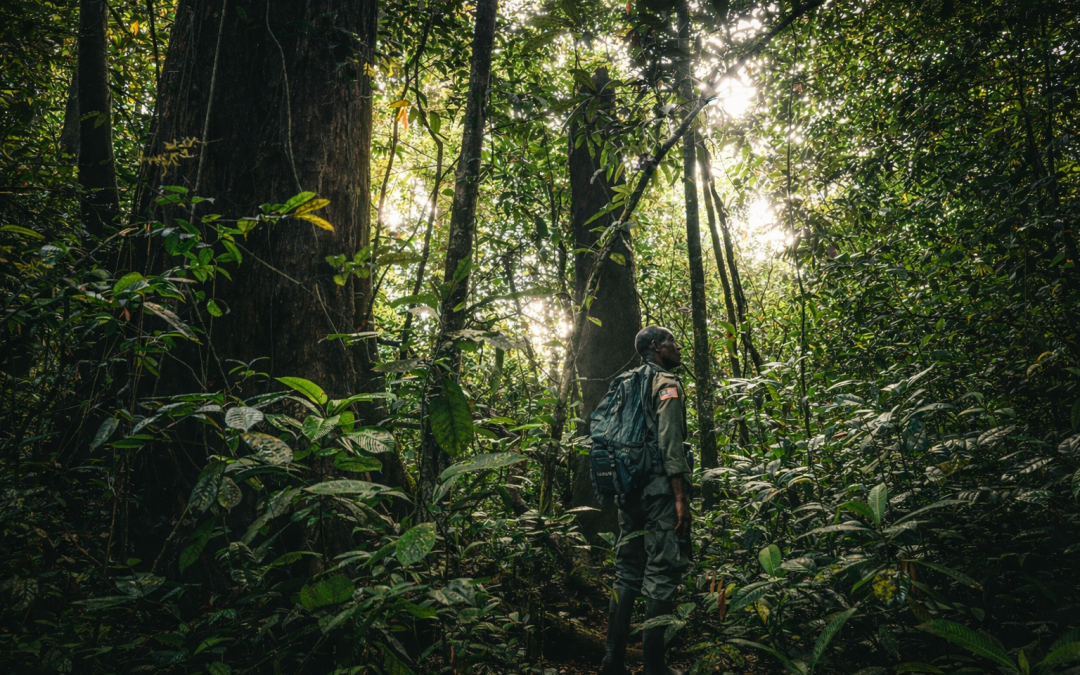
We trekked deep into the jungle, surrounded by dense vegetation, towering trees, and the constant hum of insects. Wildlife is elusive here, but that’s part of what makes it real. This isn’t a safari park—it’s raw wilderness.
In a region where so much forest has been cleared, places like Sapo feel increasingly rare.
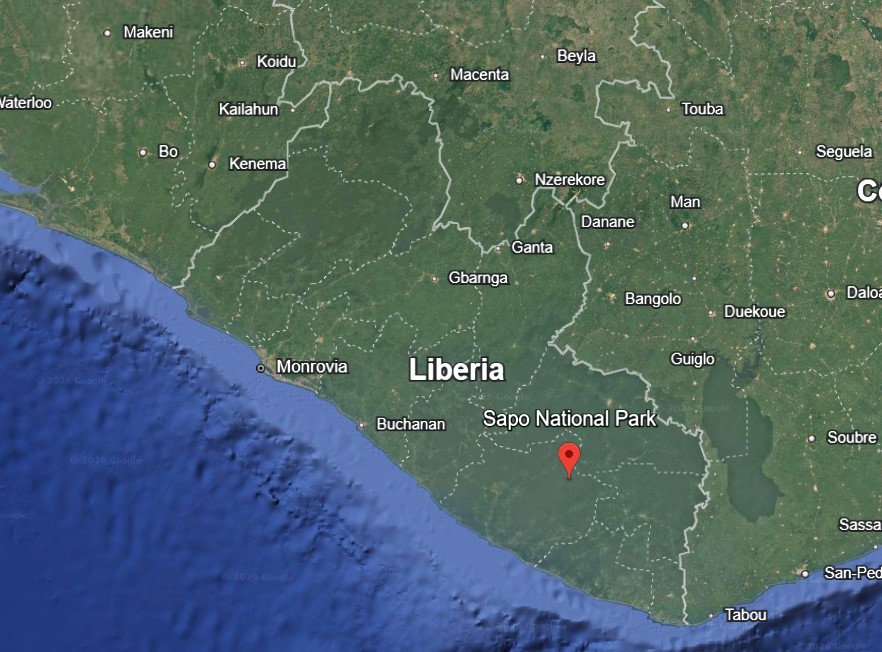
Location of Sapo National Park
About the War in Liberia
I knew from my first visit to Liberia just how devastating its civil wars had been. The scars were visible everywhere.
Men and women missing limbs—many amputated during the conflict—sat along the roadside asking for money. They were living reminders of what the country had endured.
Poverty was widespread, and desperation shaped daily life. Crime and banditry were common in some areas. To escape that reality, drug use took hold—especially a substance known locally as “cush.” It’s often described as a mix of narcotics and toxic chemicals, sometimes even rumored to include ground bone from graveyards. Many young people drifted through the streets in a near-zombified state, trapped in addiction with little chance of recovery.
A Country Shaped by War
Liberia’s modern history was defined by two brutal civil wars from 1989 to 2003.
An estimated 200,000 to 250,000 people were killed around 10% of the population. Nearly everyone I met who was old enough to remember the war had a story of survival, loss, or horror.
Roots of the Conflict
The violence wasn’t random. It had deep historical roots.
Much of the fighting followed ethnic and factional lines, but it was also fueled by long-standing resentment. For over a century, power in Liberia was dominated by descendants of freed American slaves, known as Americo-Liberians. Though a minority, they controlled most political and economic power.
Many indigenous Liberian groups were excluded, marginalized, and at times subjected to forced labor and harsh social systems. These tensions built over generations.
By the late 20th century, inequality, corruption, and political instability pushed the country toward collapse. The war was further fueled by natural resources—diamonds, timber, and other commodities—which were traded for weapons and, in some cases, drugs with international arms dealers and even Colombian drug cartels.
Collapse Into Chaos
The conflict began when Charles Taylor launched an attack to overthrow President Samuel Doe.
What followed was not a traditional war, but the collapse of the state.
Militias controlled different territories. Neighborhoods were divided by warlords. Violence wasn’t only directed at rival groups—people were often killed by their own factions due to paranoia, fear of betrayal, or suspicion of spying.
Massacres occurred. Bodies were left in the streets. The violence was chaotic, senseless, and deeply personal.
The Death of Samuel Doe
One of the most infamous moments of the war came in 1990, when President Samuel Doe was captured by a rival faction led by Prince Johnson.
What followed was filmed and widely circulated, becoming one of the most shocking and recognizable images of the conflict.
The footage shows Doe being held captive, humiliated, and brutally tortured over an extended period. Fighters pinned him down, mocking him as they carved off parts of his body while he screamed.
In one of the most surreal and disturbing aspects of the video, Prince Johnson is seen sitting smugly in a chair, wearing sunglasses, drinking a beer, and being fanned by a woman while the torture unfolds in front of him.
At the time, many fighters and civilians believed in spiritual protection and invincibility. Doe himself was rumored to be protected by such forces. The public filming of his torture served a purpose—it was meant to prove to the population that he was not invincible, that he could suffer, bleed, and die like any other man.
He was tortured for many hours before eventually being killed and even reported to have been cannibalized by Prince Johnson and his men.
Child Soldiers and Atrocities
Across Liberia, armed groups committed widespread atrocities:
- Villages were destroyed
- Civilians were targeted
- Amputations were used as punishment and intimidation
- Children were recruited as soldiers and forced into violence
Many child soldiers were drugged and manipulated. Some were forced to commit acts against their own communities, ensuring they could never return to normal life such as killing and even raping members of their own families.
The result was a war where the usual rules of humanity simply did not exist.
A Fragile Recovery
The war finally ended in 2003, when international pressure and internal resistance forced Charles Taylor from power. He later faced trial and was convicted of war crimes.
Today, Liberia is at peace—but recovery is slow.
You see it in the infrastructure, in the economy, and most of all, in the people.
The war ended more than two decades ago, but its impact is still everywhere. For most Liberians, the past is not something distant—it’s something they still live with every day.
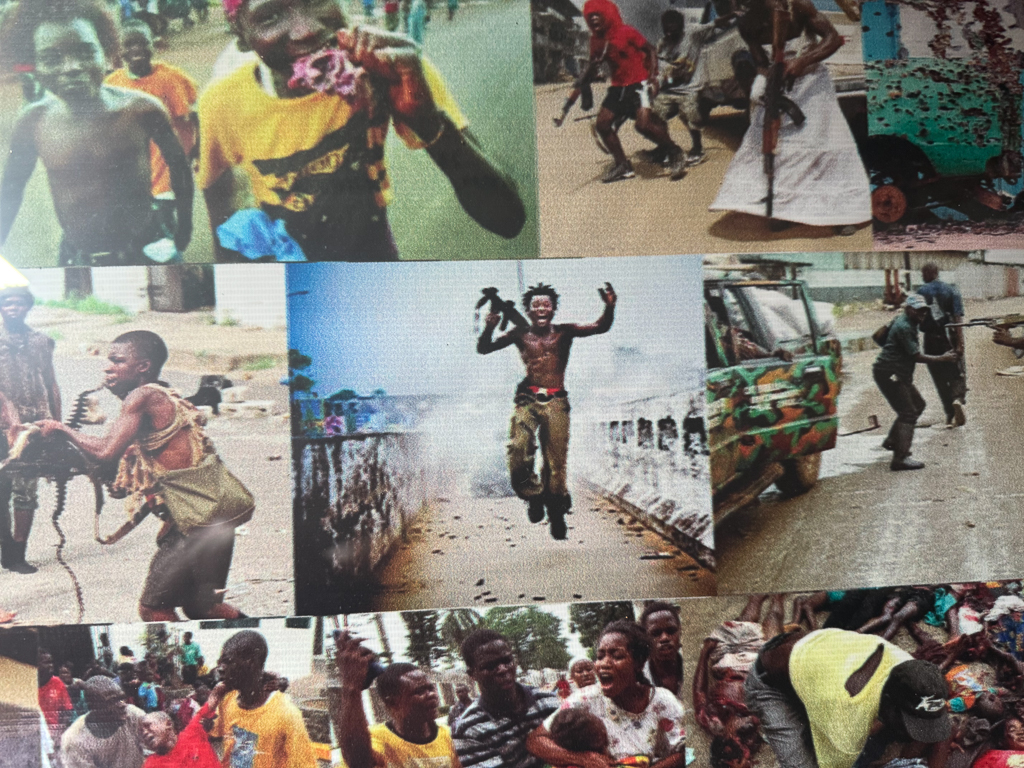
Photo of the War from the National Museum in Monrovia
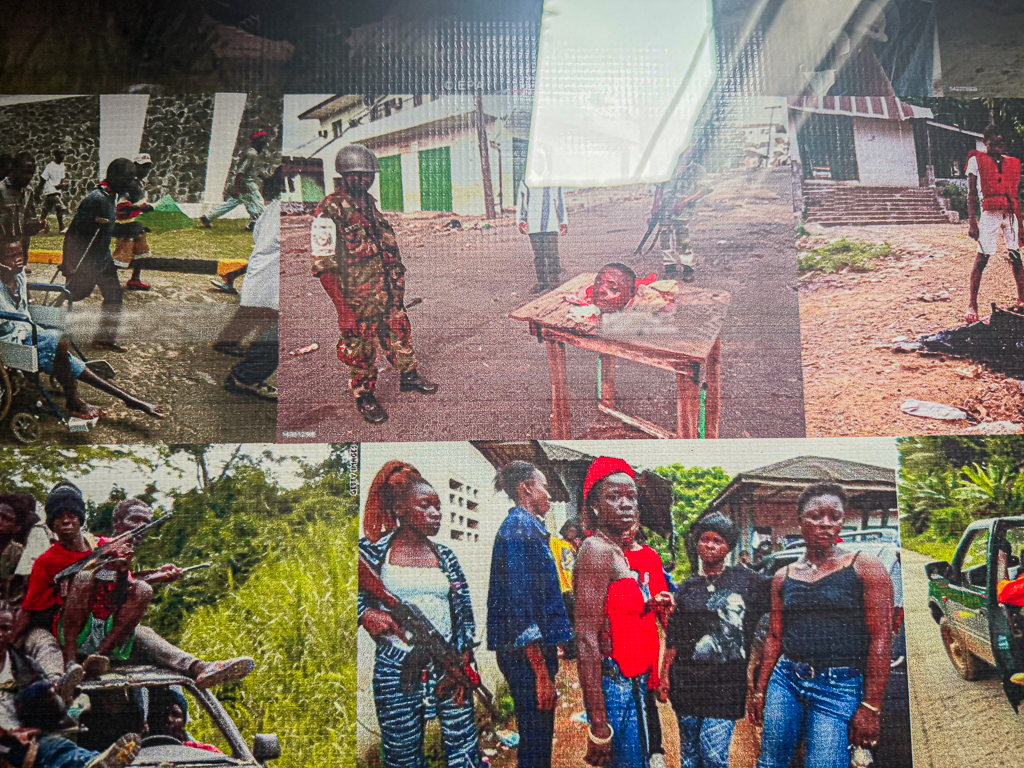
Photo of the War from the National Museum in Monrovia
Getting to Liberia
The Visa Process
The first challenge was getting a Liberian visa.
Since my last visit, Liberia introduced an e-visa system. In theory, this eliminates the need to mail your passport to an embassy. In reality, it introduces a different set of problems—mainly technical issues and confusion.
When I checked the official website, it clearly stated that Americans were not eligible for e-visas. I even confirmed this with the Liberian Embassy in Washington, D.C.
But then I started hearing from other American travelers who had successfully obtained them.
So I emailed the e-visa office. An immigration officer responded and told me Americans were eligible. However, it was true that I couldn’t apply through the official e-visa portal. Instead, he told me I could send him a copy of my passport directly, and he would organize the visa for me.
He said he could process it within a few days if I sent the passport via WhatsApp, and that I could simply pay on arrival.
I verified that he was a legitimate immigration official. Combined with the fact that others I knew had obtained visas in a similar way, I decided to go through with it. At the time, I was also preoccupied with other trip logistics and didn’t think too much of it.
A few days later, he sent me what appeared to be a visa over WhatsApp.
Then things became concerning.
He began calling me in the middle of the night, demanding payment and becoming increasingly aggressive. Knowing that he was a real immigration officer made the situation even more unsettling. What had initially seemed like a workaround now started to feel like an attempt to extract money.
Based on my previous visit to Liberia—where I experienced multiple attempts by immigration officials and police at checkpoints to solicit money—I became increasingly worried this could turn into a similar situation, or escalate into outright extortion upon arrival.
Even though I eventually paid him, the calls didn’t stop. He continued reaching out afterward, which only reinforced my concerns. Eventually, I had to block him on WhatsApp.
At that point, I no longer trusted the document he had sent.
Around the same time, I spoke with a Liberian man from my church. After hearing the situation, he told me he had contacts and could arrange a visa properly.
I decided not to take any chances.
I arranged a second visa through my contact. Technically, it was still an “e-visa,” but in practice it was an official authorization letter. This is shown to immigration on arrival, where the actual visa is issued at the airport.
Despite the chaotic and concerning start, everything ultimately worked.
Flying to Liberia
Getting to Liberia is not the easiest journey in the world. It is a small country in a part of West Africa that is not especially well connected, particularly from the United States.
The most direct route, at least for me, was flying through Brussels. Even then, it is not simple. Flights are limited, schedules are not always ideal, and prices can be high.
I was fortunate to have accumulated enough United miles to cover most of the trip. That ended up being a major advantage, not just financially but also in terms of flexibility. Award tickets can be cancelled at the last minute for a full refund of miles, which is extremely valuable when traveling to places where plans can change quickly.
A Smooth Start in Brussels
I began the trip by flying to Brussels and spending the night there. The plan was to meet up with my friends and then all fly together the next day to Liberia on Brussels Airlines.
Everything was going according to plan until the night before the flight.
We checked in online from a bar. My friends received seat assignments immediately. I did not. Instead, I received a message telling me I was checked in but needed to see an agent.
That was the first sign something might go wrong.
When Travel Plans Fall Apart
The next morning at the airport, things unraveled quickly.
After waiting in line for over an hour, I was told I had been bumped from the flight. A previous flight had been cancelled, and those passengers were given priority. My friend who was flying standby was also bumped.
My other friends continued on as planned, but I was left behind.
I was given 800 dollars in compensation and rebooked, but the real problem was timing. There were no direct flights available for days.
The Long Way Around
Instead, I was rebooked on a route with Ethiopian Airlines.
This meant flying thousands of miles out of the way and adding more than 16 hours of travel time. The connections were tight, which introduced the possibility of missing a flight and being stranded somewhere else in Africa.
To make things worse, I could not select my seats in advance, and most of the good ones were already gone.
What had started as a straightforward trip had turned into a long and uncertain journey.
Considering Walking Away
At that point, I seriously considered cancelling.
I was already in Belgium. I could stay a few days, explore, and then go home early without dealing with the stress of complicated travel across multiple countries.
It would have been the easy decision.
But I knew I would regret it.
Why I Went Anyway
This was not just another trip.
I had put a lot of effort into planning it. I wanted to visit Sapo National Park. I had arranged to meet a former warlord known as General Butt Naked. I was traveling with friends, and the opportunity to return to Liberia was not something that would come around often.
Even though I would lose a full day, I decided to continue.
Committing to the Journey
I boarded the Ethiopian Airlines flight and committed to the longer route.
It was not comfortable and it was not efficient, but it was the only way forward.
Travel does not always go according to plan. Sometimes the experience begins with delays, reroutes, and uncertainty.
But those moments often define the trip as much as the destination itself.
And in this case, the destination was Liberia.
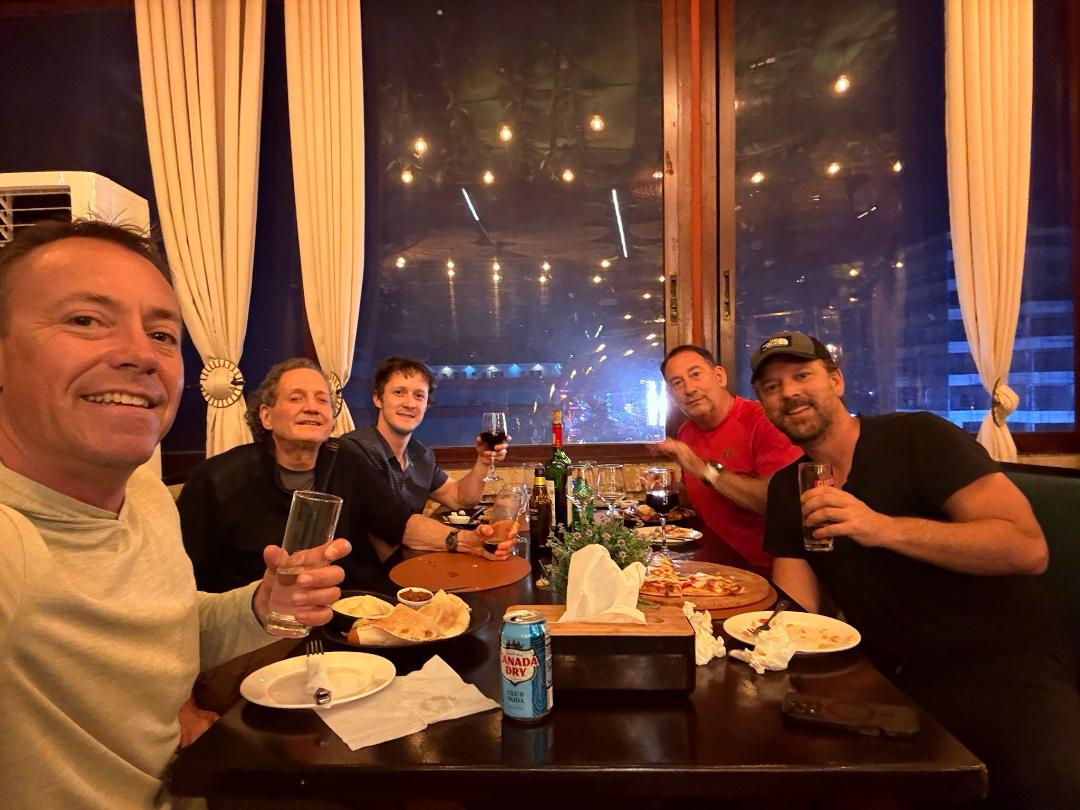
Dinner with my friends at the Boulevard Palace Hotel, Top Floor, on the Night of the Arrival of Jimmie and me
Meeting General Butt Naked
During my first visit to Liberia, I thought it might be interesting to meet a former warlord, especially one who I heard about in a documentary, who went by the name “General Butt Naked.”
His real name was Joshua Milton Blahyi, and by the time of my visit he had become a Christian preacher and had reportedly started his own church and center for street children.
I hoped to meet Joshua because a big part of my travels is not just visiting places where history unfolded but also trying to meet the people—good or bad—who were part of making that history.
About Him
This is most of the information I learned about Joshua from interviews with him including my own. Joshua is from southern Liberia, from the rainforest region where Sapo National Park is today.
His father was a powerful tribal priest and witch doctor who practiced traditional African religion focused on using dark spiritual power to protect the tribe and overpower enemies. His father was also revered for helping infertile women become pregnant, which led to Joshua having a lot of siblings.
Joshua was selected at a young age to become his father’s successor as the tribal spiritual leader and when he was a young boy he was sent away to a kind of spiritual or “voodoo” school in a remote village where he spent around two years living mostly in darkness, meditating, learning spells, rituals, sacrifices, and how to communicate with spirits.
He was taught how to use spiritual power to heal people, curse enemies, gain revenge, and strengthen himself as a warrior. But worst of all during this time he was initiated into the practice of making sacrifices to tribal Gods that sometimes-involved children. At the time in Liberia, Christianity wasn’t as widespread as it is today and these types of dark spiritual beliefs were sometimes practiced.
Becoming General Butt Naked
When Liberia’s civil war began, Joshua’s tribe allied with the rebel forces of Charles Taylor.
Joshua was only around 17 years old when he formed a battalion of child soldiers and went to Monrovia to support Taylor. Monrovia became a war zone divided by warlords and turned into a living hell. Liberian warlords obsessed with American action movies, adopted names of action figures like Chuck Norris and other bizarre nicknames. I read about one warlord that went by the name “General Mosquito” and his arch nemesis, “General Mosquito spray”.
During the war, he and his gang terrorized parts of the city, especially areas associated with tribes allied with President Samuel Doe.
Joshua described himself during this time as completely consumed by violence, drugs, and spiritual beliefs tied to war.
He and his child soldiers often took traditional drugs mixed with cocaine before battle to make it easier for them to commit atrocities.
He became infamous for leading attacks completely naked to terrify people even more, which led to him earning his nickname, “Butt Naked.”
According to Joshua’s own repeated confessions, before battles he sometimes performed ritual sacrifices involving children. He claimed that he and his soldiers would consume parts of the body and cover themselves in blood because they believed it gave them spiritual protection and the power of innocence.
Joshua believed that fighting naked while covered in blood would make him invisible to bullets.
Before eventually laying down his weapons and converting to Christianity, Joshua claimed that he and his forces were responsible for the deaths of somewhere near 20,000 people.
Turning to Christianity
After becoming a Christian, he fled to refugee camps in neighboring countries during the chaos after the war. He said he could have stayed there safely but felt called to return to Liberia to help rebuild the country and seek atonement for his sins.
After returning, he started a center to help street children, including former child soldiers and kids addicted to cush. He said he wanted to help them break addiction, learn skills, and build better lives. He also began preaching at churches and revival events around Liberia.
What makes Joshua unusual is that he does not hide from his past. He openly talks about the things he claims to have done during the war and says he sought out people he harmed to ask for forgiveness.
He also testified before Liberia’s Truth and Reconciliation Commission and openly confessed many of his crimes. According to Joshua and others familiar with the process, the commission recommended exoneration rather than prosecution because of his cooperation and confessions. To this day in Liberia, a war tribunal court has not been established to hold the war criminals accountable. But the country is finally moving to set one up.
Setting Up a Meeting with Him
Months before returning to Liberia, I found a local guide who personally knew Joshua and had met him several times.
The first time my guide met him was when he was a child at a church revival event where Joshua was preaching. Afterwards, his family boarded a shared taxi van to go home and Joshua happened to get in the same vehicle and my guide ended up sitting on Joshua’s lap during the ride. Even as a child he already knew who Joshua was and the reputation he carried from the war. The memory stayed with him ever since.
Years later, now in his early twenties, my guide met Joshua again at another church event and stayed in touch with him. Because he had Joshua’s contact information, I made sure we arranged a confirmed visit well in advance. I even asked our guide to tell Joshua we would make a donation to his center. Still, nothing was certain.Joshua was apparently not very responsive and for a while we weren’t even sure if he would still be in Monrovia or even Liberia when we arrived.
Eventually, after weeks of uncertainty, we confirmed a meeting at his center.
On the Way to Meet Him
After a much-needed night of sleep—though not much since we had to wake up early—we met our guide and driver the next morning to set off for our morning meeting with Joshua.
Part of me was driven by morbid curiosity. I wanted to meet someone capable of such evil and see what kind of person he actually was. But another part of me genuinely wanted to believe he had changed. As a Christian, I believe Jesus can change people and that even very bad people can be forgiven. I hoped meeting Joshua would somehow confirm that.
At the same time, I also had doubts. Part of me wondered whether he was really transformed or simply a charismatic manipulator who reinvented himself after the war. And now, after years of hearing about him and missing my first chance, I was finally on my way to meet him.
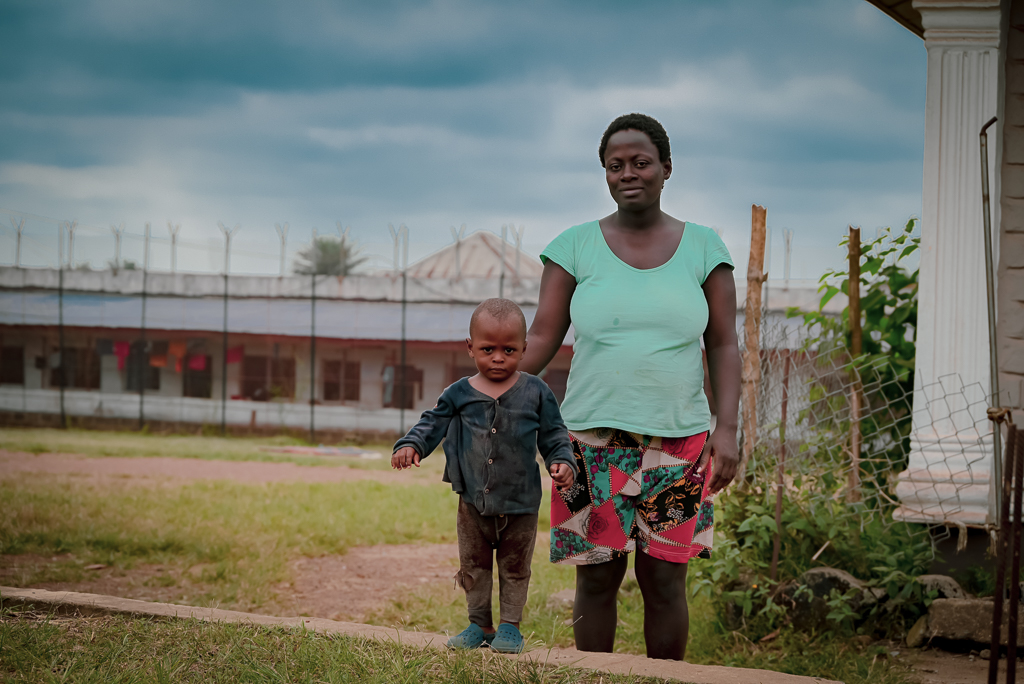
A Mother and Son living at Joshua’s Center
Arriving at Joshua’s Compound
On the way, we passed the house of Charles Taylor’s wife. Our guide mentioned that if we wanted, we could possibly stop later in the day and even meet her.
The idea sounded surreal and strangely exciting, but the day moved quickly and we never found the time.
As we drove through Monrovia, we also passed buildings still standing in ruins from the war—bullet-riddled concrete shells and structures where major battles had once taken place.
At one point we crossed a large bridge over the river, and I thought about a story my Liberian friend Benjamin had told me back in the United States.
When I first mentioned my plans to meet Joshua, Benjamin immediately knew who he was.
He told me that during the war it was General Butt Naked’s fighters who controlled this very bridge, preventing civilians from crossing and making it difficult to obtain food and supplies.
Benjamin said that at one point, when his wife was pregnant and they desperately needed food, he had no choice but to swim beneath the bridge at night to avoid being seen and potentially shot by Joshua’s men.
Hearing that story while physically crossing the same bridge added a strange weight to the moment.
After an hour and a half of horrific Monrovia traffic, we finally arrived in the part of the city where Joshua’s center for street children was located.
Joshua’s Compound
Joshua’s center was more like a compound than a simple outreach center.
High walls surrounded the property. A long driveway led toward a main house, with barracks-like structures and smaller buildings spread behind it.
Painted on one of the walls was a mural showing a proposed future hostel Joshua hoped to build someday to house more street children.
There were numerous men and boys around the compound, along with a few women and children, though the population was overwhelmingly male.
One of the boys brought out plastic chairs and arranged them for us in front of the main house.
Hanging nearby was a Liberian flag, unmistakably modeled after the flag of the United States—a reminder of Liberia’s origins and its deep historical ties to America.
Then an SUV rolled into the compound.
Then an SUV rolled into the compound. Inside were Joshua Milton Blahyi, his wife—who I later found out had strangely enough just arrived the night before from Fargo, Minnesota, my home state—and a driver.
Joshua stepped out smiling broadly. He was a large man with an immediately warm and welcoming presence.
He shook all of our hands enthusiastically and made us feel comfortable almost instantly.
Talking With Joshua
We sat down in the plastic chairs, and Joshua told us we were free to ask him absolutely anything.
He wasn’t exaggerating.
At first, we talked mostly about his center, the children he was helping, and his religious work.
But the conversation quickly shifted to the war.
At one point, my friend Evan asked him directly:
“How many people did you eat?”
Joshua didn’t flinch.
He calmly replied:
“Countless.”
There was no hesitation in his voice and no visible discomfort discussing it.
He went on to describe how he killed children and consumed their hearts as sacrifices to his tribal gods, believing these rituals would provide spiritual protection and power to him and his fighters.
This was a story I had already read about before coming to Liberia.
But hearing him calmly describe it in person made it feel completely different.
It suddenly became real.
Joshua was charismatic and surprisingly likable in conversation. He smiled often, joked occasionally, and spoke warmly about helping children and serving God.
That contrast made the entire experience difficult to process.
The horrific nature of the acts he described felt almost impossible to reconcile with the friendly, welcoming man sitting in front of us.
It was genuinely hard to connect him to the person he claimed he once was.
Joshua’s Story of Redemption
Joshua spent a lot of time talking not just about the terrible things he did during the war, but also about the events that he believes led to his conversion to Christianity.
According to him, one day during the war he was washing the blood of a little girl off his hands in a river after killing her as a ritual sacrifice.
While standing in the river, he claimed he saw a vision of Jesus telling him to repent or die.
Joshua said that at that moment he knew he needed to stop.
But at first, he thought perhaps he could still continue fighting while following Jesus—using Christianity almost as another source of spiritual strength in war.
Then, according to Joshua, something happened that shook him even more deeply.
Two Liberian missionaries somehow managed to get past his armed child soldiers and guards and reached his compound. They knocked on his door directly.
Joshua said he was shocked they had made it through his security.
He told them they were very brave for approaching a man widely known as a ruthless warlord who killed without hesitation.
According to Joshua, the missionaries told him they were following the call of Jesus to speak to him.
Then they simply left.
Joshua said that after this encounter he knew he needed to completely turn away from his old life.
Ironically, however, his immediate reaction was anger toward his own guards for allowing the missionaries to reach him.
He said he became furious over the security failure and shot one of his own guards in the leg, sending him to the hospital.
But in the days that followed, Joshua claimed he fully repented.
He said he laid down his weapons and told his soldiers:
“You can follow me and Jesus, or continue fighting. I understand.”
According to Joshua, most followed him, though some continued the war.
He later visited the wounded child soldier he had shot in the hospital and personally asked for forgiveness.
Joshua said the boy—like many of his fighters—had an intense loyalty to him and was deeply moved that Joshua would come see him in the hospital.
Sadly, according to Joshua, the boy died in the following weeks from tuberculosis.
Trying to Make Amends
Joshua said that his penance for the things he did during the war is to spend the rest of his life helping the people hurt by it.
That, he explained, is why he started the center for street children—many of whom are now adults themselves.
He hopes to expand the center and help even more people in the future.
Part of that effort involves teaching practical skills that allow former street children and struggling youth to earn money and survive independently.
He showed us examples such as tie-dye shirts made at the center, which the children then sell for small amounts of money.
Before we left, I asked Joshua whether he believed Liberia’s future war crimes tribunal might eventually arrest him.
He answered surprisingly calmly.
Joshua explained that although Liberia’s Truth and Reconciliation Commission recommended exoneration after he confessed his crimes publicly, he personally believes Liberia cannot fully heal unless people responsible for atrocities—including himself—are held accountable.
He said that if a war crimes tribunal is eventually established, as has been discussed for years, he believes there is a good chance he will be arrested.
And according to him, he is at peace with that.
He told us he is willing to accept whatever punishment may come, but until then he intends to spend the rest of his life trying to do as much good as possible.
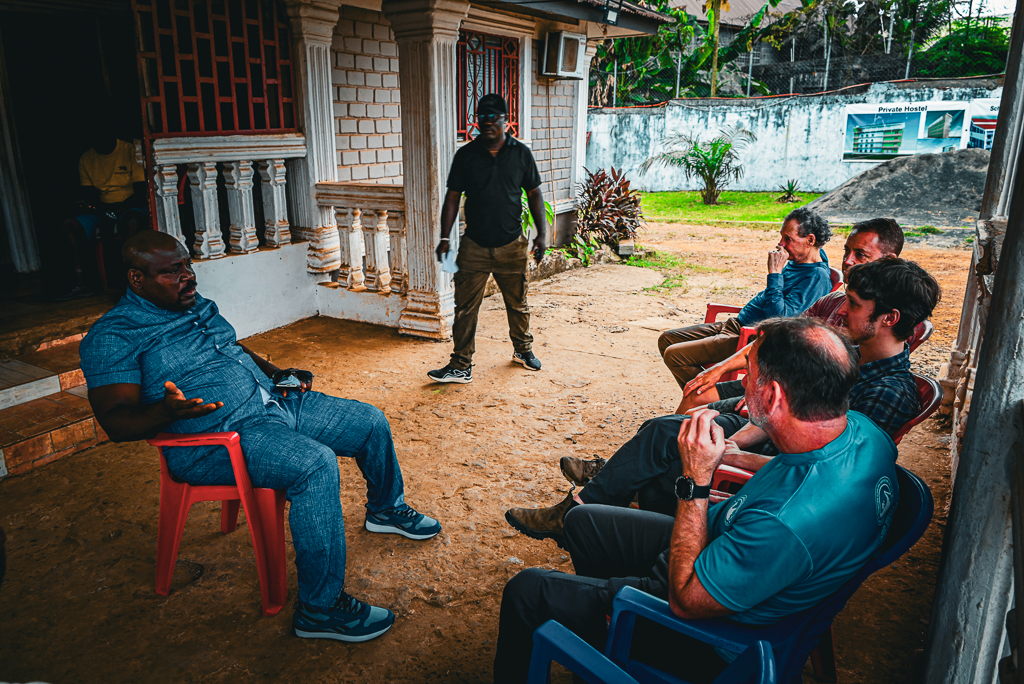
My friends and I Meeting Joshua Blahey, the former warlord, General Buttnaked
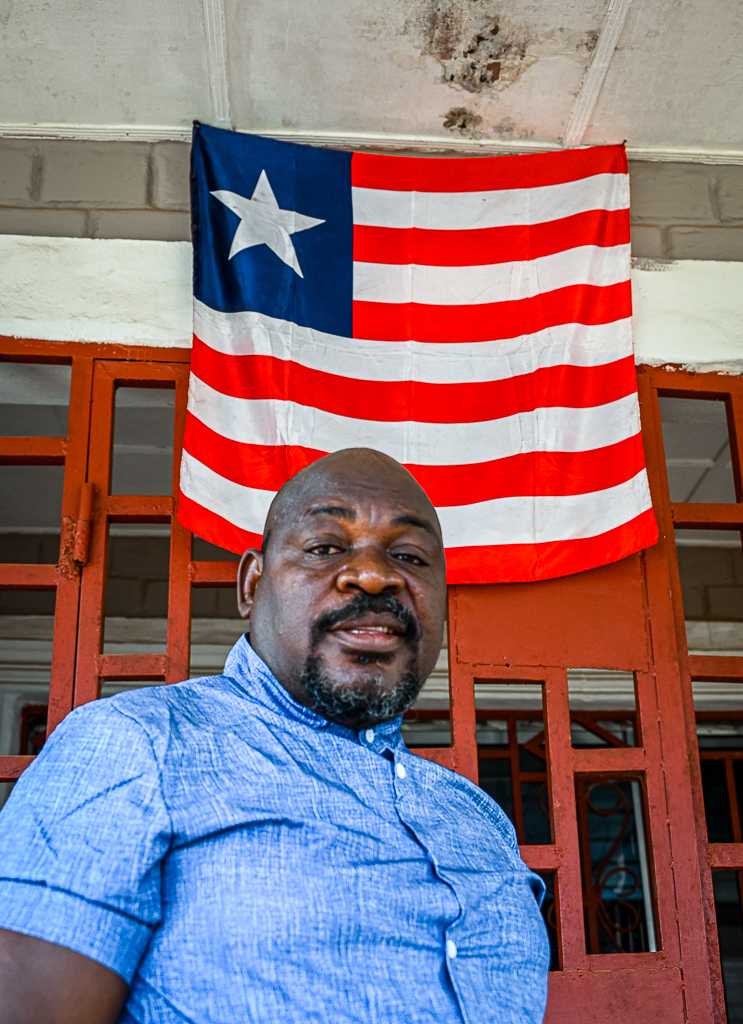
Johua Blahey, Former Warlord General Buttnaked
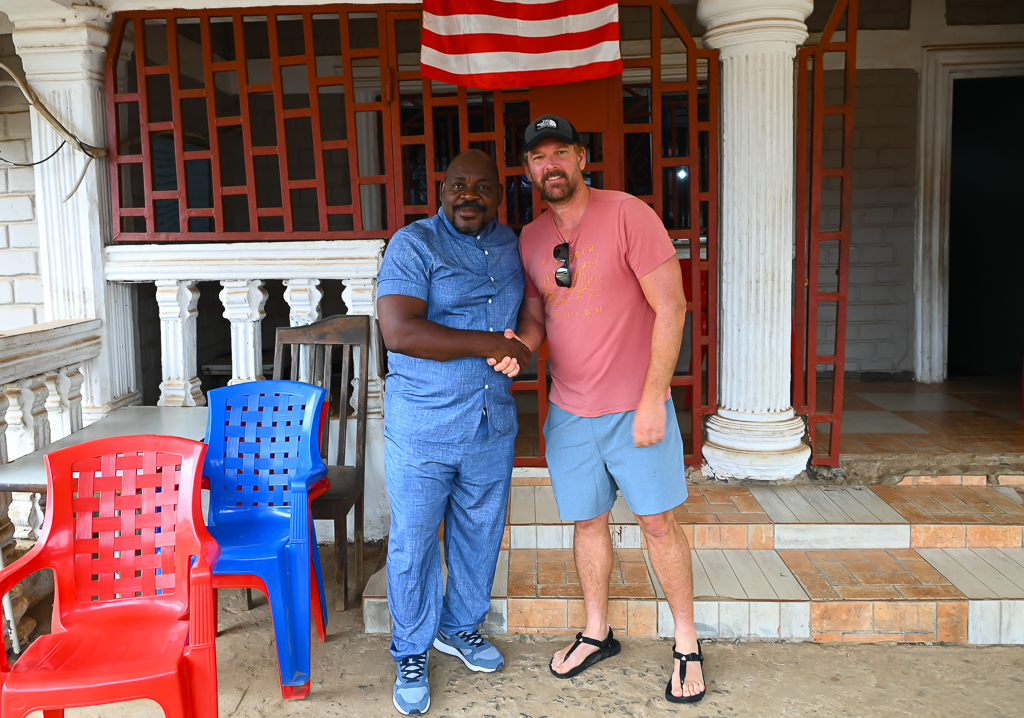
Me with Johua Blahey, Former Warlord General Buttnaked
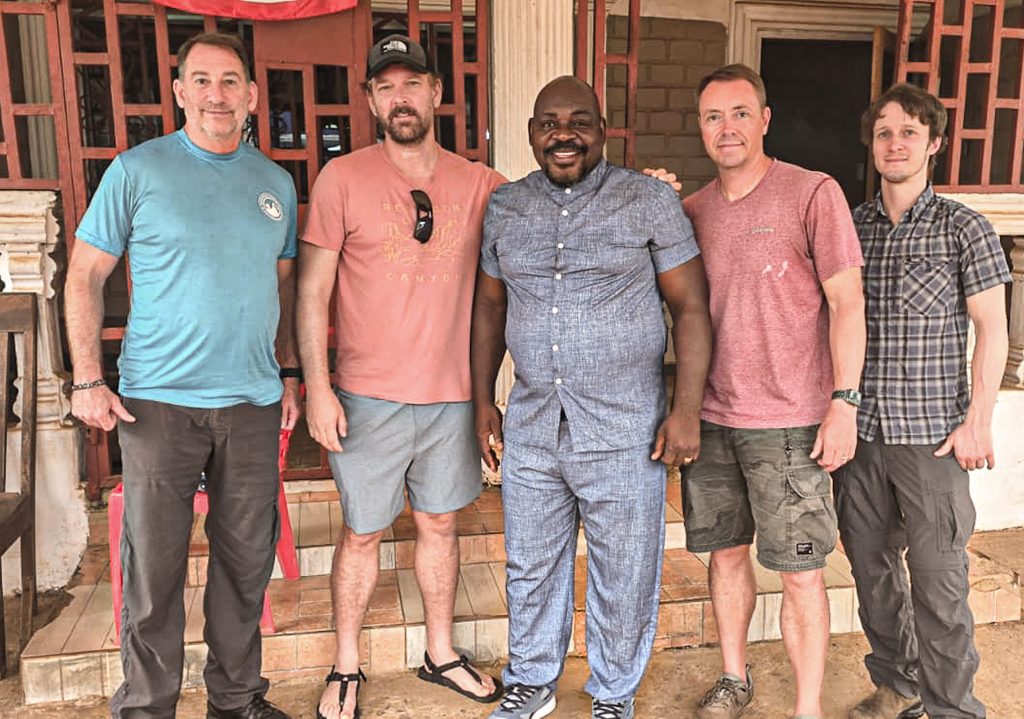
My friends and I with Johua Blahey, Former Warlord General Buttnaked
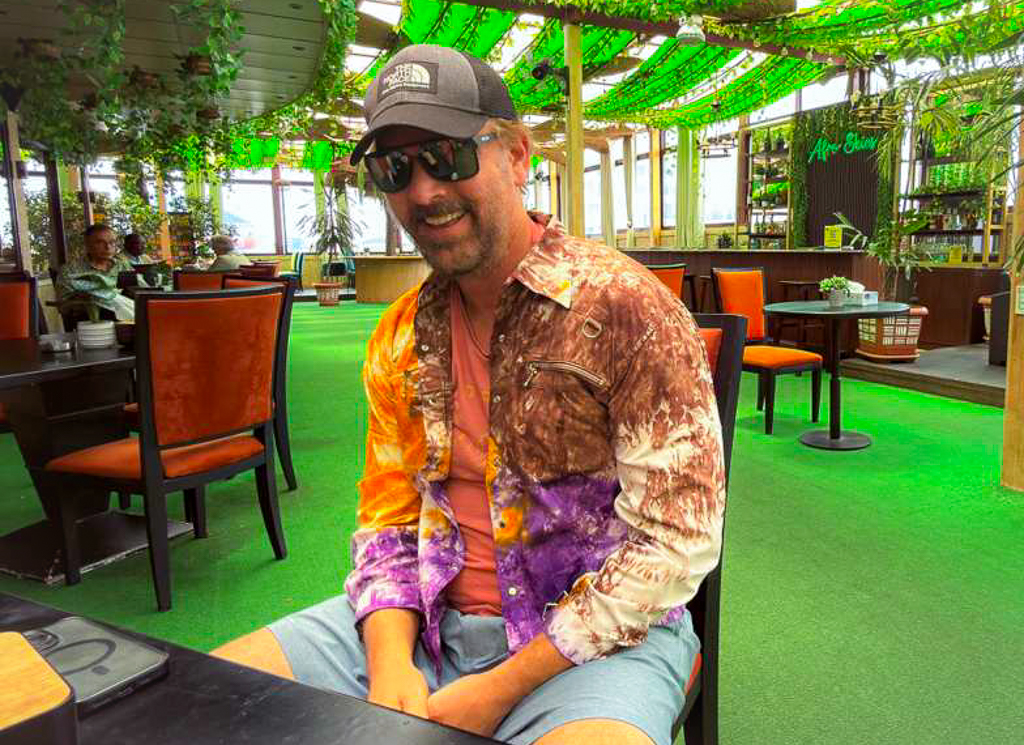
Me in one of the shirts that street kids tie-dyed at Joshua’s Center and were selling for Income
Exploring Monrovia
After leaving Joshua’s compound, we continued exploring Monrovia and visited the first church built in Liberia before heading to the national museum.
The museum itself was fascinating.
Inside were traditional artifacts, ceremonial objects, intricately carved wooden masks, and even a bulletproof Mercedes reportedly gifted to former President Charles Taylor by Muammar Gaddafi.
But what I found most interesting—and disturbing—was the section about Liberia’s civil war.
The displays included graphic photographs showing mutilated bodies, devastated neighborhoods, and crazed-looking rebel militias posing with weapons and ritual objects.
Seeing the war documented visually like that made it feel much more real than simply reading about it.
The Ebola Exhibit
Another section of the museum focused on the Ebola outbreak that devastated Liberia and parts of West Africa.
The photos from that period were extremely disturbing.
One image that especially stayed with me showed Ebola patients lying isolated in hospital beds, visibly suffering in intense heat and pain.
In another image, a man was crawling across the hospital floor, leaving a snail trail of blood behind him as he hemorrhaged.
The outbreak began in neighboring Guinea before spreading into Liberia and other countries in the region.
Officially, around 2,500 people died from Ebola in Liberia, though according to our guide, many locals believe the true number was likely higher.
Our guide told us that one of his own neighbors contracted Ebola, and just days earlier, he had shaken his hand before knowing the man was infected. Our guide emphasized just how scary Ebola was, and according to him, “When the rest of the world was scared of COVID, we were dealing with Ebola. COVID wasn’t even an afterthought for people here.”
Abandoned Hotel
But the real highlight of the day was visiting the Ducor hotel, once owned by Gaddafi and now seemingly abandoned.
Constructed in the 1980s with Libyan involvement, the massive hotel once symbolized luxury and ambition. During the Civil War, however, it became something entirely different.
Because of its elevated position overlooking parts of Monrovia, fighters used it strategically during the conflict. The building saw combat and was heavily damaged during the war.
Today, it still stands abandoned—an enormous concrete shell slowly being reclaimed by time and tropical decay.
Technically, the property is still owned by Libya. To enter, we had to pay local security guards, who then escorted us through the ruins and asked that we not take photographs.
We respected the rule, at least while the guards were watching, anyway.
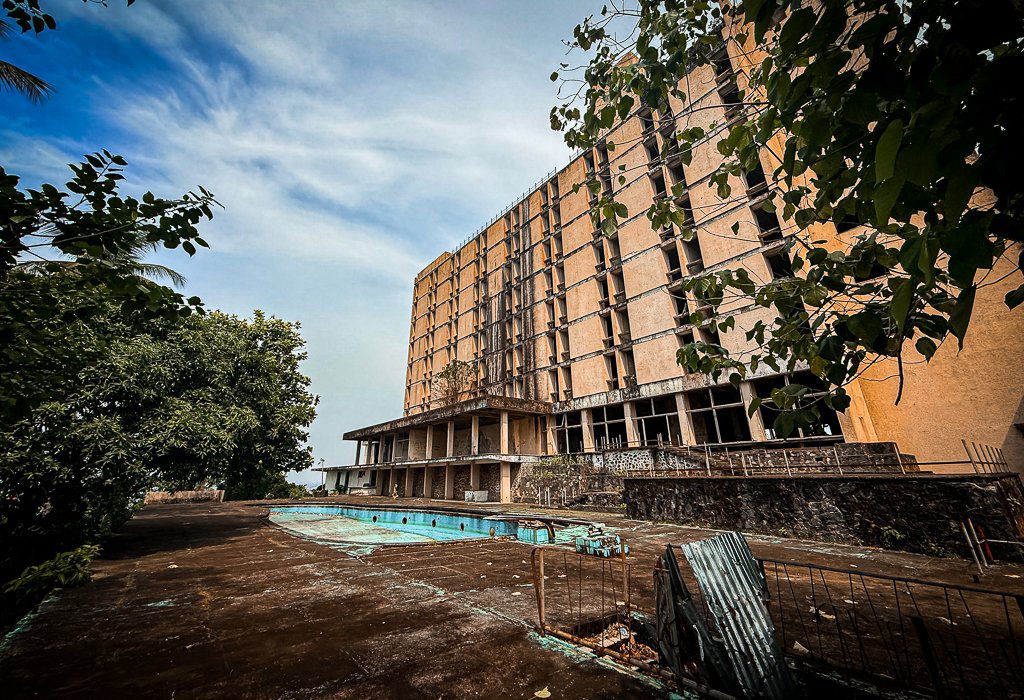
Abandoned Ducor Hotel
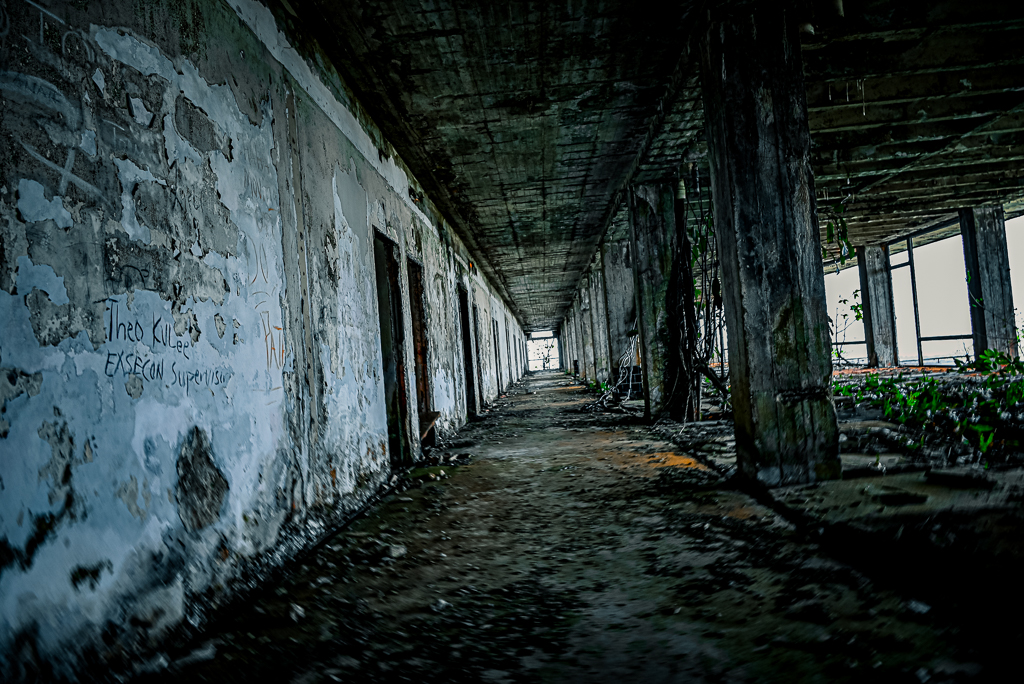
Abandoned Ducor Hotel
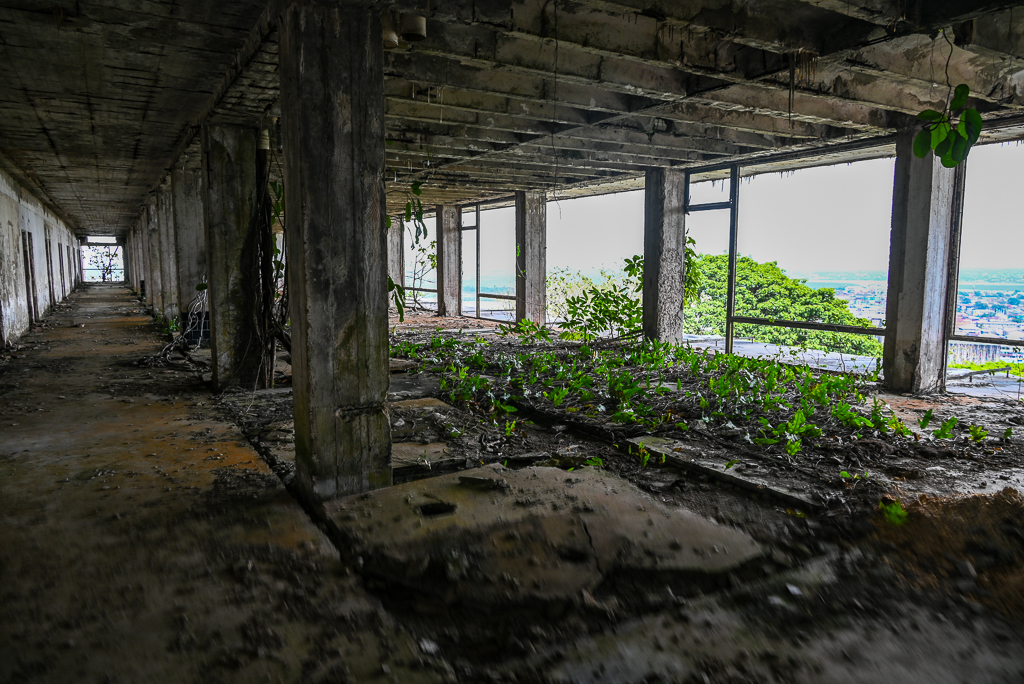
Abandoned Ducor Hotel
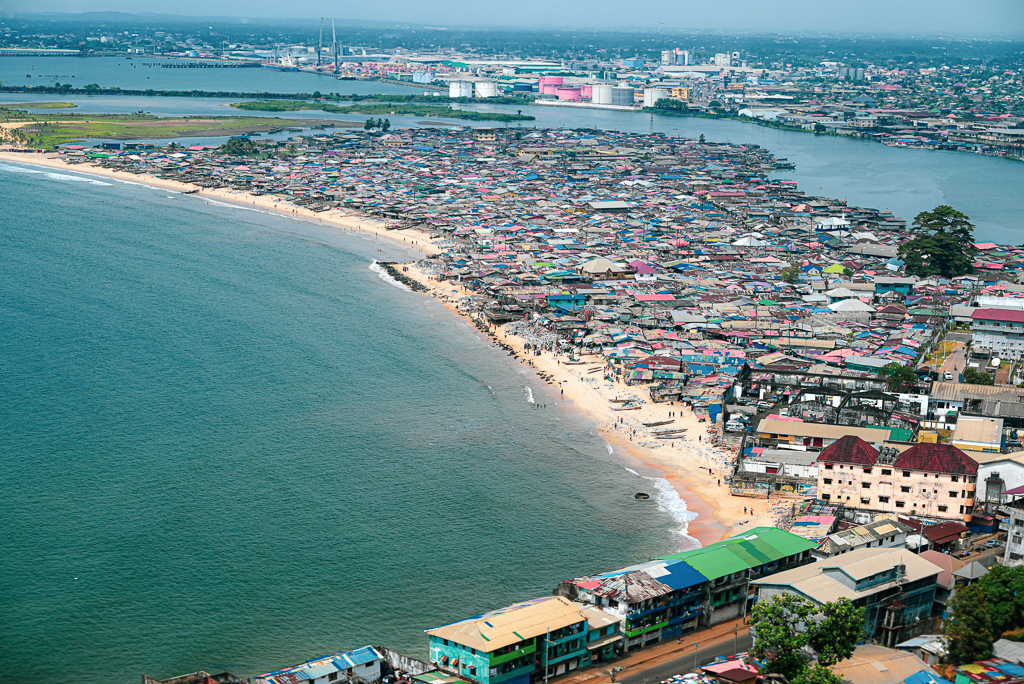
View from abandoned Ducor Hotel
Palm Grove Cemetery
A Cemetery Tied to Liberia’s History
I was excited to visit Palm Grove Cemetery, one of the oldest cemeteries in Monrovia.
Cemeteries have always interested me, and this one felt especially unique.
Built in the 1800s and located in the old part of town, it serves as the final resting place for some of Liberia’s most notable citizens, including former presidents and political figures.
One of the country’s presidents who was overthrown during the 1980 coup era is buried there. He and members of his cabinet were massacred and later buried in a mass grave within the cemetery.
The cemetery also became a battle site during Liberia’s civil war. Because of its concealed location and dense overgrowth, intense fighting reportedly took place there during the conflict.
Decay and Neglect
Before visiting, I had read that many of the graves were overgrown and collapsing—victims of decades of neglect and slowly being reclaimed by jungle-like vegetation.
Some coffins had reportedly been dug up by grave robbers, with anything valuable stripped from the bodies.
And according to stories locals told us, even the remains themselves were not safe.
I was told that some bones had been unearthed by cush addicts and ground into the drug before being snorted.
Whether every story was true or exaggerated, the cemetery clearly had a dark reputation.
At the same time, I suspected it might not be entirely safe.
When I asked our guide whether it was okay to visit, he casually reassured me.
“No problem,” he said.
But when we arrived, the reality felt completely different.
A Place That Felt Wrong
As soon as we parked along the street, I could tell this was not somewhere tourists normally visited.
Groups of kids high on cush lingered near the roadside and wandered through the cemetery itself.
Later, I learned there were reportedly entire lawless communities of addicted street kids living inside parts of the cemetery because police generally avoided going in after them.
Trash piles lined the road and spilled into the graveyard. Smoke drifted from burning piles deeper inside the cemetery.
The cemetery itself was surprisingly large.
Tombstones began right at the curb, some surrounded by garbage and weeds. Beyond them stretched dense overgrowth, jungle scrub, smoke, and scattered groups of people moving through the grounds.
I realized almost immediately that we were not going far into the cemetery.
The entire environment felt dangerous.
Between the overgrowth, isolated corners, burning trash piles, and gangs lingering throughout the grounds, it felt like the perfect place for a robbery or violent crime.
Even stepping out of the vehicle to take a single photograph felt risky.
Thirty Seconds Outside the Car
We got out for maybe thirty seconds total.
Almost immediately, a soldier approached us aggressively, yelling that photographs were not allowed.
That was enough for us.
We quickly got back into the vehicle and decided to leave.
This was not the kind of place where you linger.
As we drove away, our guide casually mentioned that he had brought another tourist there not long before. After the tourist started taking photos, a man suddenly attacked him and began punching him.
Hearing that afterward only reinforced the feeling we had the moment we arrived:
sometimes instinct tells you when it’s time to leave.
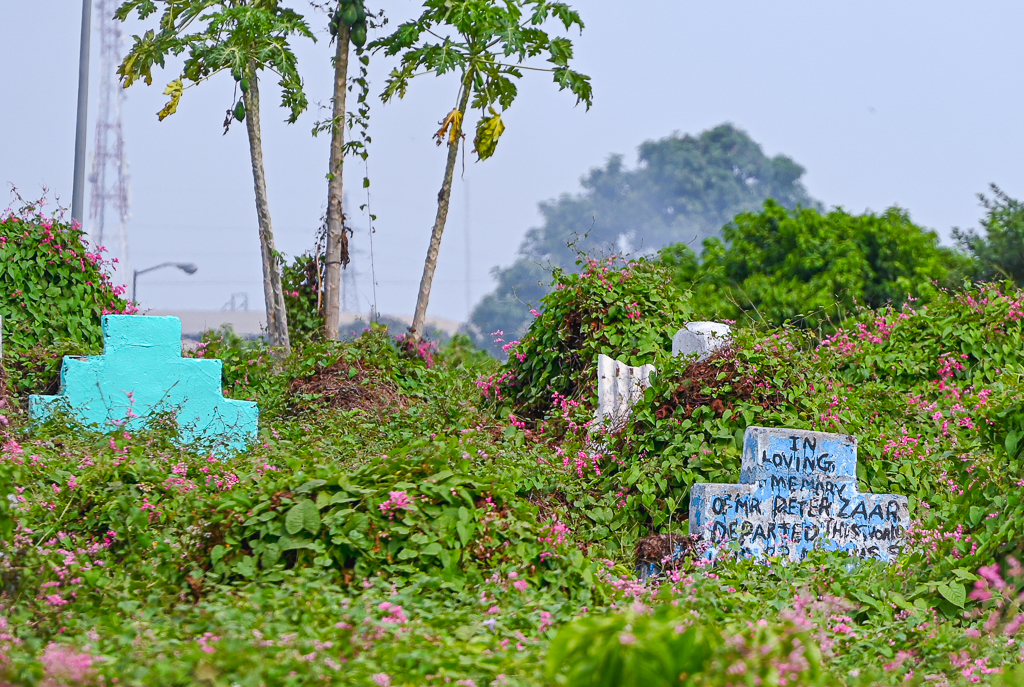
Palm Grove Cemetery
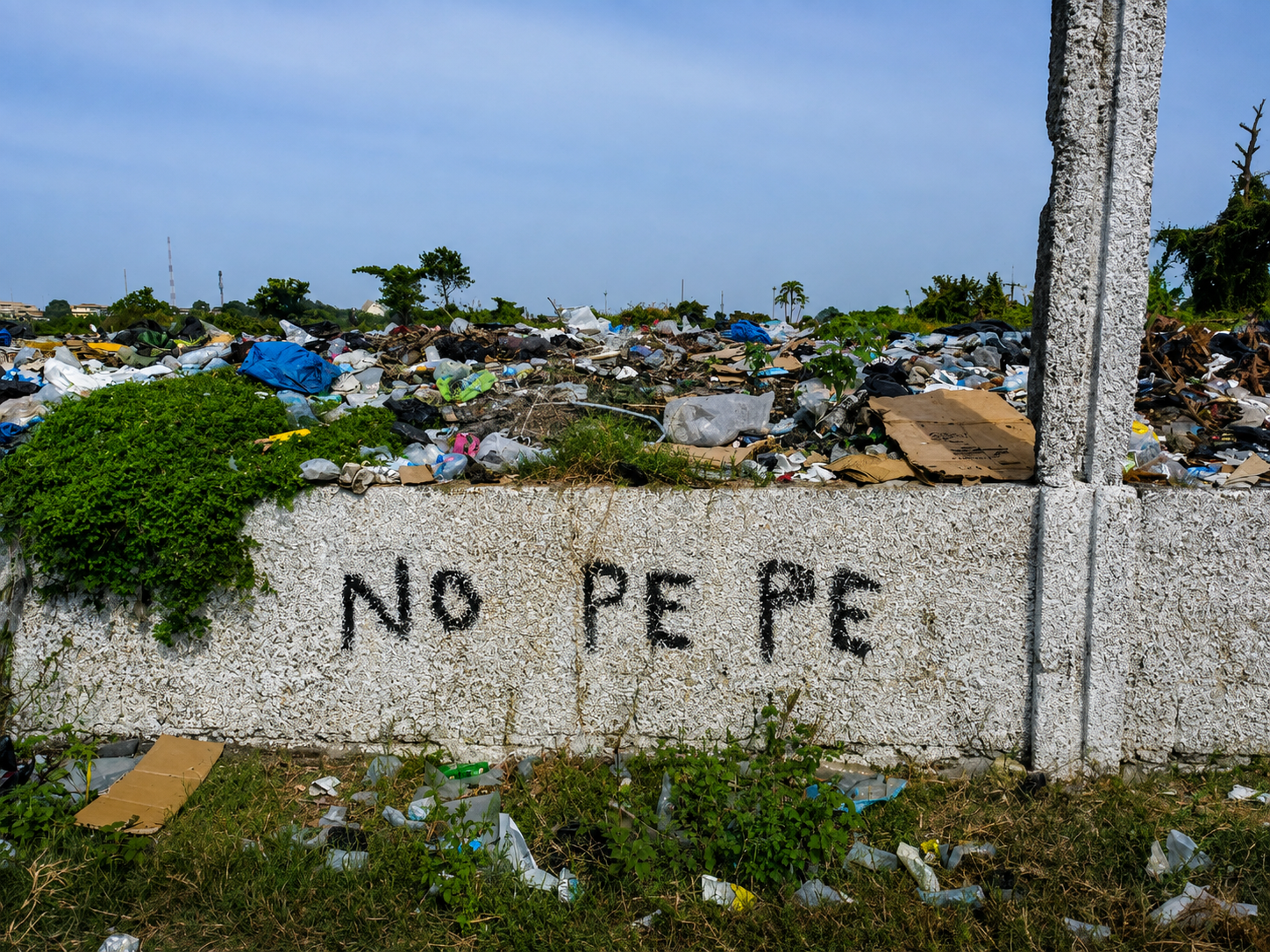
Cemetery wall with spray painted warning to not go “pe pe”, a common sight on most walls in Monrovia where public urination is evidently a problem.
Leaving Monrovia for Sapo
Preparing for the Journey
We spent another much-needed night relaxing at our new hotel, a beach hotel in Mamba Point, before setting off early the next morning for Sapo National Park on what we already knew would be a long and potentially difficult journey.
Even organizing transportation had been complicated.
Months before the trip, I started reaching out to Sapo National Park to arrange guides, accommodations, and vehicles. Eventually, a helpful French woman responded to my WhatsApp messages and assisted me in securing guides, simple bungalows for our stay, and 4WD rental vehicles.
But communication was inconsistent and frustrating.
Responses often came slowly—or not at all—and until the very last moment, I honestly wasn’t sure whether vehicles would actually show up.
That uncertainty is something you learn to expect while traveling in parts of Africa. Plans often exist in a strange limbo until suddenly they become real.
To reduce risk, I arranged two vehicles for our group: partly for comfort, but mostly as insurance in case one broke down. On rough African roads, breakdowns are common enough that having a backup vehicle felt essential.
Finally on the Road
The vehicles arrived early the next morning, each with its own driver.
Although both drivers technically spoke English, understanding them was often difficult due to thick accents and fast speech.
The driver of my vehicle spoke a kind of Liberian pidgin English that reminded me of talking to an old blues musician somewhere deep in Mississippi.
Communication became a constant mix of repetition, guessing, and context clues.
We spent the first hour stuck in Monrovia traffic before eventually reaching an office to finalize payment for the vehicles.
Even that became an ordeal.
The office employee initially miscalculated the total and almost charged us nearly double the agreed amount until I pointed out the math error. Had I not checked carefully, we probably would have paid it.
After sorting that out, we made one final stop at a supermarket to buy water and supplies.
This would be the last real store we would see for the rest of the journey.
The Long Road South
One of the recurring frustrations during planning was that nobody could give us a straight answer about how long the drive would actually take.
Depending on who we asked, estimates ranged anywhere from eight to sixteen hours.
In the end, the drive took around ten hours.
Only a couple hours of the route were paved. The rest was dirt road, though thankfully in relatively good condition for Liberia.
During the wet season, however, the roads reportedly deteriorate badly and travel times can easily double.
The downside of traveling during the dry season was the dust.
Our vehicle was slower than the other one in our group, so we constantly found ourselves trapped inside a giant cloud of red dust kicked up by vehicles ahead of us.
Luckily, the air conditioning worked, allowing us to keep the windows closed.
I felt bad for the occasional motorbike drivers who ended up caught in the dust cloud behind us.
At one point, a motorcycle wiped out on the loose dirt, sending both passengers sliding onto the road. We stopped briefly to make sure they were okay before continuing.
Into the Rainforest
As we got closer to Sapo, the jungle slowly began enclosing the road and everything started feeling much more remote.
A lightning storm briefly accompanied us during part of the drive, producing some genuinely terrifying lightning strikes over the rainforest.
Surprisingly, we did not see much bushmeat for sale along the roadside, something I had expected based on my experiences in other forested parts of Africa.
In fact, we rarely even saw villages, other vehicles, or logging trucks.
The area felt far more isolated and intact than I expected.
Checkpoints and Mind Games
The road south involved a series of mandatory checkpoints where officials recorded passport information and vehicle details.
I already had plenty of experience with checkpoints across Africa and knew there was always the possibility of a shakedown or demands for money.
My general rule in these situations is simple:
Stay calm. Never show frustration.
Some of the checkpoint officials clearly wanted to establish dominance over us and played small psychological games.
At one stop, one official scolded a member of our group simply for crossing his legs while sitting.
Instead of reacting negatively, I deliberately stayed friendly.
I shook their hands, called them “brother,” smiled constantly, and even jokingly invited some of them to visit the United States someday.
That approach seemed to work surprisingly well and often sped up the interactions.
The stops were tedious and slowed us down considerably, but unlike some of my previous experiences in Liberia, there were no direct attempts to demand bribes or extort money.
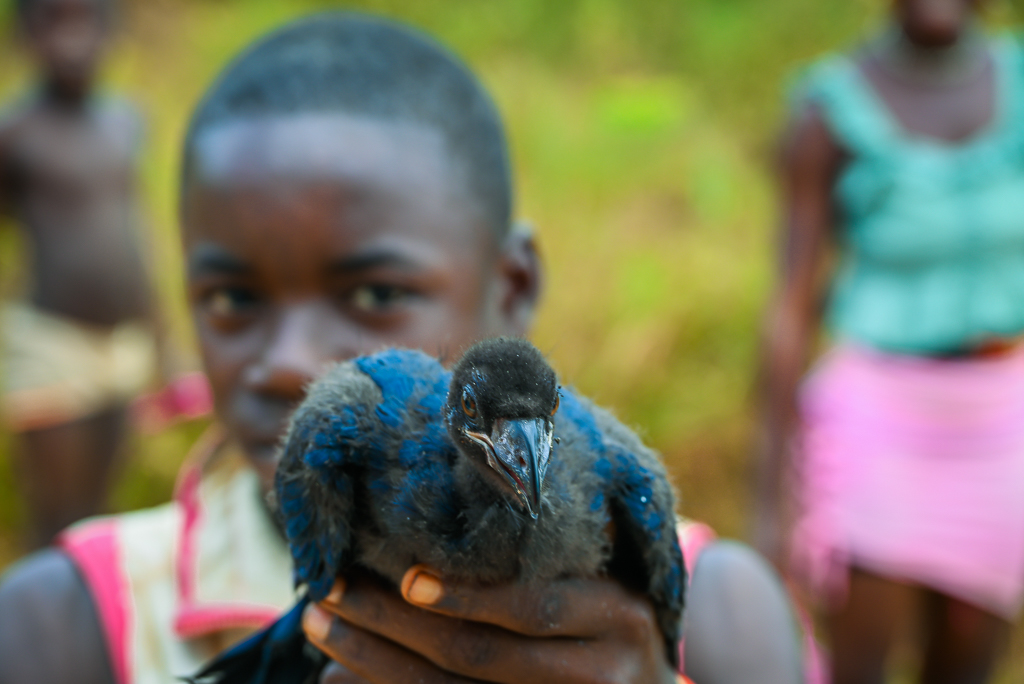
Kid selling bushmeat from the side of the road in the jungle
Our Rainforest Camp
Our camp was rustic, but scenic and surprisingly comfortable.
A small group of local villagers managed the camp and took excellent care of us throughout our stay, cooking meals and helping with whatever we needed. Despite how remote the location was, their hospitality made the experience feel welcoming rather than harsh.
The camp itself consisted of simple bungalows hidden deep in the rainforest on the banks of a river.
It was located about an hour’s hike from the nearest village and technically sat just across the river from the official boundary of Sapo National Park.
The food at camp was simple but good.
Most meals consisted of rice, fish—usually full of tiny bones but still tasty—fried plantains, and lots of fresh pineapple.
The plantains quickly became my favorite.
One thing I did not expect was that the camp also sold cold beers, which felt pretty luxurious considering how remote we were.
The reason they could refrigerate drinks at all was because the camp had solar panels providing limited electricity and refrigeration.
Overall, it was an incredibly peaceful place where monkeys occasionally visited us.
With no internet and almost no connection to the outside world, it became a perfect place to relax, read, and just listen to the rainforest.
After the chaos of Monrovia and the exhausting drive south, the isolation felt refreshing.
At night, I would lie in bed with a small battery-powered handheld fan blowing on my face because there was no fan inside my bungalow.
Eventually, after listening to the endless sounds of insects and frogs outside, I would finally drift off to sleep.
One night, though, I suddenly woke up to a loud crunching sound coming from somewhere above my ceiling.
At first I tried to ignore it.
But the noise kept going and slowly started driving me crazy.
Finally, I grabbed my flashlight and investigated.
It turned out to be a large gecko that had ambushed a huge flying beetle near the porch light outside my bungalow and was loudly crunching through it piece by piece.
Life Along the River
The river quickly became my favorite part of the camp.
During the heat of the day, it was the perfect place to relax, eat, cool off, and admire the surrounding rainforest. Huge boulders broke the current into pools and rapids, creating natural swimming areas beneath the jungle canopy.
But the river was not entirely safe.
It was also home to crocodiles and pygmy hippos.
The crocodiles here were mainly pygmy crocodiles and slender-snouted crocodiles. While smaller than Nile crocodiles, they are still capable of biting and can absolutely pose a danger to humans.
Because of that, we only swam in pools protected by fast-moving rapids and boulders, where the current made it less likely for large animals to enter.
Searching for Pygmy Hippos
One of the animals I most hoped to see was the Pygmy hippopotamus. I was very lucky to see one on an earlier trip in Sierra Leone and didn’t think I would get so lucky again.
These elusive rainforest hippos are one of West Africa’s rarest and most mysterious animals, and Sapo is one of the few places left where they still survive.
Unfortunately, despite searching extensively, we never actually saw one.
The only evidence we found were tracks along muddy sections of riverbank.
Later, I was told that the wet season is usually the best time to spot them. We had arrived near the end of the dry season—probably one of the worst possible times for sightings, as many animals retreat deeper into the forest or become more difficult to track.
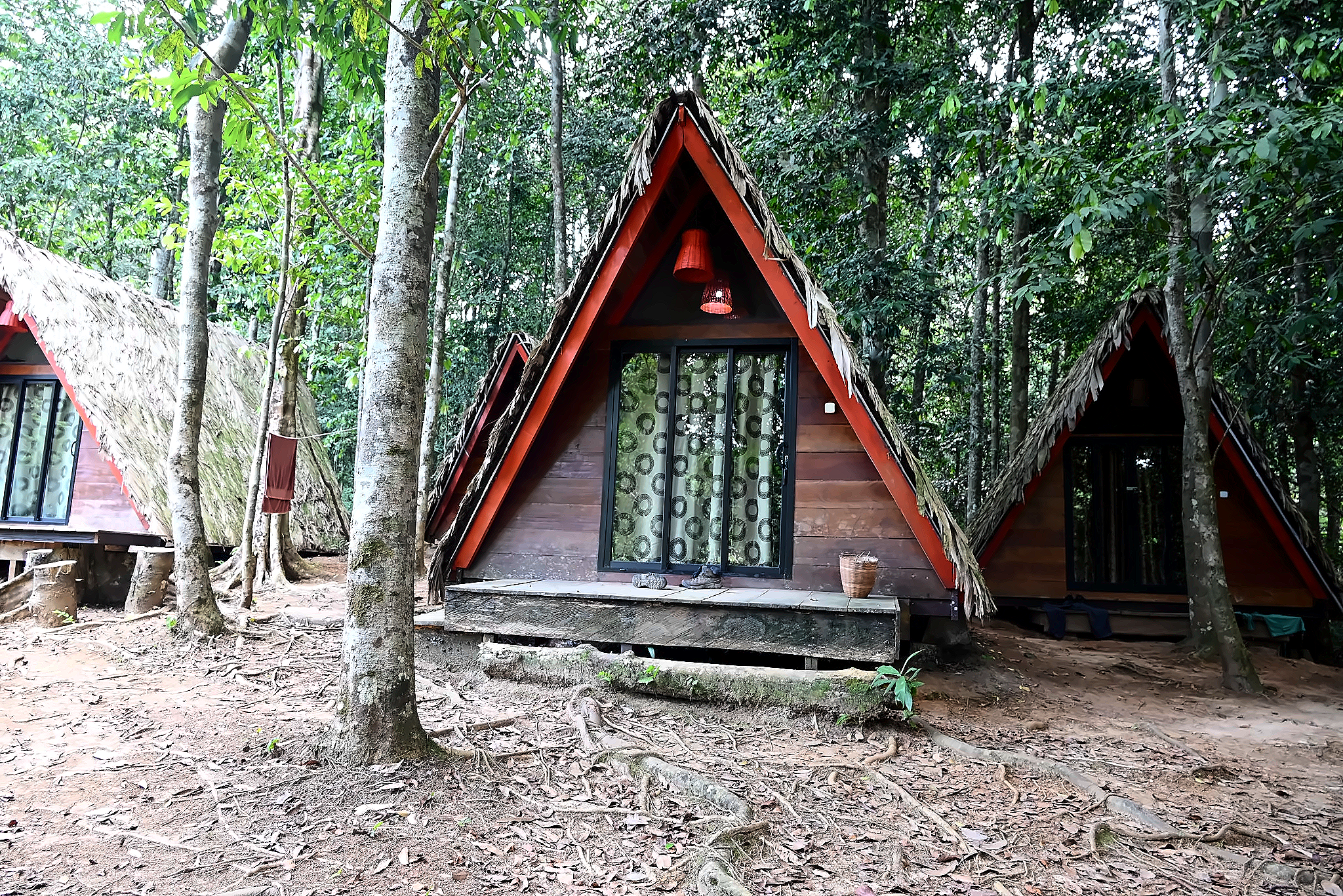
Sapo National Park Bungalow Rooms
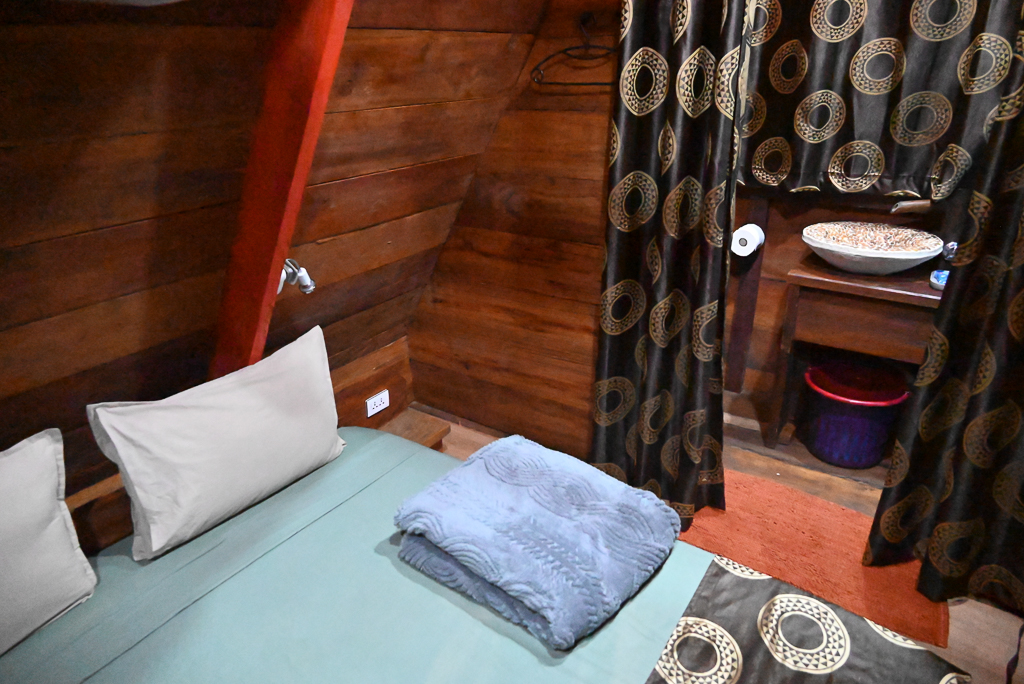
Interior of bungalow rooms with a flush toilet and a shower. The shower was not much more than a trickle, but it was great to have.
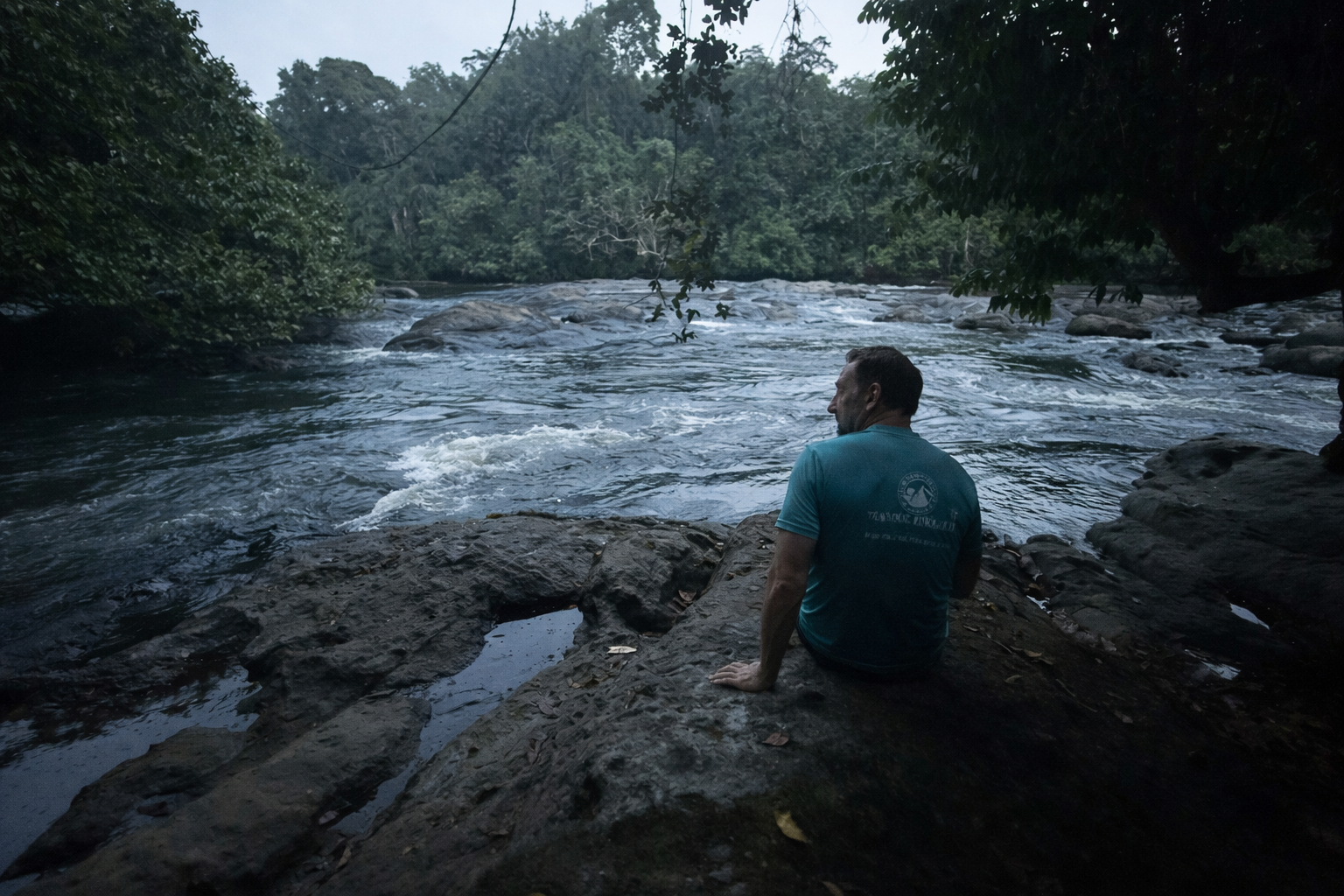
Jimmie sitting next to the river at camp
Exploring the Rainforest
My friends and I were led through the forest by a park ranger from Sapo National Park named Thomas.
Thomas was from the local area and had grown up around the rainforest. Unlike some Liberians who descend from freed American slaves that settled the country in the 1800s, Thomas belonged to the Sapo tribe—the original inhabitants the park is named after.
Walking through the jungle with him felt less like hiking with a guide and more like traveling with someone completely connected to the forest around him.
He knew the park better than anyone—its trails, rivers, plants, and animals.
He could instantly identify trees, spot subtle animal signs we would have completely missed, and explain how local people traditionally used many rainforest plants for medicine, food, or construction.
Weirdly enough, Joshua Milton Blahyi was also originally from this same region.
Thomas told us he actually knew Joshua when they were children and remembered him as being surprisingly quiet.
Even stranger, Thomas mentioned that Joshua’s younger brother still lived in the nearby village.
And sure enough, on our way back to the vehicles at the end of our stay, we briefly met him.
It was a strange reminder of how interconnected Liberia can feel. One moment we were deep in one of West Africa’s last intact rainforests talking with a ranger about conservation and war, and the next we were casually meeting the brother of one of Liberia’s most infamous warlords.
Thomas’ War Story
Like many Liberians, Thomas also carried scars from the civil war.
He told us he grew up during the conflict and lost many members of his family.
When militias entered his town, he hid his wife and child deep in the rainforest.
He described one particularly horrific moment when a neighbor accused of being a traitor was executed in front of him. According to Thomas, the man’s heart was removed while villagers were forced to watch and warned the same would happen to them if they did not cooperate.
Thomas said that was the moment he decided to flee during the night to try to find his family hiding in the forest, despite the danger.
He believes that decision is the reason he survived the war.
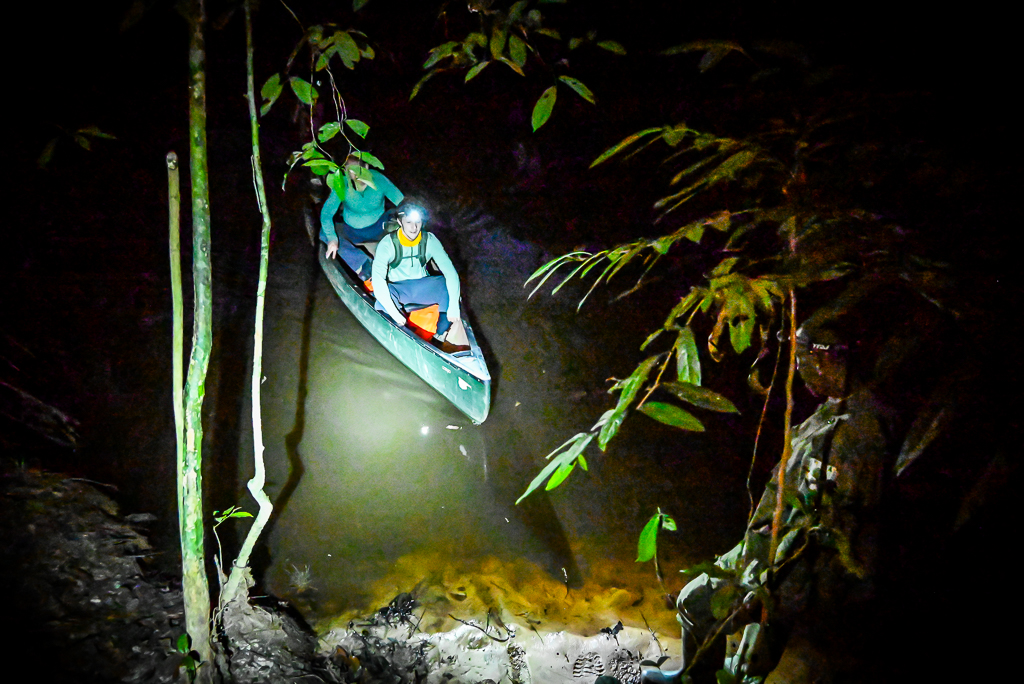
Early morning boat ride across river to start our hike
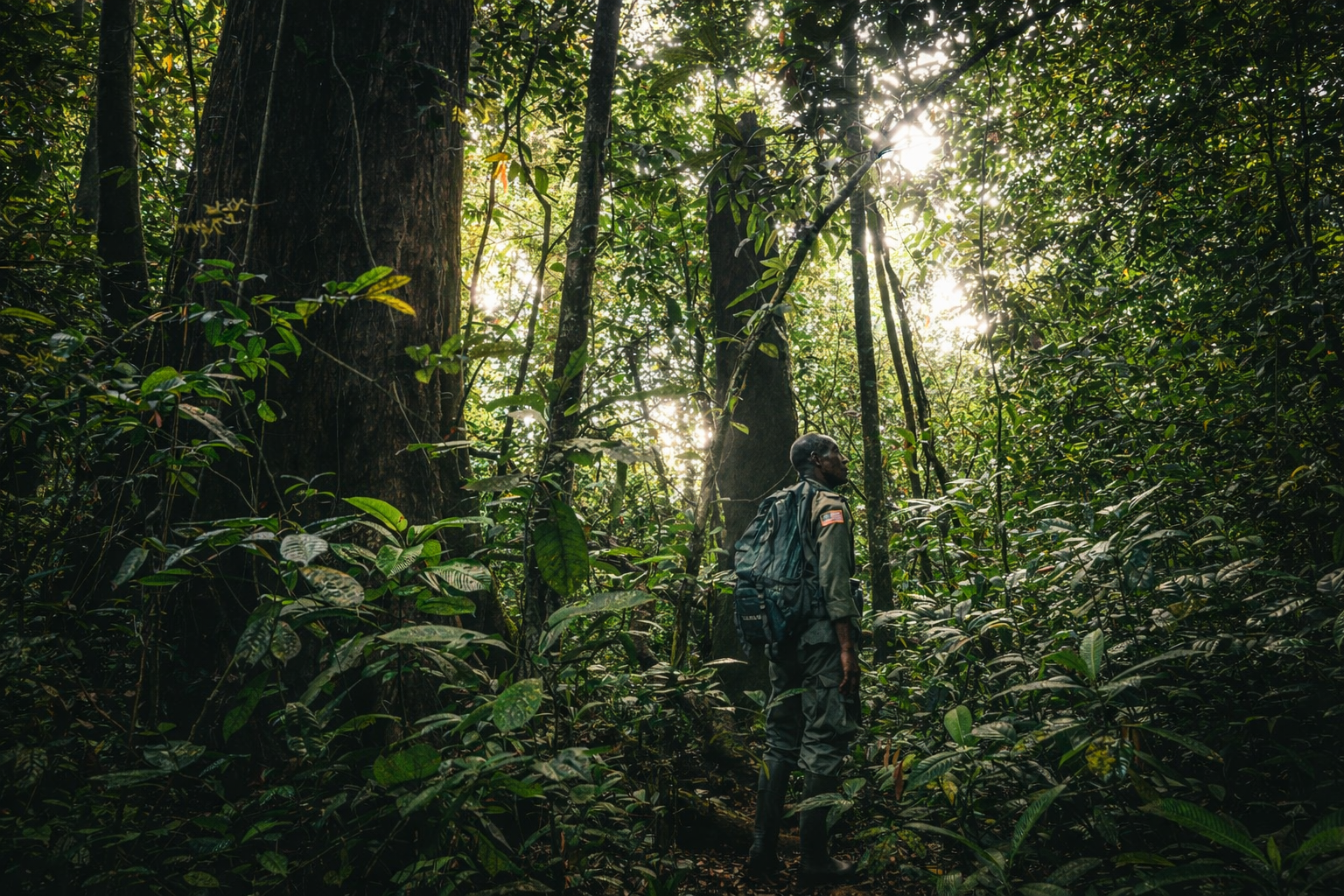
Our guide leading us in the jungle
Not Enough Time to Explore
Unfortunately, because of my flight delay earlier in the trip, we had lost an entire day from our itinerary.
Originally, we had hoped to spend a night camping deeper inside the jungle farther away from villages, where wildlife might be more abundant and less disturbed.
But with the shortened schedule, there simply was not enough time to do it properly.
Instead, we decided to spend every possible moment hiking and searching for wildlife.
And that’s exactly what we did.
Wildlife in Sapo
Wildlife viewing in a dense rainforest is very different from a safari.
Animals are difficult to spot, visibility is limited, and much of the experience involves hearing movement rather than actually seeing the animals themselves.
The reserve also suffered tremendously during Liberia’s civil war from poaching and hunting pressure.
But that was decades ago, and according to Thomas, wildlife populations are slowly rebounding.
Thomas told us that even recently he had seen forest elephants, chimpanzees, Pygmy hippopotamus, buffalo, and many other animals deep inside the forest.
He explained that near the end of the dry season, however, wildlife becomes much harder to spot.
Elephants, he said, have even raided nearby villages to eat crops.
Still, over the course of our hikes, we managed to spot several monkeys moving high through the canopy (Diani and Red Colobus), along with hornbills, squirrels, elephant tracks, and more pygmy hippo tracks along muddy sections of trail and riverbank.
The Mangabey Monkey Project
About an hour deeper into the national park, the French woman who had helped coordinate much of our visit was staying with local villagers at a separate rustic research camp.
The group there woke up early every morning to track a nearby troop of mangabey monkeys.
Their goal was to slowly habituate the monkeys to human presence so they could eventually become part of an ecotourism project that might help bring sustainable tourism income to the area.
We joined them one morning hoping to finally get a good look at the monkeys.
But every time we got close, the monkeys disappeared deeper into the canopy before we could properly see them.
Although we did manage to spot some monkeys during our hikes, we did hear them nearby and Thomas told us we had actually been pretty unlucky overall with wildlife sightings during our time in the forest.
The Forest Itself
But honestly, the real highlight wasn’t any single animal.
It was the forest itself.
The trees were enormous—towering rainforest giants rising high above us beneath layers of dense canopy.
In many parts of West Africa, forests like this have been logged, fragmented, or completely destroyed.
But here, despite everything Liberia has been through, large sections of rainforest still remain intact.
Just being inside a place like that felt special.
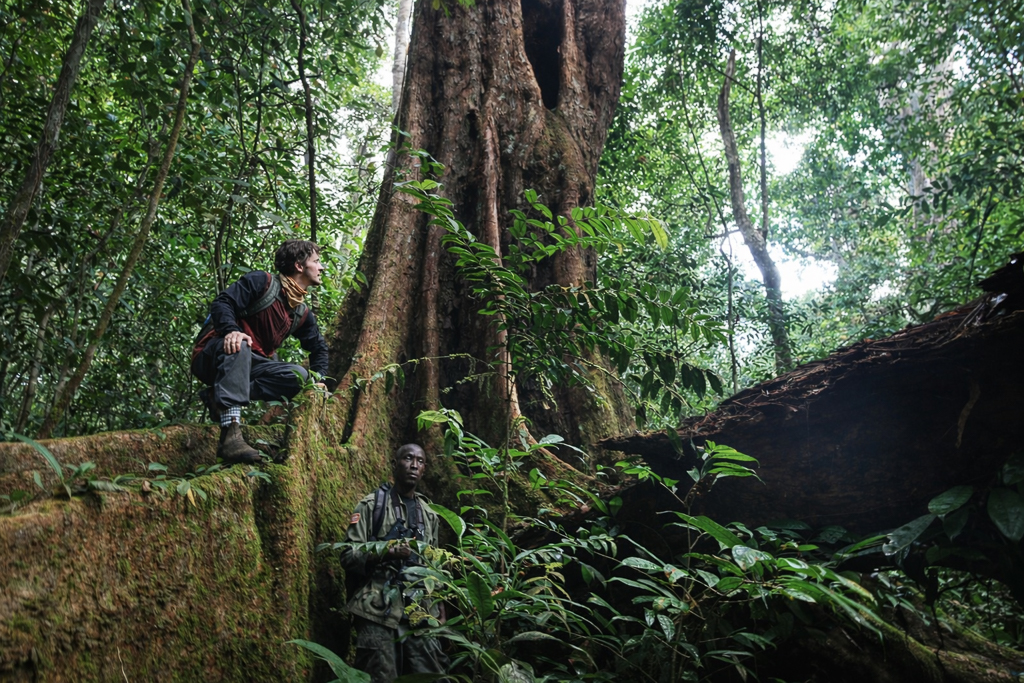
Wes on one of the large tree buttresses
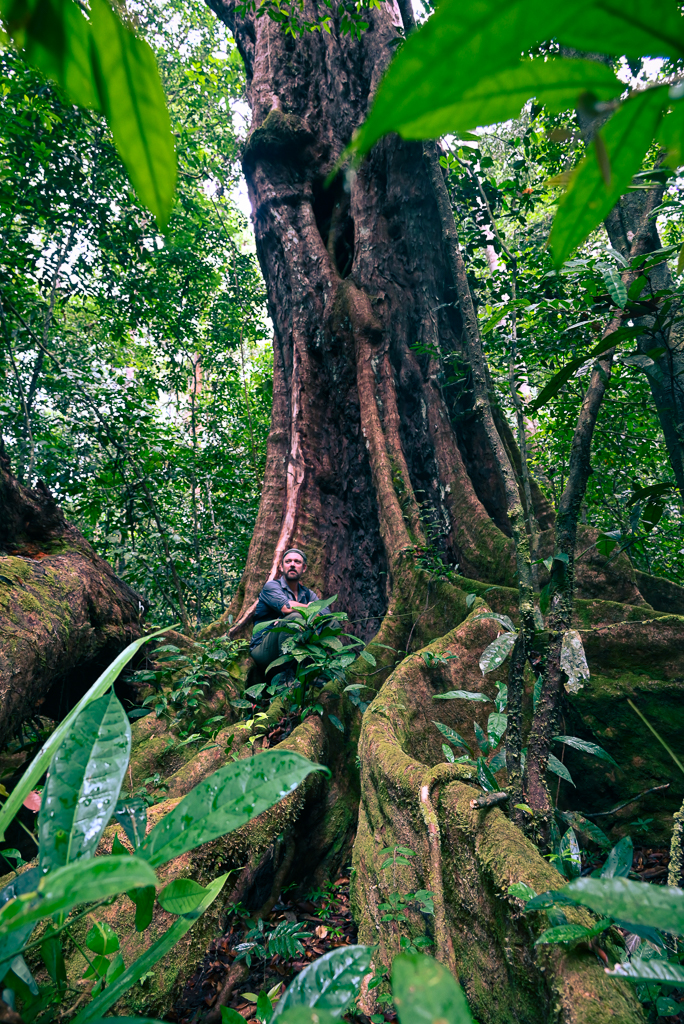
Me looking for snakes
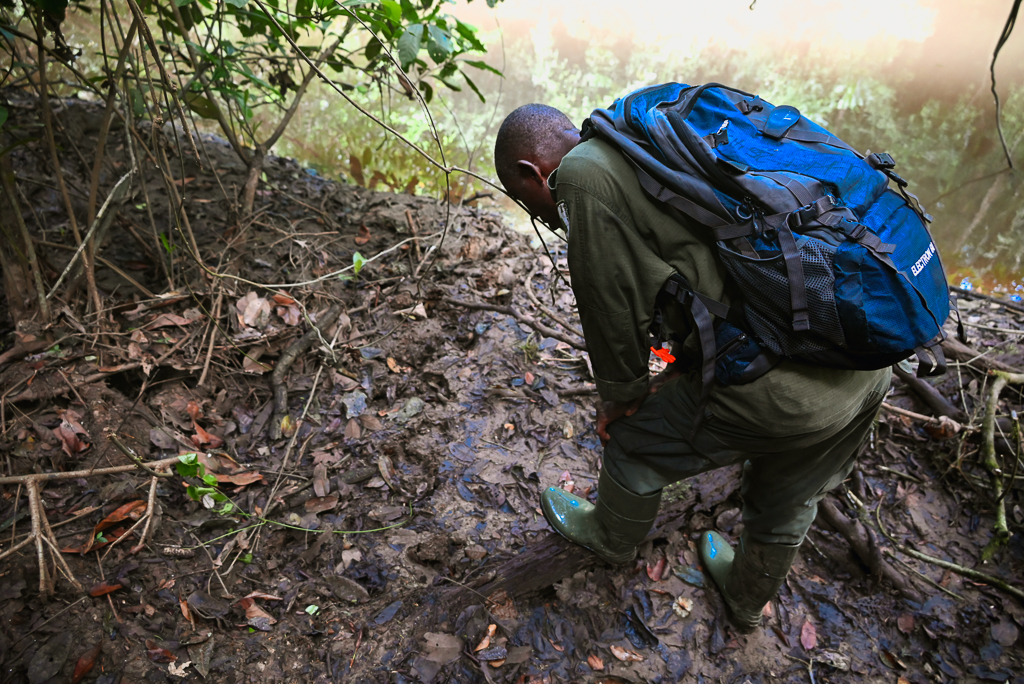
Our guide looking at pygmy hippo tracks
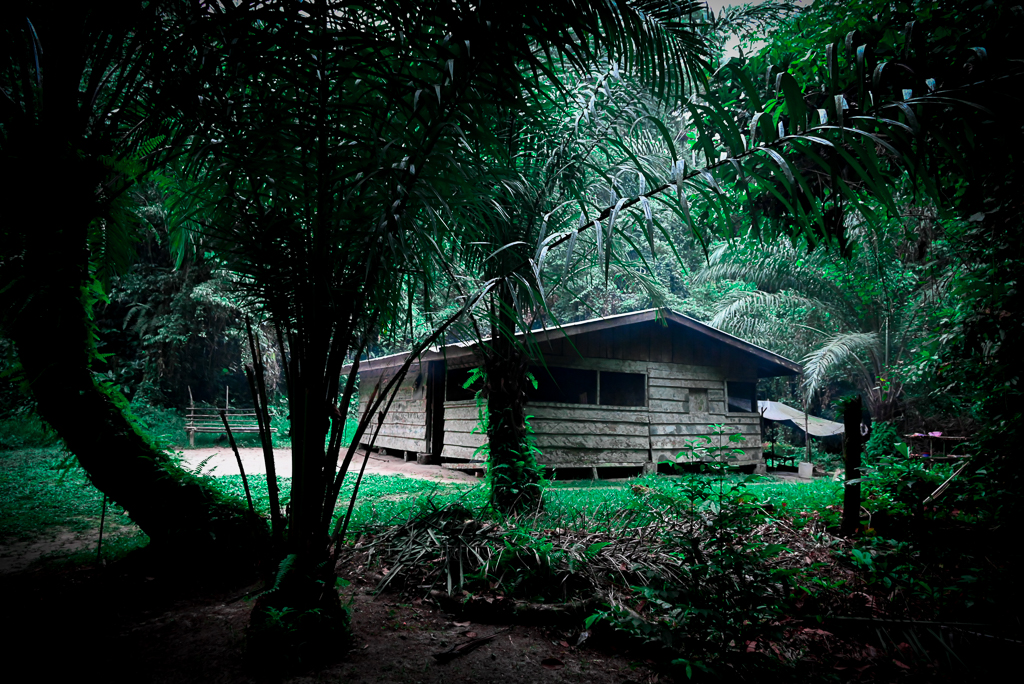
The habituation camp in the rainforest where a team of locals and a wildlife specialist help to habituate a group of mangabey monkeys to hopefully promote this activity for ecotourism.
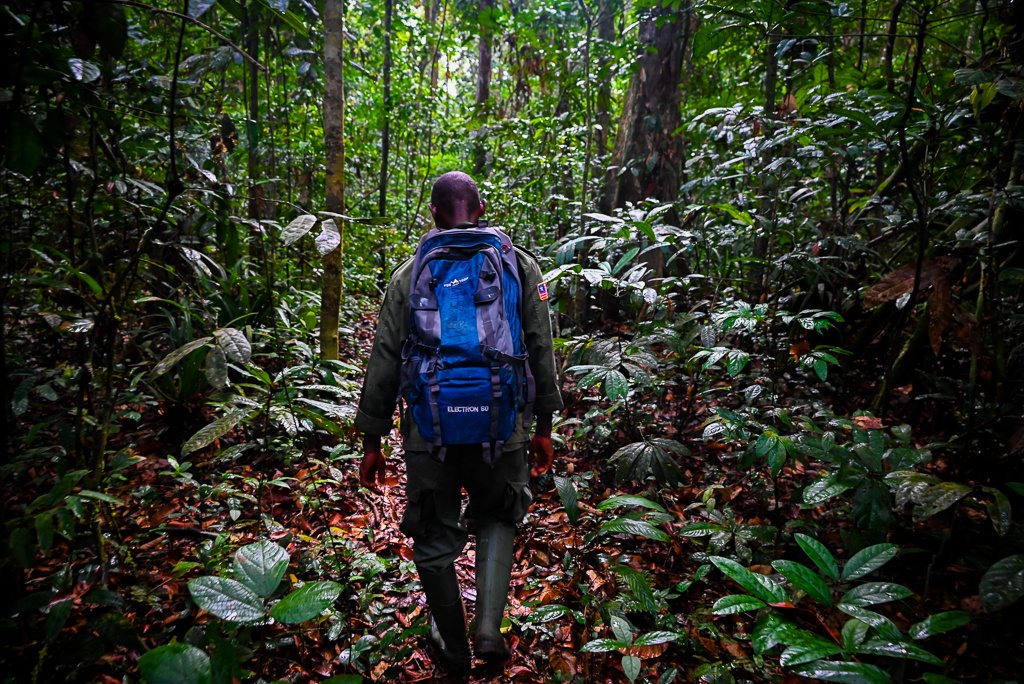
Jungle hiking
Canoeing the River
Another activity we did in the park was canoeing down the river in search of wildlife. Although I would have preferred to paddle our own canoe, Jimmie and I had a mandatory guide.
The trip lasted around two hours and was one of the most peaceful parts of our time in the rainforest.
The river moved slowly through dense jungle, with thick vegetation hanging over the banks and towering trees reflecting off the dark water. Apart from the sounds of insects and birds, everything was quiet.
As we drifted downstream, we kept scanning the riverbanks and overhanging branches hoping to spot wildlife.
We saw several hornbills flying through the canopy and occasionally landing high in the trees, their massive bills unmistakable even from a distance.
But beyond that, wildlife sightings were limited.
No pygmy hippos surfaced. No crocodiles appeared along the banks.
Still, the experience never felt disappointing.
Simply floating through an intact West African rainforest—far from roads, cities, and noise—was memorable enough on its own.
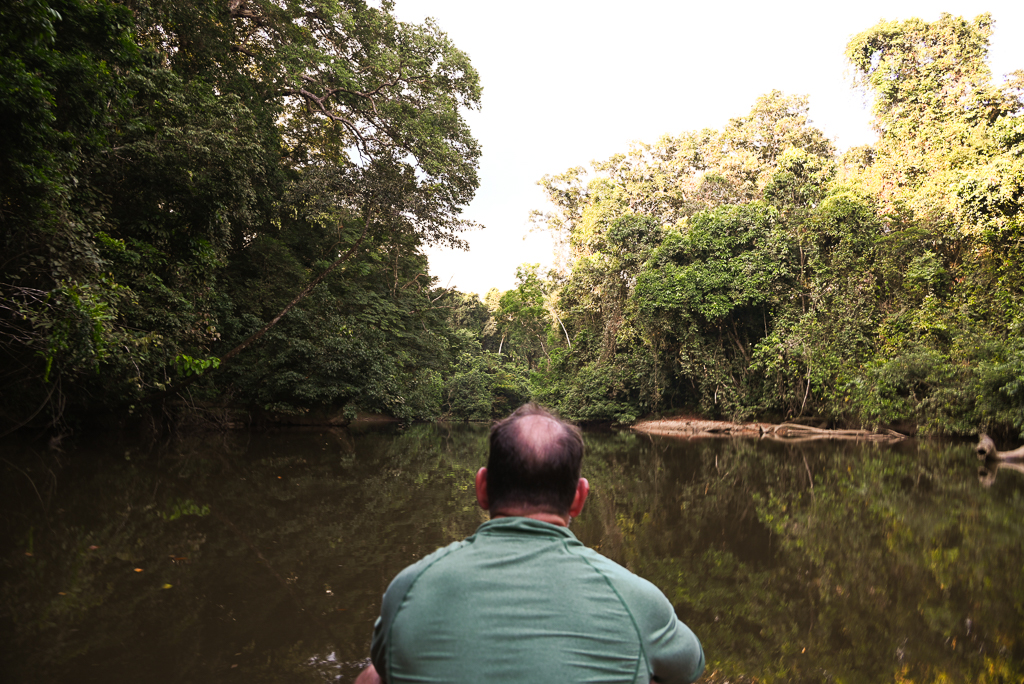
Jimmie on the canoe
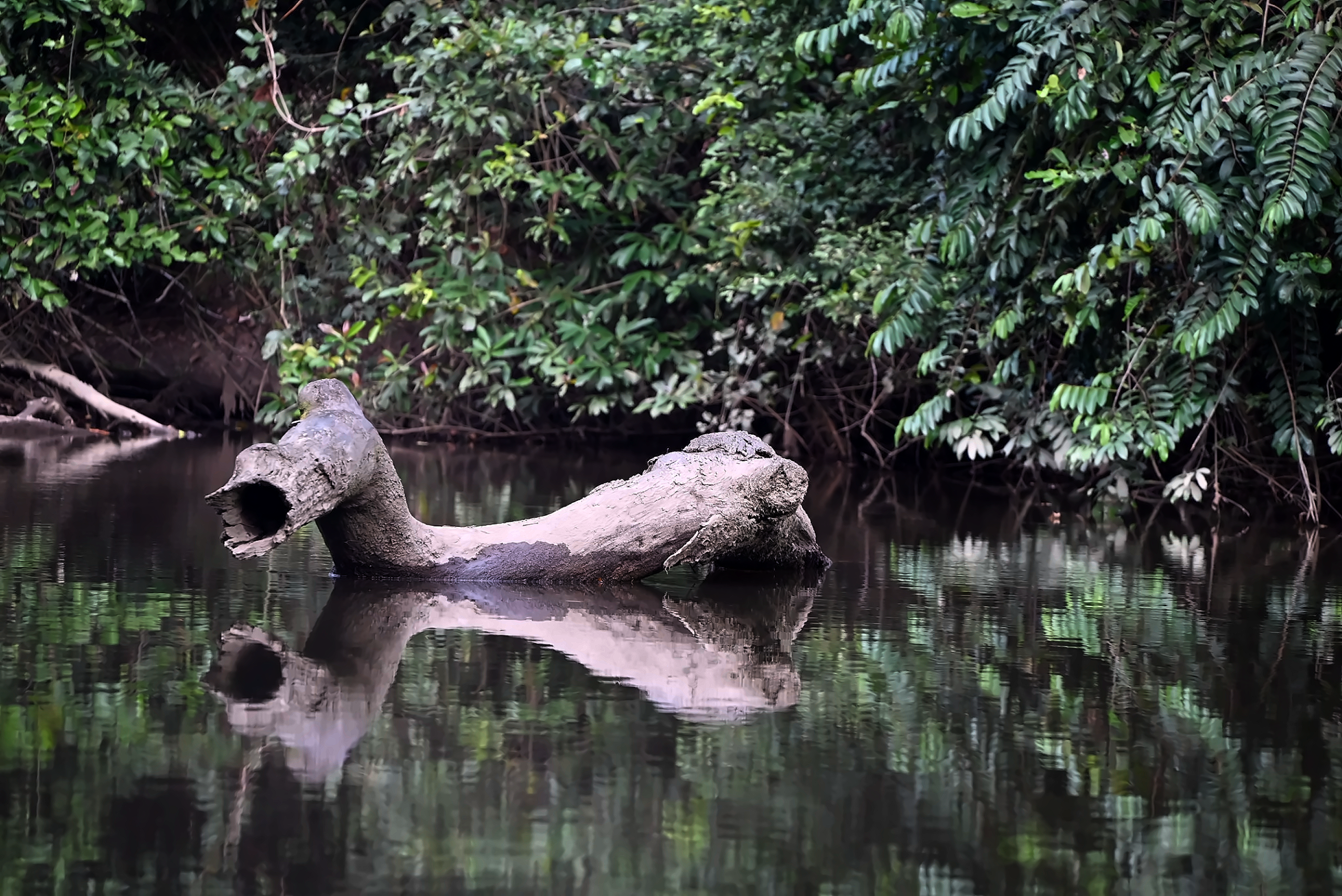
River scenery
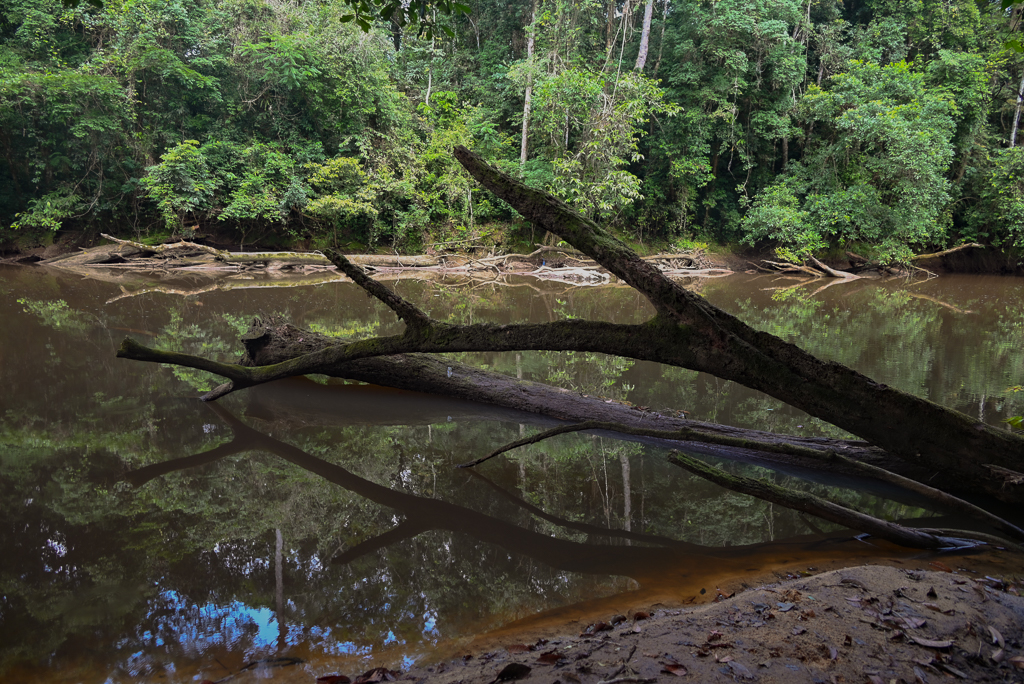
River scenery
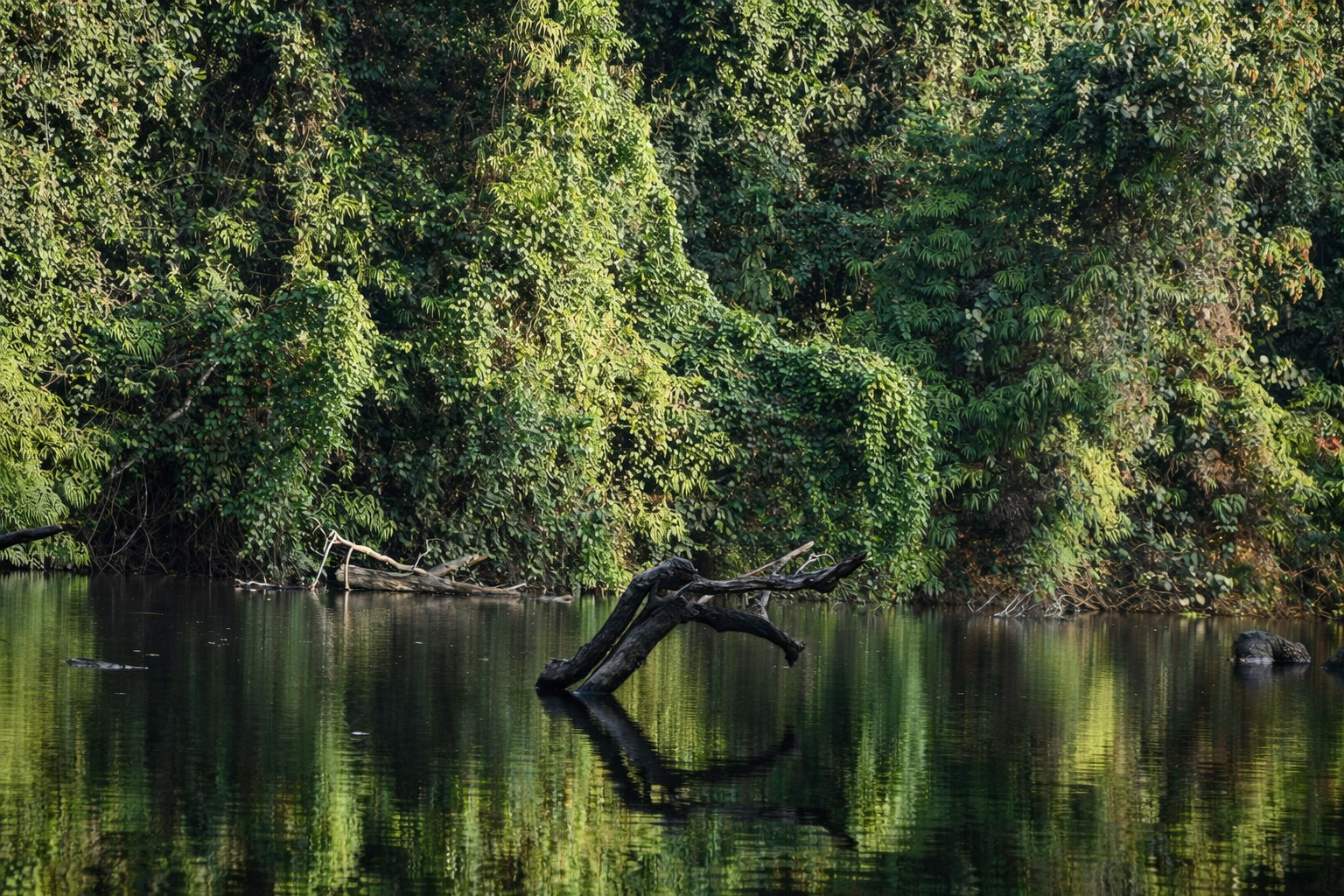
River scenery
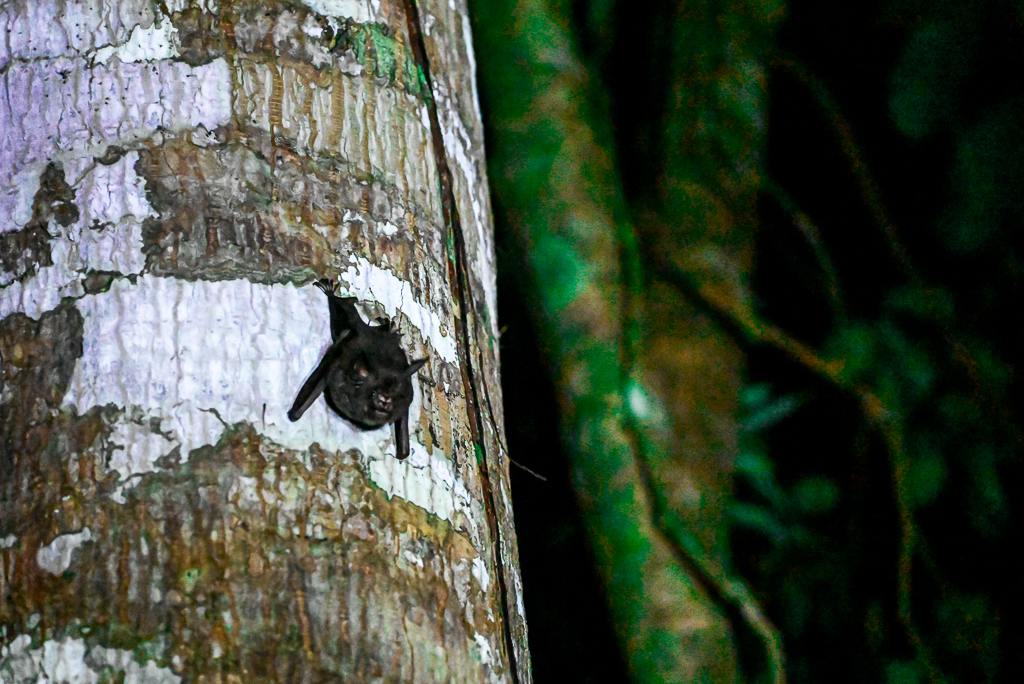
Bat
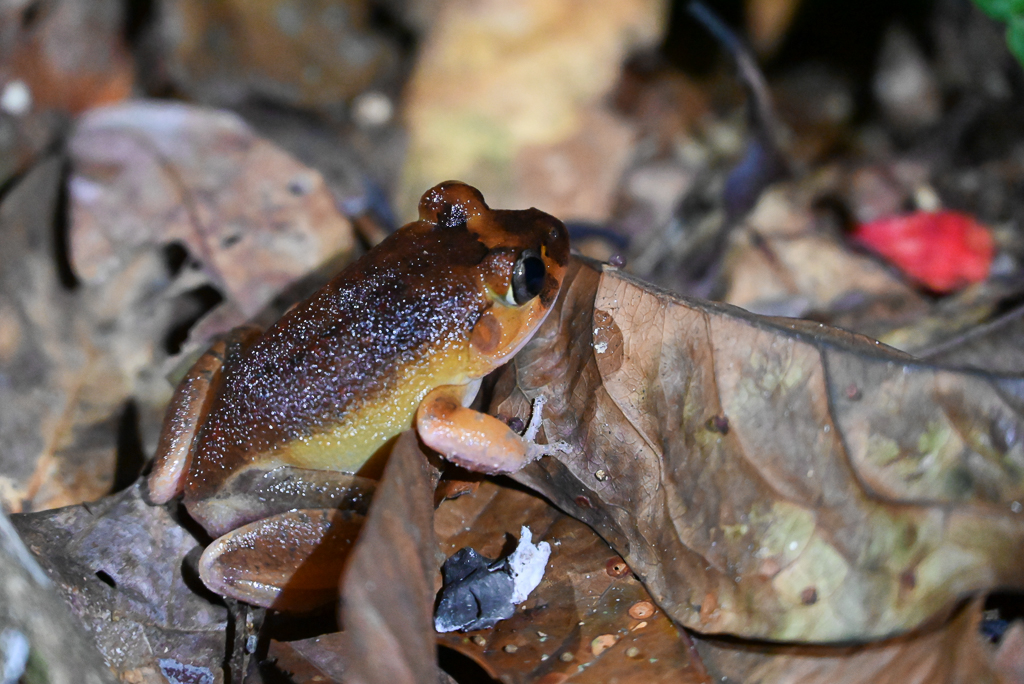
Frog
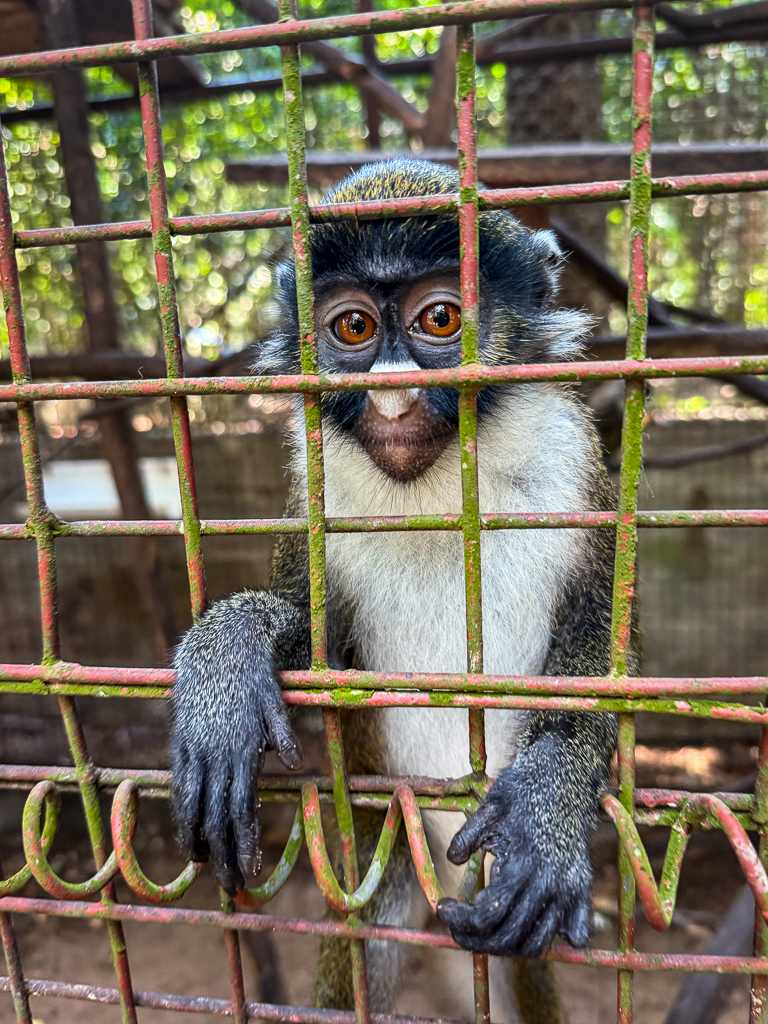
Baby Monkey at the rehabilitation center for wildlife