Arrival in Northern Saudi Arabia
February 2026: From Egypt, we flew into Tabuk, where we began the next part of our journey—a week-long adventure driving across northern Saudi Arabia between Tabuk and AlUla.
This region is one of the most dramatic in the country, and easily one of the most beautiful desert landscapes I’ve seen anywhere in the world. It’s filled with rugged desert mountains, ancient trade routes, and archaeological sites that have only recently opened to travelers.
This part of Saudi Arabia felt far more visually striking than what I experienced on my first trip nearly ten years ago, when I focused on the eastern desert near Riyadh, exploring caves and more barren terrain.
Highlights of the Journey
Our plan was simple: rent a car and explore the region, stopping wherever the landscape or history pulled us in. But along the way, there were a few mandatory stops.
Climbing Jebel al-Lawz
One of the most exciting goals of the trip was climbing Jebel al-Lawz, a remote mountain that some believe could be the biblical Mount Sinai.
Reaching the summit and exploring the surrounding desert landscapes was something I had wanted to do for years.
Camping at Al Hisma Oasis
We also planned to spend time camping in the stunning desert landscapes of Hisma Desert, where towering sandstone formations rise from the red sand. The area is quiet, remote, and incredibly scenic — perfect for a night under the stars.
Exploring the Tombs of Hegra
The final highlight would be visiting Hegra, located near AlUla.
These ancient tombs, carved directly into sandstone cliffs by the Nabataeans over 2,000 years ago, are often compared to Petra in Jordan but are far less visited.
It was the perfect next chapter after Egypt — continuing the journey through ancient civilizations, deserts, and forgotten landscapes.
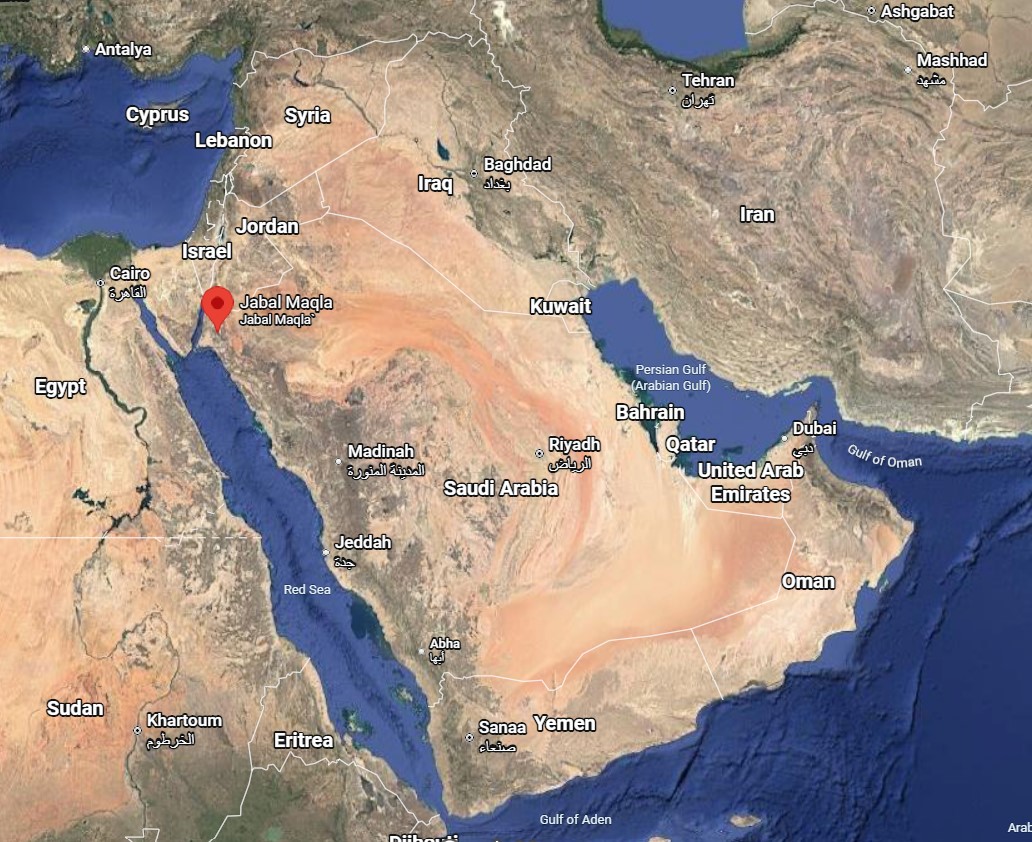
Jebel Maqla, Mount Sinai
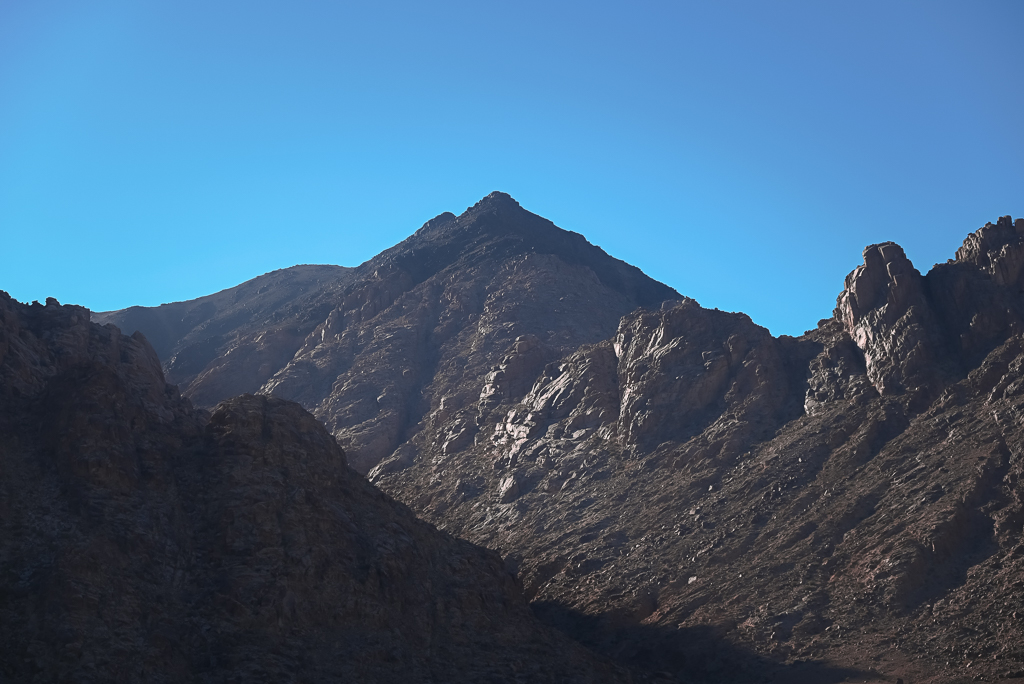
Mount Sinai
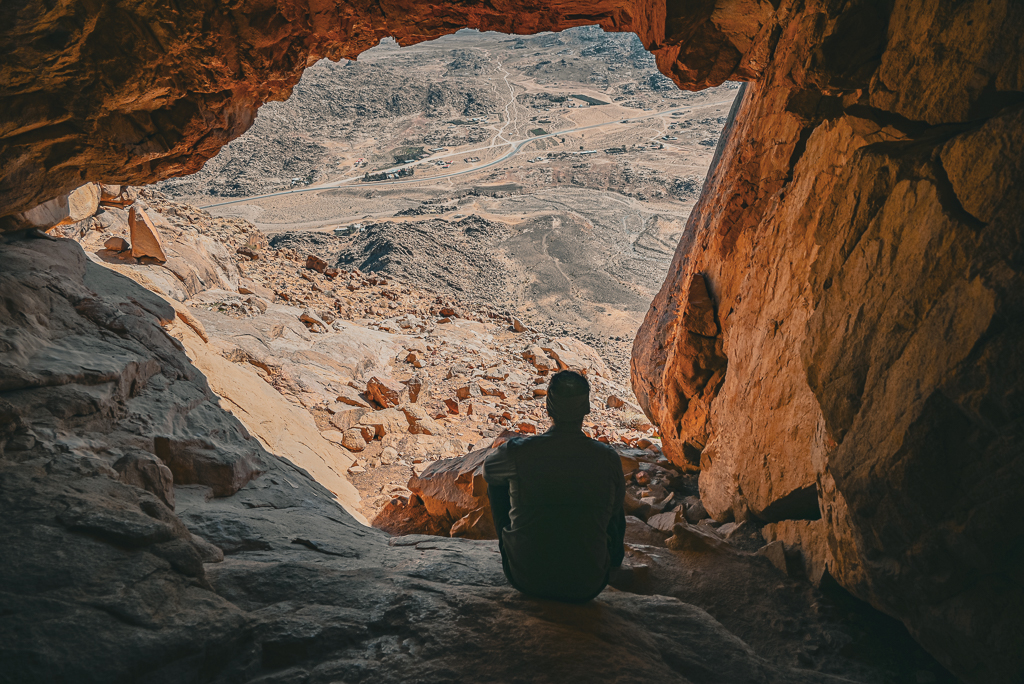
Me in Elijahs Cave
Elijah’s Cave
About an hour and a half into the climb, we scrambled up to a small cave known as Elijah’s Cave—a place some believe is where the prophet Elijah once waited for God.
The cave is tucked into the mountainside and offered a brief moment to rest and take in the silence of the surrounding desert. It isn’t deep, but it’s large enough to provide shelter. It’s also the only known cave in the immediate area, and given its proximity to the blackened peak of Jebel Maqla, it adds to the narrative that this could be the place where Elijah waited before ascending to meet God.
We sat there quietly, trying to imagine the significance of where we were—if this was indeed the place where Elijah once sheltered.
It would have been an incredible place to camp.
But we still had hours of climbing ahead—and the steepest section was yet to come.
Toward the Blackened Peak
From the cave, the climb became noticeably steeper.
We scrambled up a difficult section of rock to reach a higher plateau. From there, the darkened summit rose clearly above us—its blackened rock standing out against the desert landscape.
Some believe this plateau may have been where the Israelite elders waited while Moses ascended the mountain.
Seeing the summit in full view was both encouraging and daunting.
From that point, it took roughly another hour to reach the top. The final stretch required more scrambling over loose rock, with several false peaks along the way.
Jimmie, fresh off a long flight and still jet-lagged, was feeling the strain and made it known. I, on the other hand, was well-rested and fully acclimated.
At one point, I reminded him—half joking—that Moses, an 80-year-old man in sandals, was said to have made this same climb. Compared to that, we had no excuses.
At the Summit
Eventually, we reached the summit.
I arrived first and sat down in silence, trying to take it all in.
Part of me expected something—some overwhelming feeling, some sign, something beyond the physical accomplishment of the climb.
But there was only silence.
And maybe that was the point.
I picked up a small darkened rock to remember the moment, then sat there quietly for a few minutes longer before we began our descent. Even something as simple as stepping away from the summit felt different—it carried a sense of respect, as if the place demanded it.
The Descent
Getting down proved to be just as challenging as the climb up.
There were no defined trails—only occasional rock cairns marking a loose path, often far apart and easy to lose. The terrain was rough, and it was tempting to drop straight into the canyon below and follow it down, but I suspected the boulders there would be too large and difficult to navigate.
Instead, I chose to follow the ridgeline gradually downward.
Jimmie took a different route and descended into the canyon, where he later confirmed my suspicion—the terrain was much more difficult, filled with large boulders and obstacles.
We became separated during the descent.
After about seven hours of climbing, scrambling, and navigating, we both made it back—though not without a few cuts and scrapes. Jimmie arrived nearly an hour after me, with a deep gash on his leg from the rough terrain.
Marc and his young son were waiting for us at the vehicle, along with snacks and a much-needed bottle of Gatorade.
It was time to head back to Tabuk.
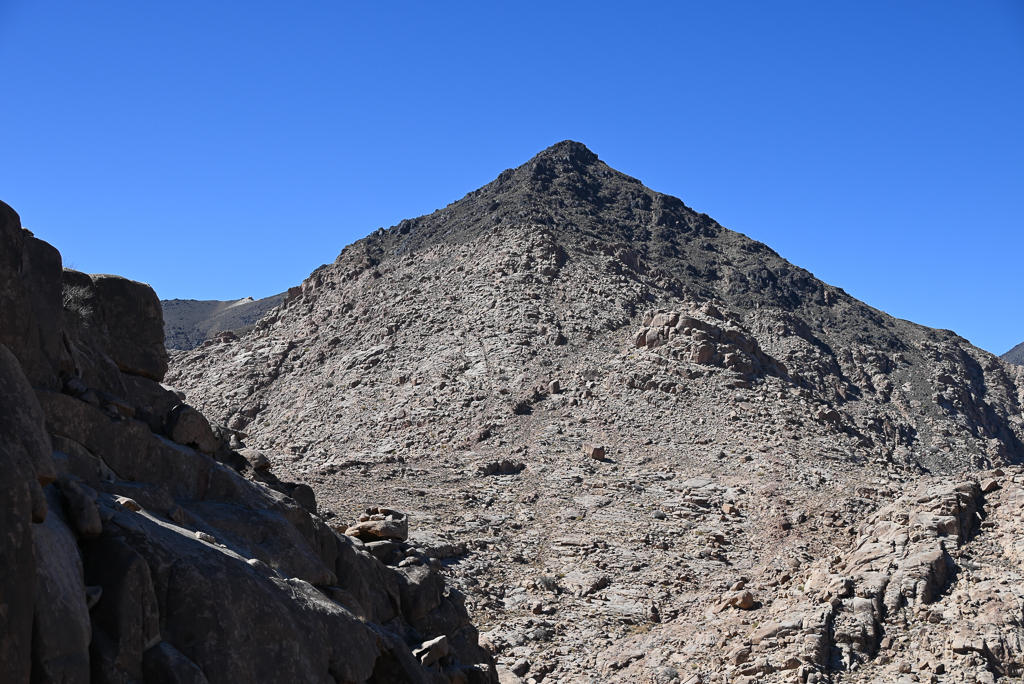
Blackened peak of Mount Sinai
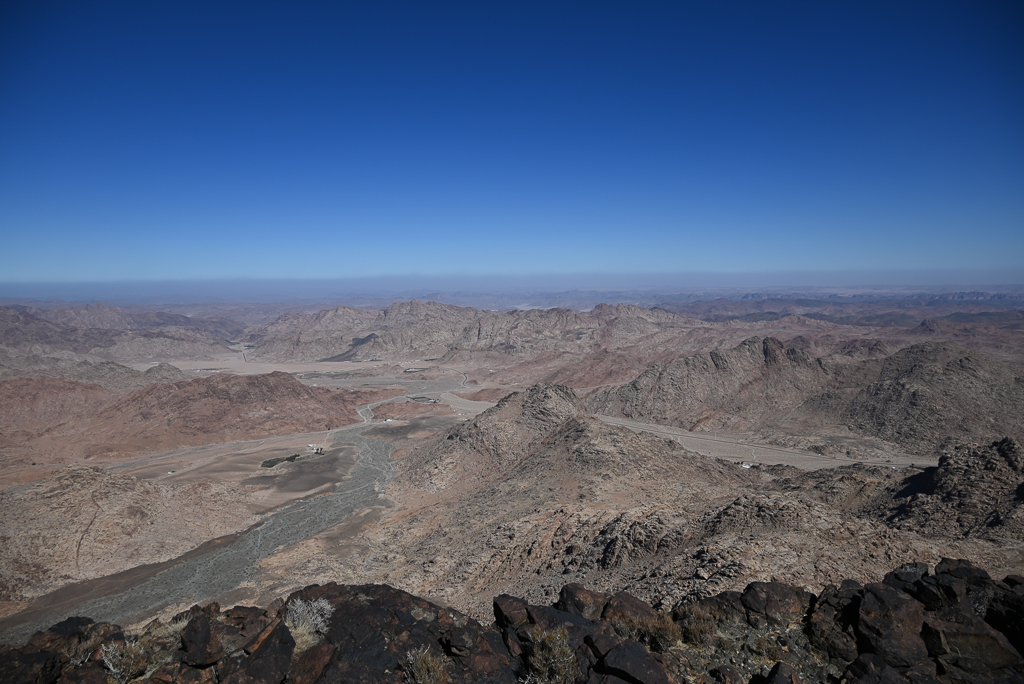
View from the Summit
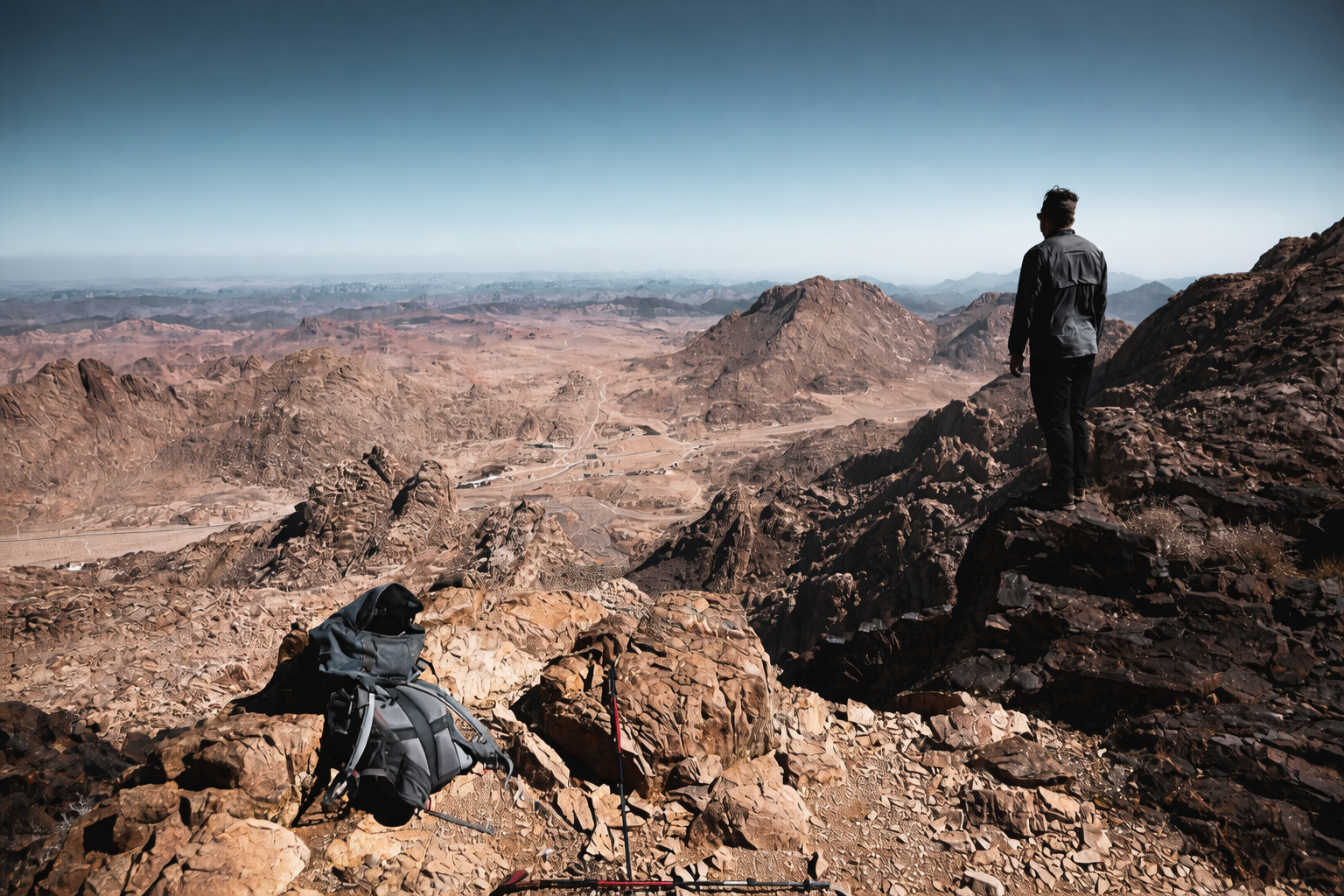
Me near the Summit
Altar of the Golden Calf
At the base of Jebel Maqla—believed by some to be the true Mount Sinai—there is a striking collection of large boulders covered in ancient engravings.
Carved into several of these stones are figures of calves and bulls, some with distinctly Egyptian-style curved horns. Many who visit the site believe these carvings could represent the Golden Calf described in the Bible, created by the Israelites while waiting for Moses to return from the mountain.
The site sits right at the base of the mountain, and we were able to drive directly up to it. Although it is enclosed by a barbed-wire fence, parts of the fence were damaged, and we were able to crawl underneath to get a closer look.
Standing among these massive stones, with the engravings etched into their surfaces, it’s easy to understand why this place has sparked so much interest and debate among visitors, historians, and biblical researchers.
Back to Tabuk
We returned to Tabuk after dark.
That evening, Marc, his wife, and their young son met us for dinner at our hotel. Afterward, they took Paula, her mom, and Indie to the local gold market, giving them a glimpse into everyday life in Tabuk.
Marc and his family were Filipino expats—part of the large Filipino community in Saudi Arabia, many of whom work in fields like healthcare and hospitality. Their warmth and generosity stood out throughout our time with them.
Before we parted ways, Marc gave Indie a small silver necklace—a simple but meaningful gift that she was thrilled to receive.
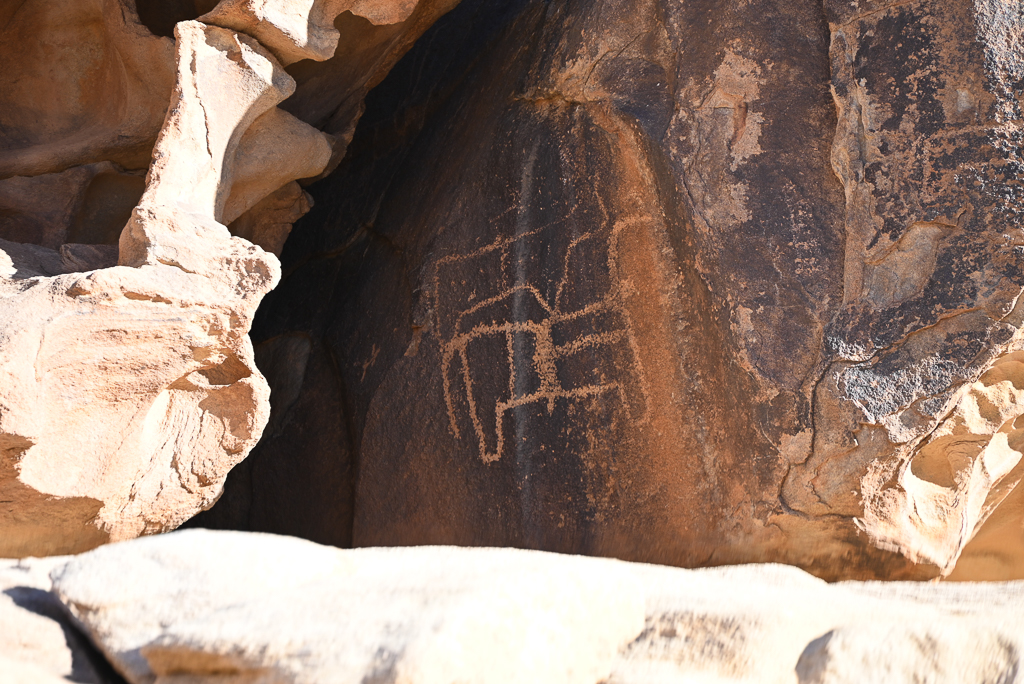
Altar of the golden calf
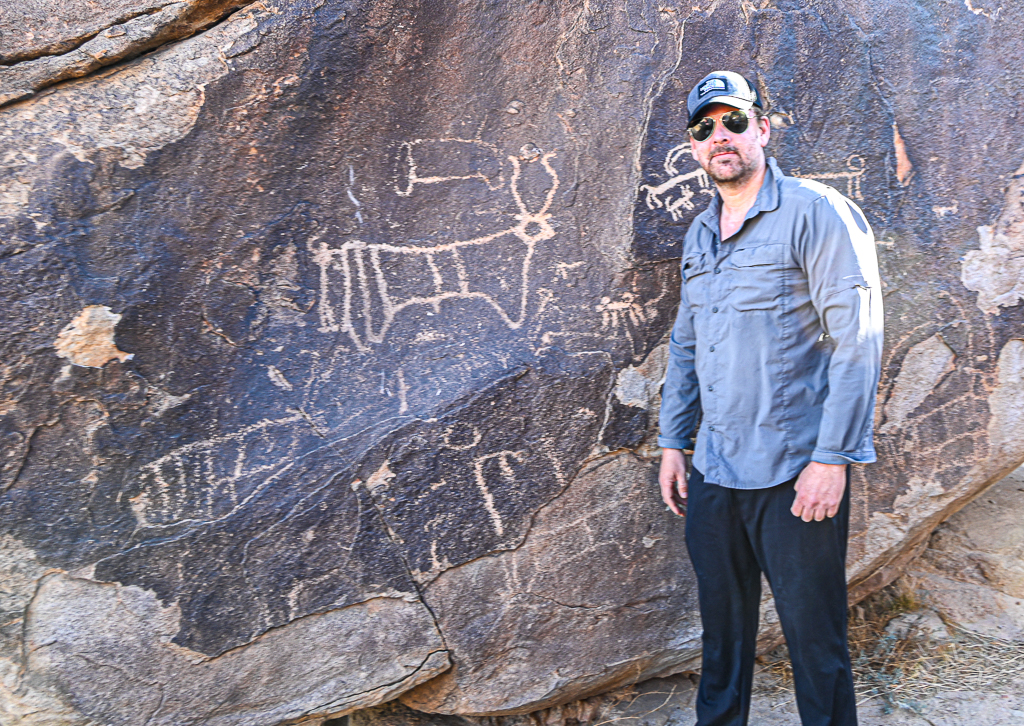
Me at altar of golden calf
Into the Hisma Desert
From Tabuk, we drove a few hours along empty desert roads—at times following stretches near the Red Sea before turning inland toward the remote Al Hisma region. The farther we went, the more isolated it became. Traffic was almost nonexistent, and in some areas the road narrowed to a single lane cutting through vast emptiness.
As we approached, the landscape transformed dramatically.
Towering sandstone mountains rose from deep red sand, creating one of the most striking desert landscapes I’ve seen anywhere in the world.
Exploring the Canyon Landscape
Ahead of time, I had arranged a camping experience via WhatsApp with a Bedouin group in a remote part of Al Hisma, along with a 4WD jeep safari into the surrounding wadis—some of which require serious off-road driving.
When we arrived at the small village oasis, tucked beneath massive sandstone cliffs and surrounded by date farms, we located the Bedouin camp that hosts visitors. To my surprise, a tour bus was there with a group of tourists. One elderly American woman was suffering from heat exhaustion, and Paula stepped in to help.
Fortunately for us, the group was leaving rather than staying overnight. Once the bus departed, we were once again among the only tourists in the area—a feeling we had grown used to and appreciated.
From there, we hired an open-top jeep driven by a young Bedouin in traditional dress to take us deeper into the desert. The terrain quickly became rugged—narrow canyons, steep rock walls, and winding tracks that would be nearly impossible to navigate without both a capable vehicle and local knowledge. I was surprised to see so many Saudi families driving their 4wd vehicles into the wadis with their families and enjoying barbecue picnics. Sone vehicle license plates showed that they came as far away as Dubai.
We spent the next four hours exploring a series of dramatic wadis, each one revealing more towering formations and hidden corridors carved into the rock.
Eventually, though, the drive began to wear on us. The terrain was getting rougher, the sun was setting, and the temperature was dropping. Indie had started coughing more frequently, and we were beginning to worry.
We decided to turn back early, even though there was still one more wadi left to explore.
The truth was, we had already seen so much beauty that it had begun to blur together. After hours of incredible scenery, we were—strangely—“wadi’d out.”
The drive itself had become the experience—bouncing through sandy valleys and weaving through towering sandstone corridors as the desert slowly shifted into evening light.
Camping with the Bedouin
That night we camped out in the desert with the Bedouin. As the sun disappeared behind the sandstone cliffs, the desert turned quiet and cool.
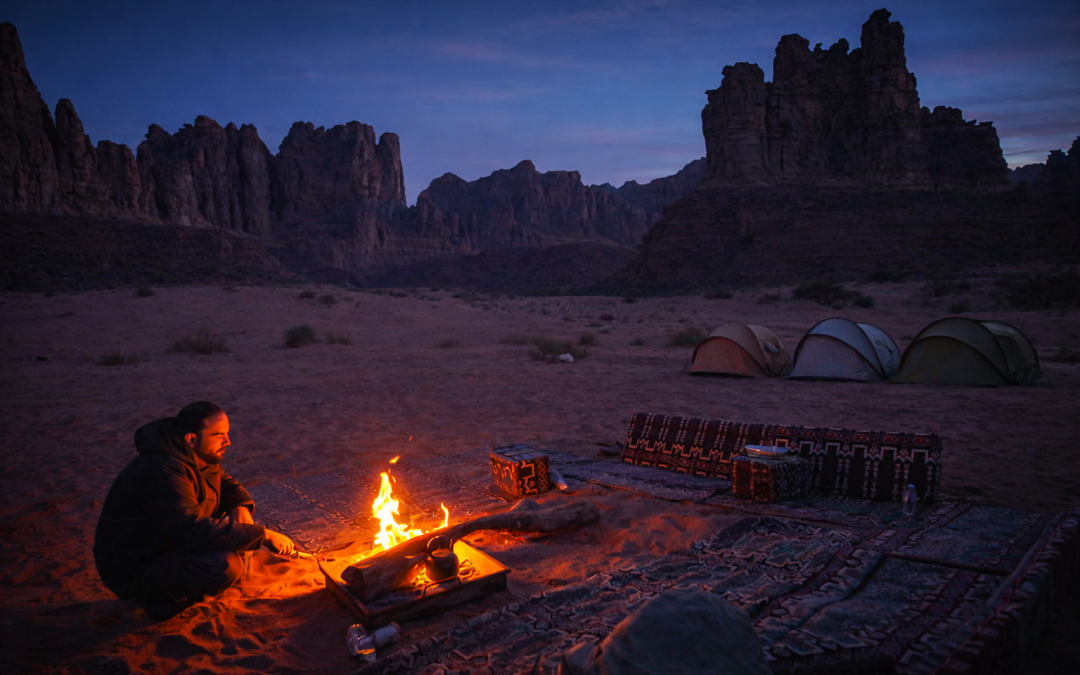
We sat around a small fire in the sand, surrounded by towering red rock formations and endless desert in every direction — one of those places where the silence feels as vast as the landscape itself.
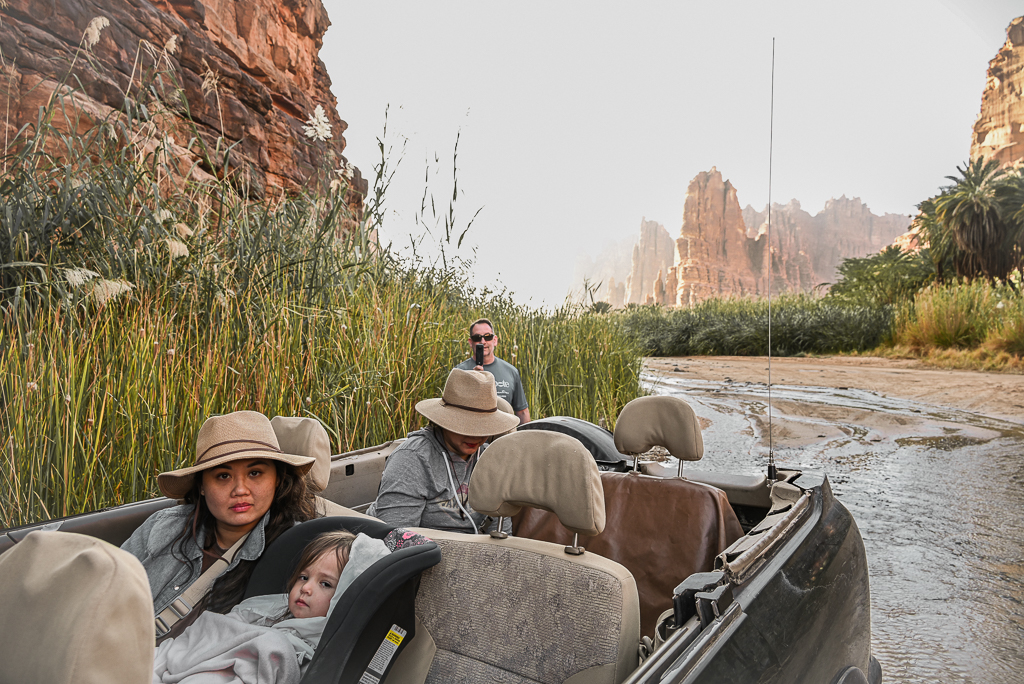
Our desert safari vehicle
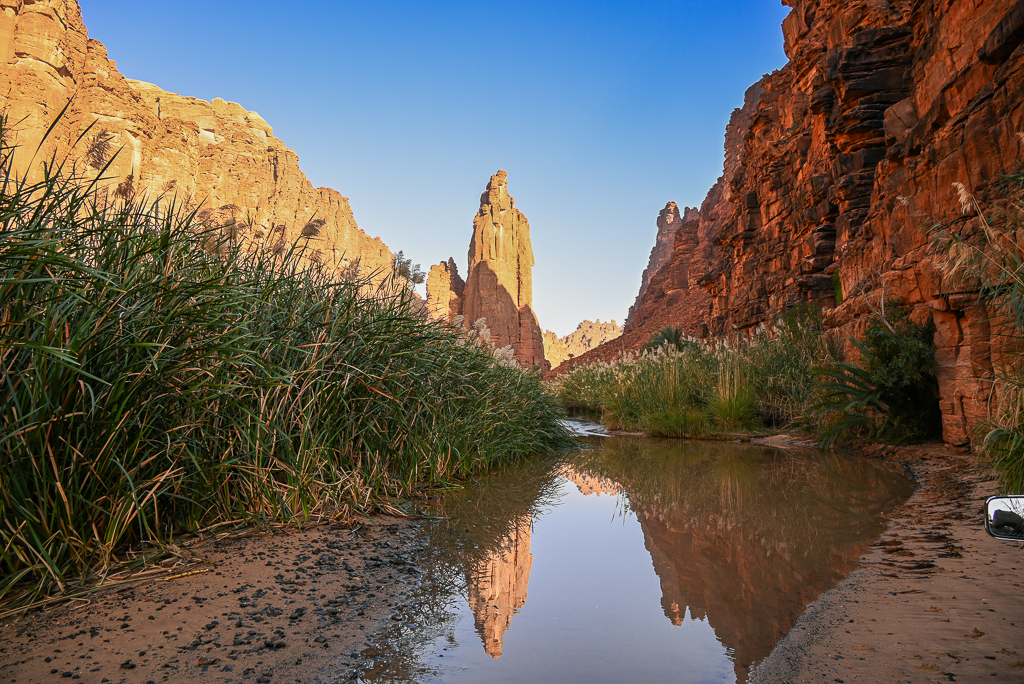
Al Hisah Desert
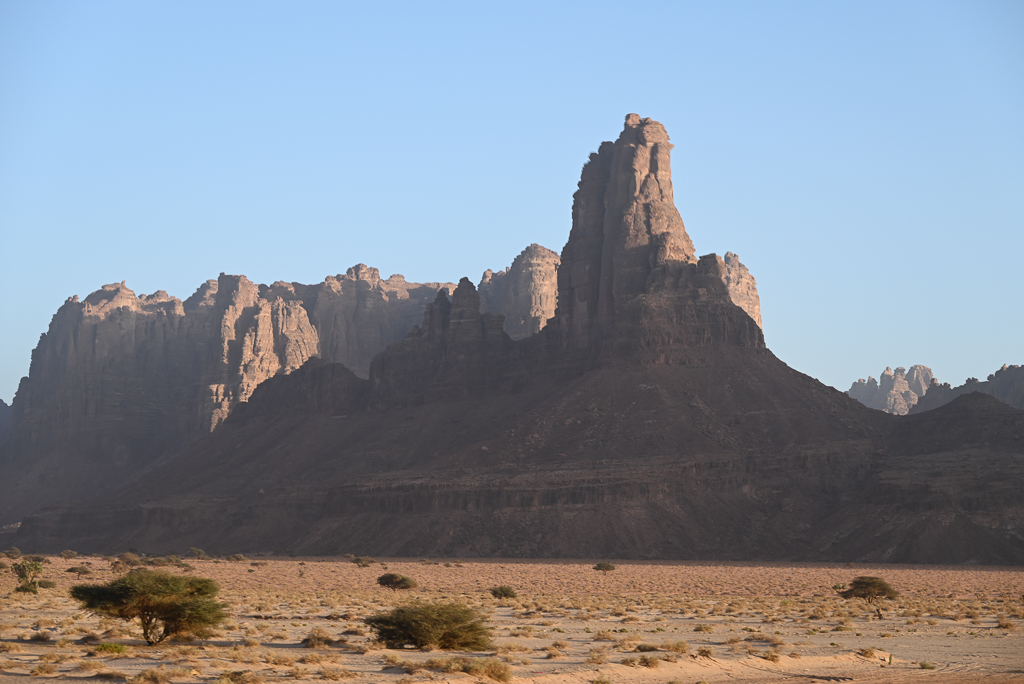
Al Hisah Desert
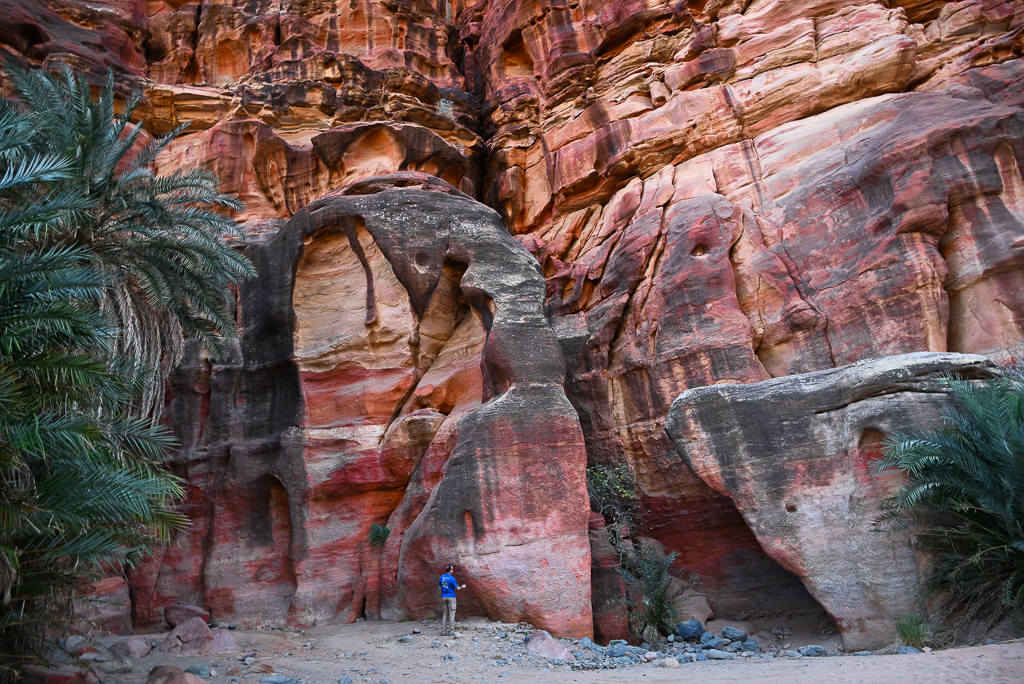
Al Hisah Desert
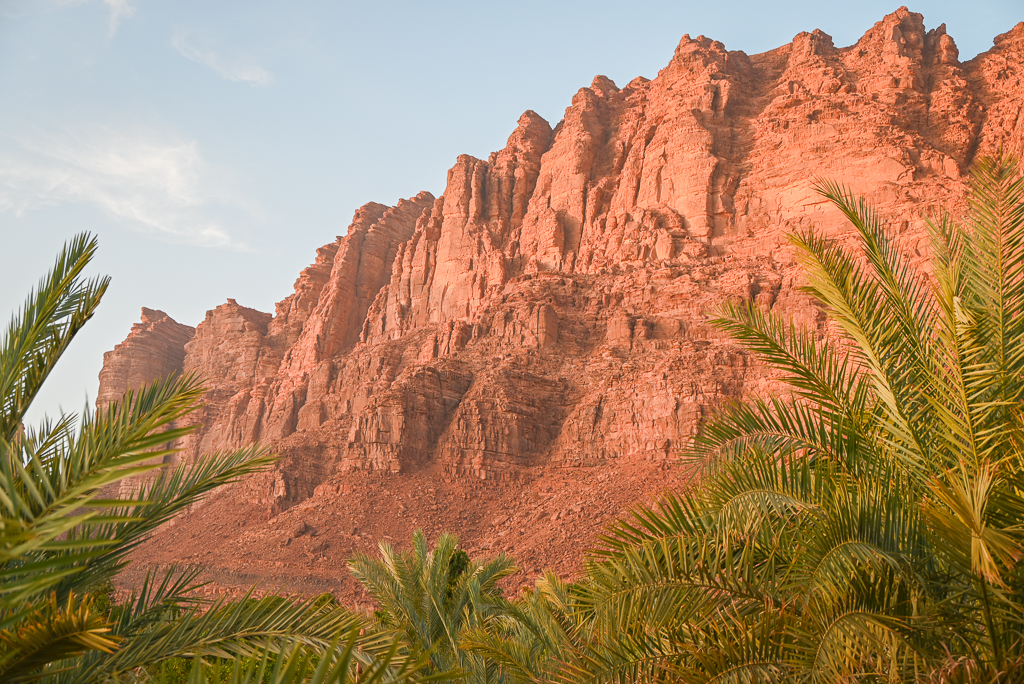
Al Hisah Desert
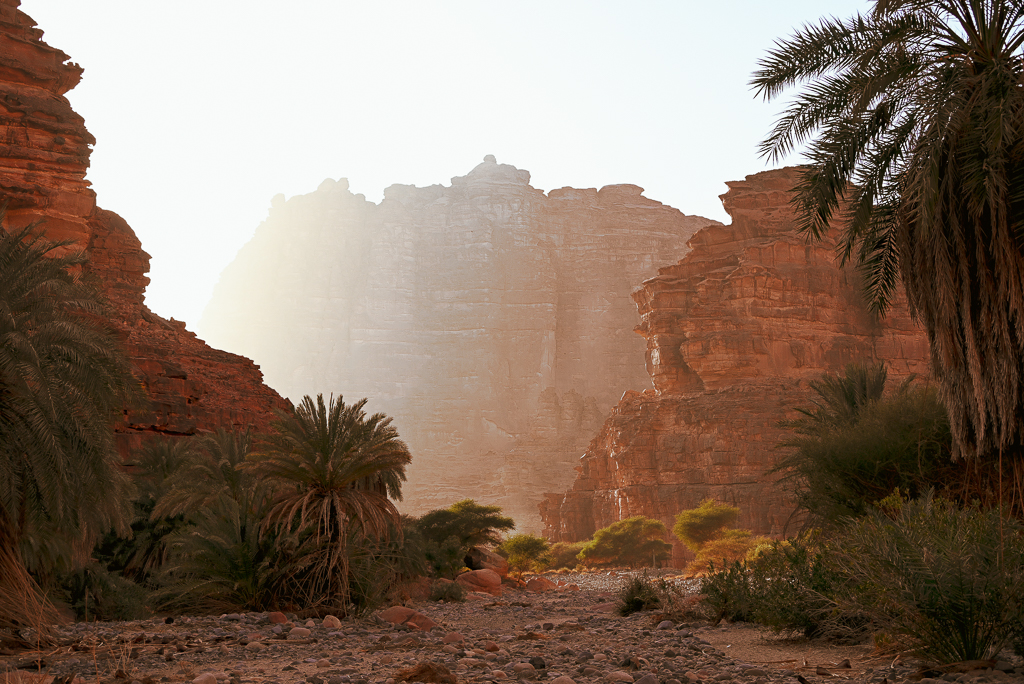
Al Hisah Desert
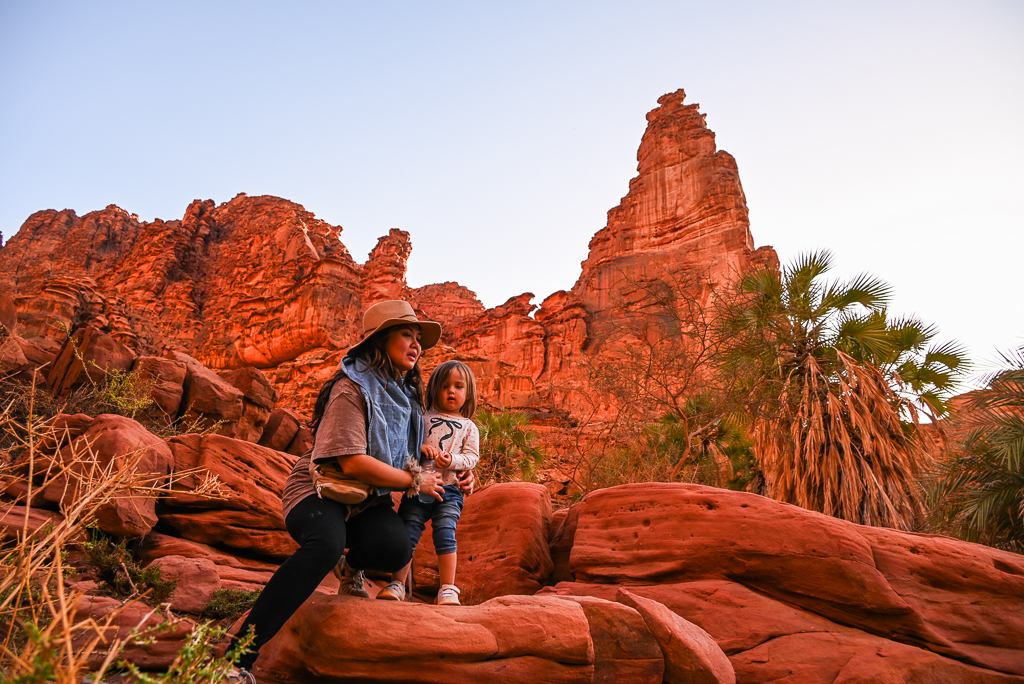
Al Hisah Desert
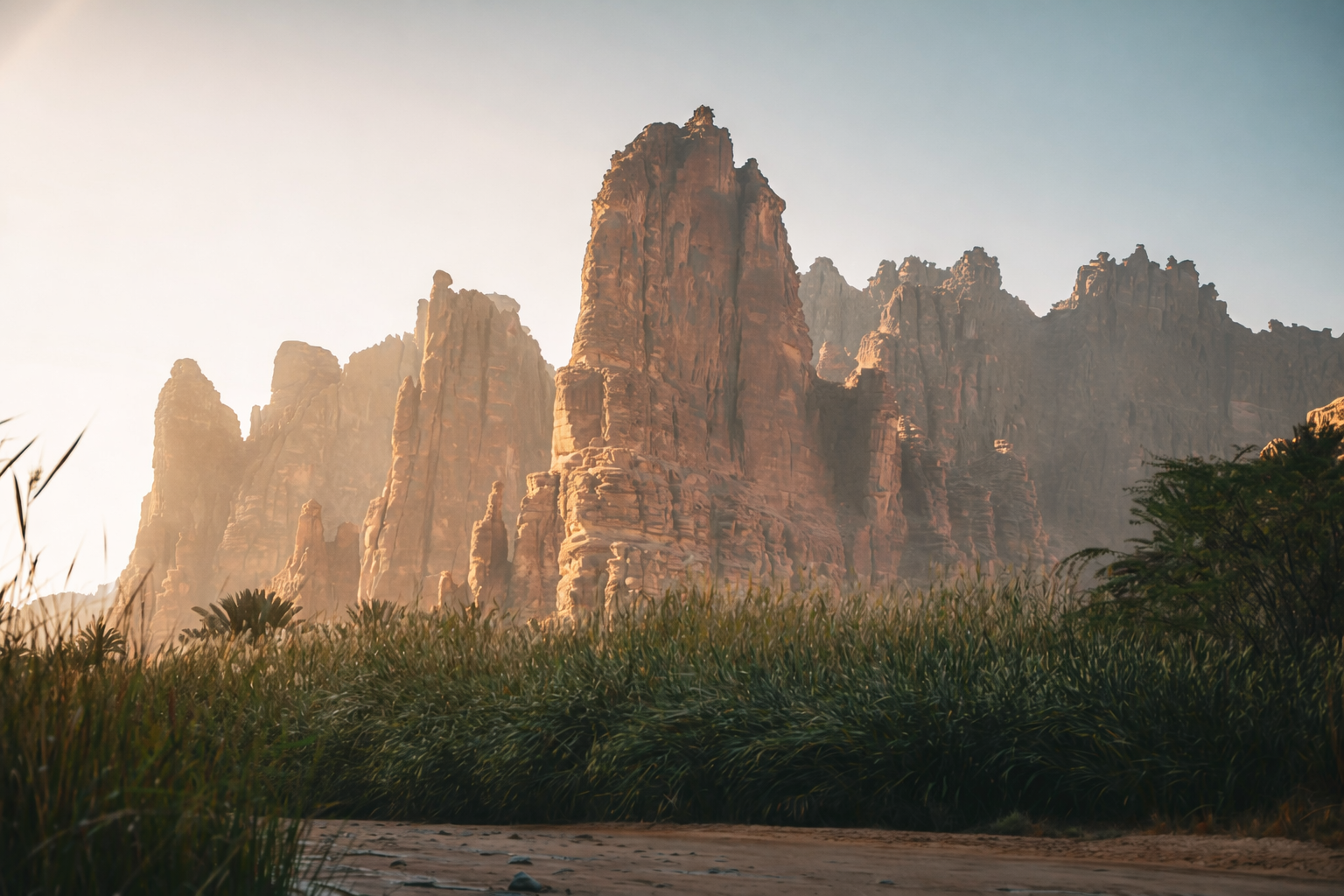
Al Hisah Desert
Camping in the Red Desert
Camping under the stars in the red desert of Al Hisma Desert with the Bedouin was an incredible experience, and the second time on our trip that we had spent the night camping in the desert. Unlike the Sahara, the desert sand here was red and we were sorrounded by towering sandstone cliffs and whistling rock hyrax’s.
Camping in the Hisma Desert
Driving Into the Dunes
We drove our own car into the desert, following the Bedouin in their Hilux jeeps. The sand quickly became deep and treacherous, forcing us to let air out of our tires for better traction. Even then, it wasn’t easy.
When we finally reached a small hill where we planned to camp for the night, we got stuck in the soft sand.
Unexpected Company
While sorting that out, I noticed something unexpected—two Saudi women, both wearing full niqabs, had joined the Bedouin crew. Later, we learned they worked with the outfitter to help accommodate tourists, and one of them was even studying tourism at university.
They were in their early twenties and incredibly kind. They immediately connected with Indie—playing with her, taking selfies, and even offering to help watch her. Once we reached camp, they removed their niqabs, likely because we were far from town and outside the expectations of public life.
It was a small but fascinating glimpse into a changing Saudi Arabia.
A Country in Transition
What struck me most was how much the country had transformed since my last visit nearly eight years earlier. Back then, I had traveled to Saudi Arabia at a time when tourism was virtually nonexistent. Foreigners were only just beginning to enter the country, largely tied to major events like Formula One, which I skipped in favor of exploring remote areas. Tourist visas didn’t really exist, and seeing other travelers was rare.
At that time, women were far less visible in public life—rarely seen outside the company of male relatives, not driving, and almost always wearing a niqab.
Now, the difference was striking.
In Tabuk, I saw Saudi women driving regularly. They were working in hotels, restaurants, and other public-facing roles—positions that previously were often filled by expats. They were confident, friendly, and engaging.
And here in the desert, we were sitting with two young Saudi women, unrelated to the Bedouin men, working alongside them, interacting openly with us, and helping host tourists. One was even pursuing a degree in tourism, preparing for a future where Saudi Arabia would welcome visitors from around the world.
There were noticeably more tourists as well—still not crowded, but far from the near-zero presence I had experienced before.
The changes were unmistakable. Saudi Arabia felt like a country in transition—opening up, diversifying, and stepping into a new era beyond its traditional reliance on oil.
A Night in the Desert
After the sun dropped behind the towering sandstone cliffs, the temperature cooled quickly and the desert fell into complete silence.
We gathered around a small fire while the Bedouin prepared a simple meal of falafel and tea. The red sand glowed softly under the moonlight, and Indie—just like in Egypt—rolled around happily in the sand without a care.
Our tents were set up in a row, including those of the Saudi women, while some of the Bedouin chose to sleep out in the open beside the fire.
Later in the night, Indie’s cough returned and seemed to be getting worse, which added a layer of concern beneath the otherwise peaceful setting.
Looking up, the sky was completely filled with stars—far from any cities or artificial light.
Between this night in Saudi Arabia and our earlier camp in Egypt’s White Desert, the trip had given us two unforgettable experiences sleeping under some of the darkest skies in the world.
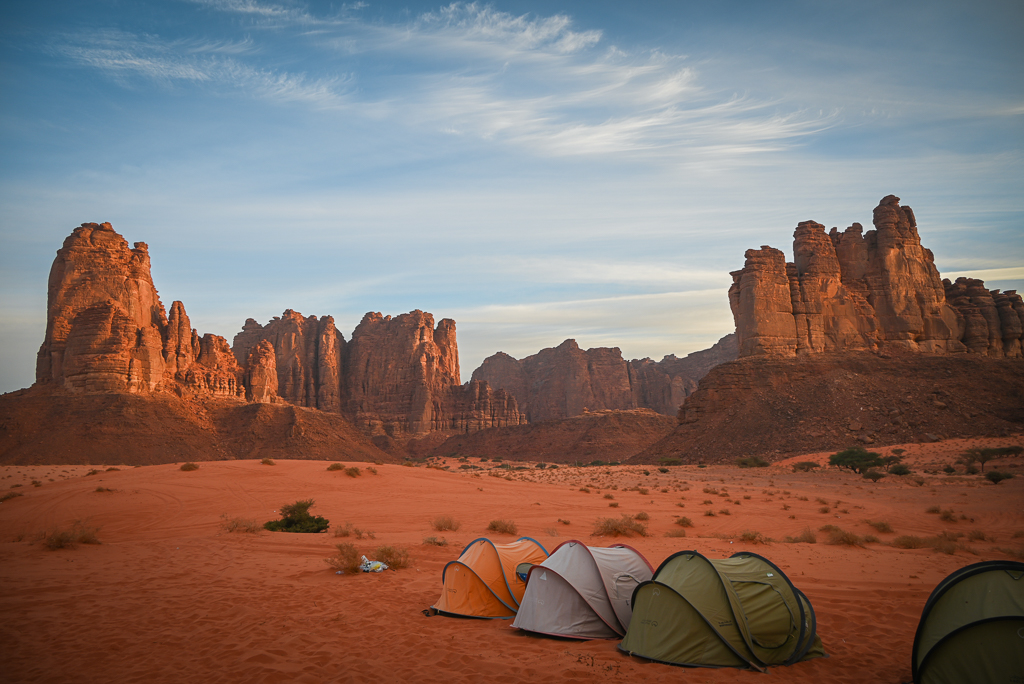
Desert Camping
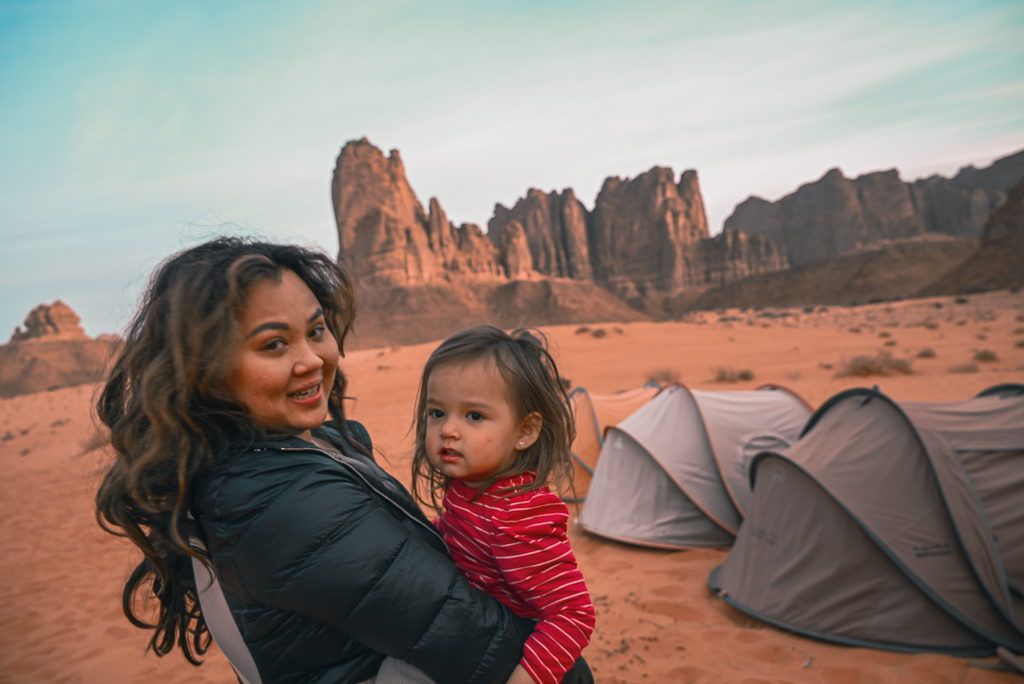
Indie and Paula
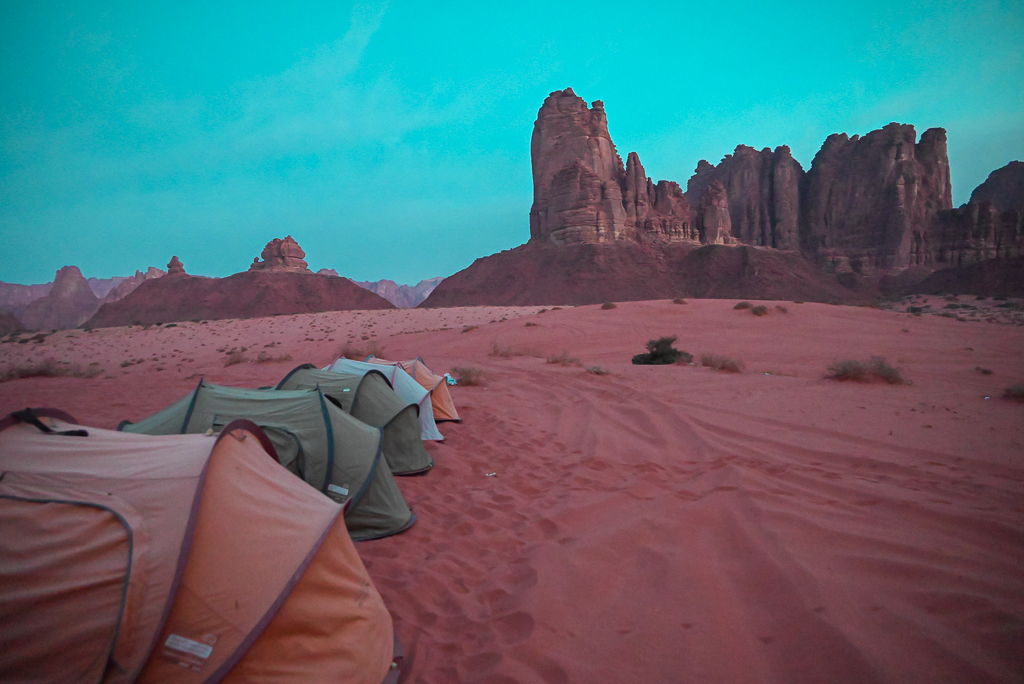
Desert Camping
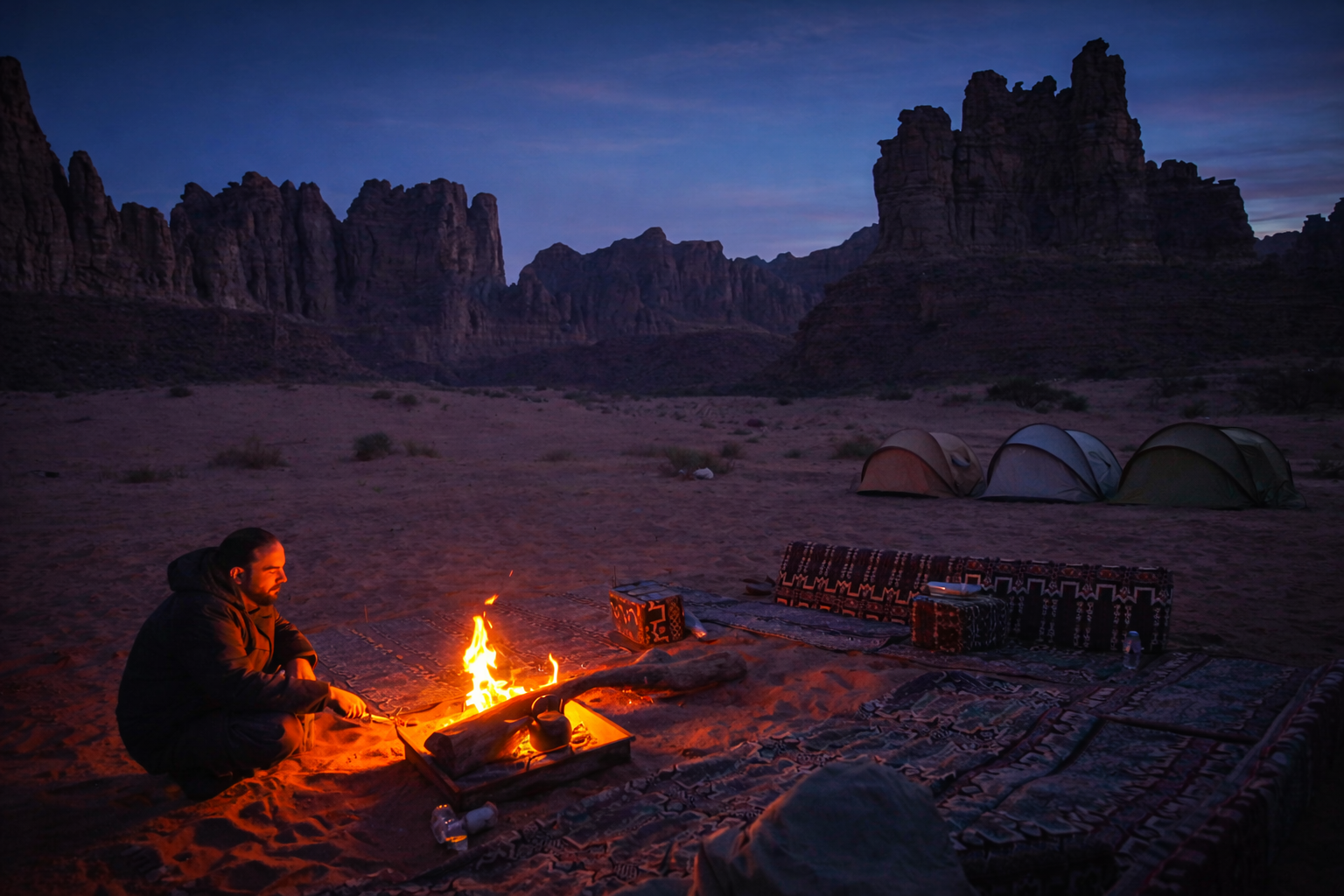
Campfire
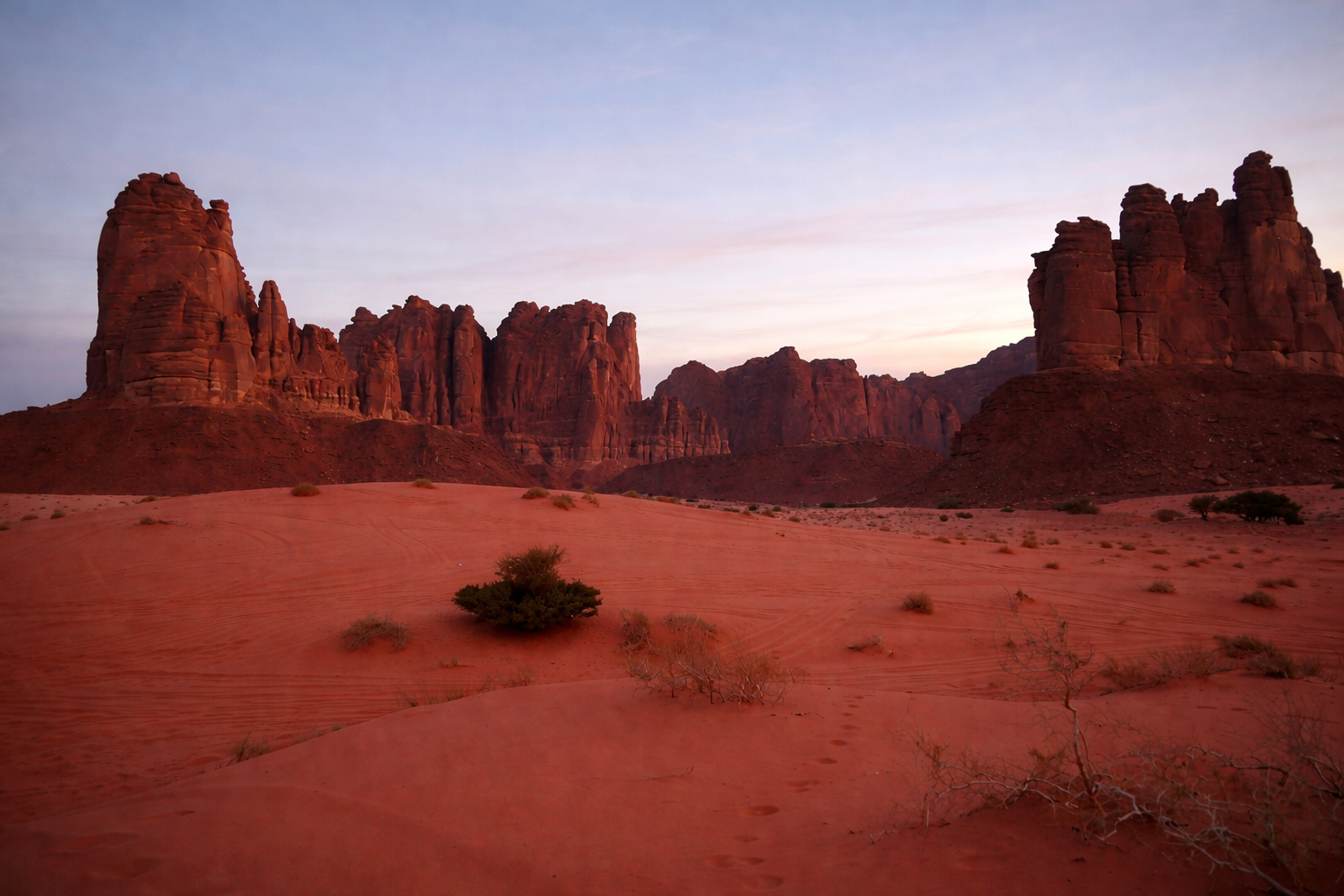
Morning in the desert
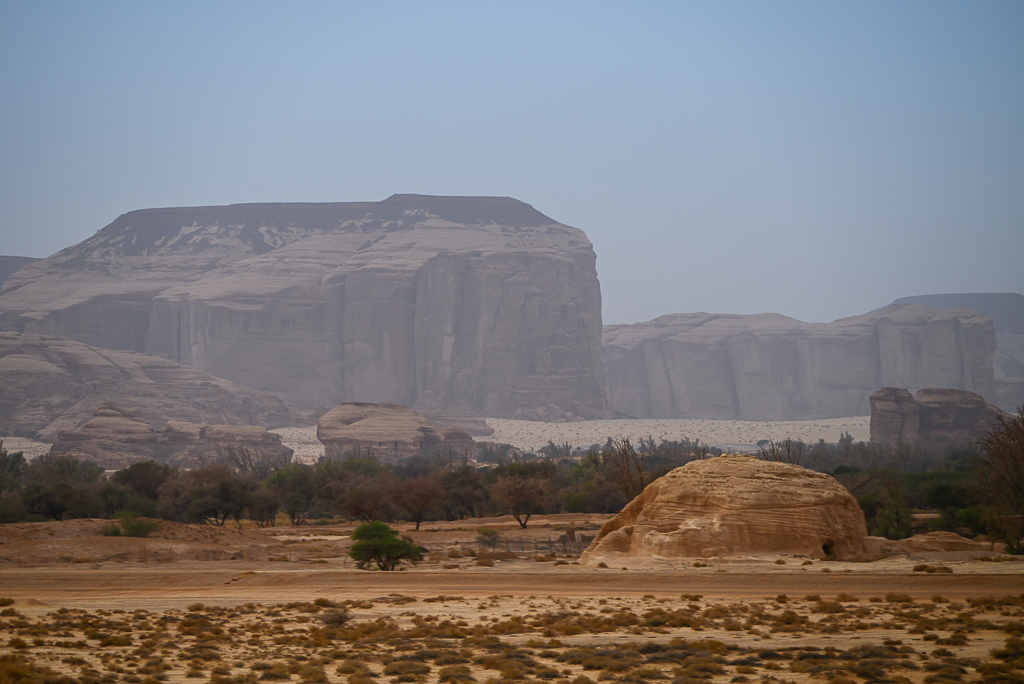
View from Hegra
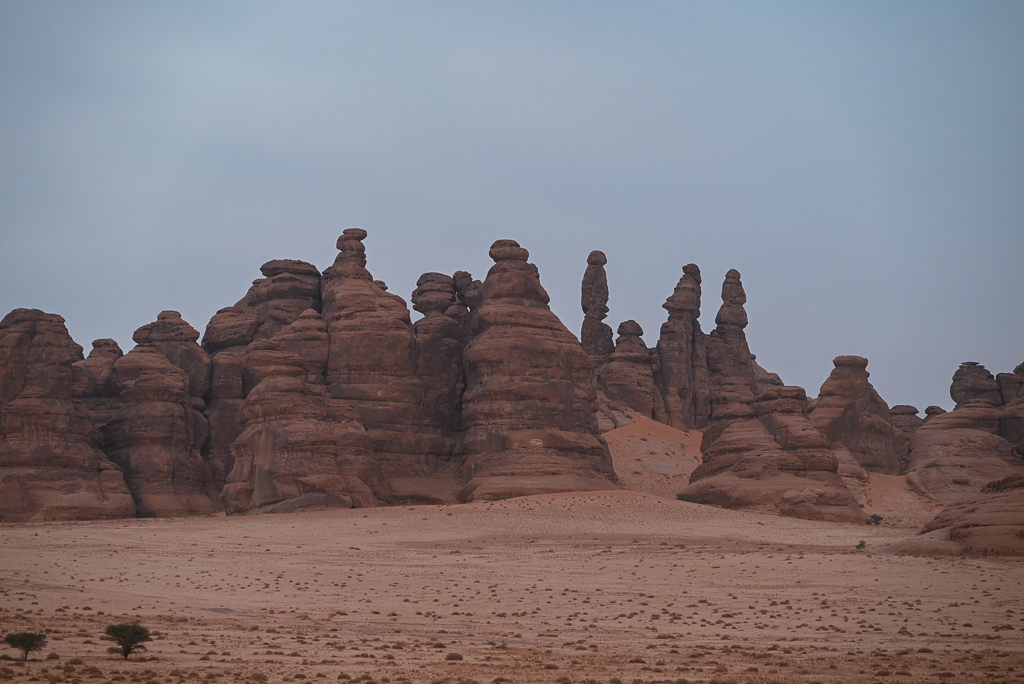
Hegra Rocks
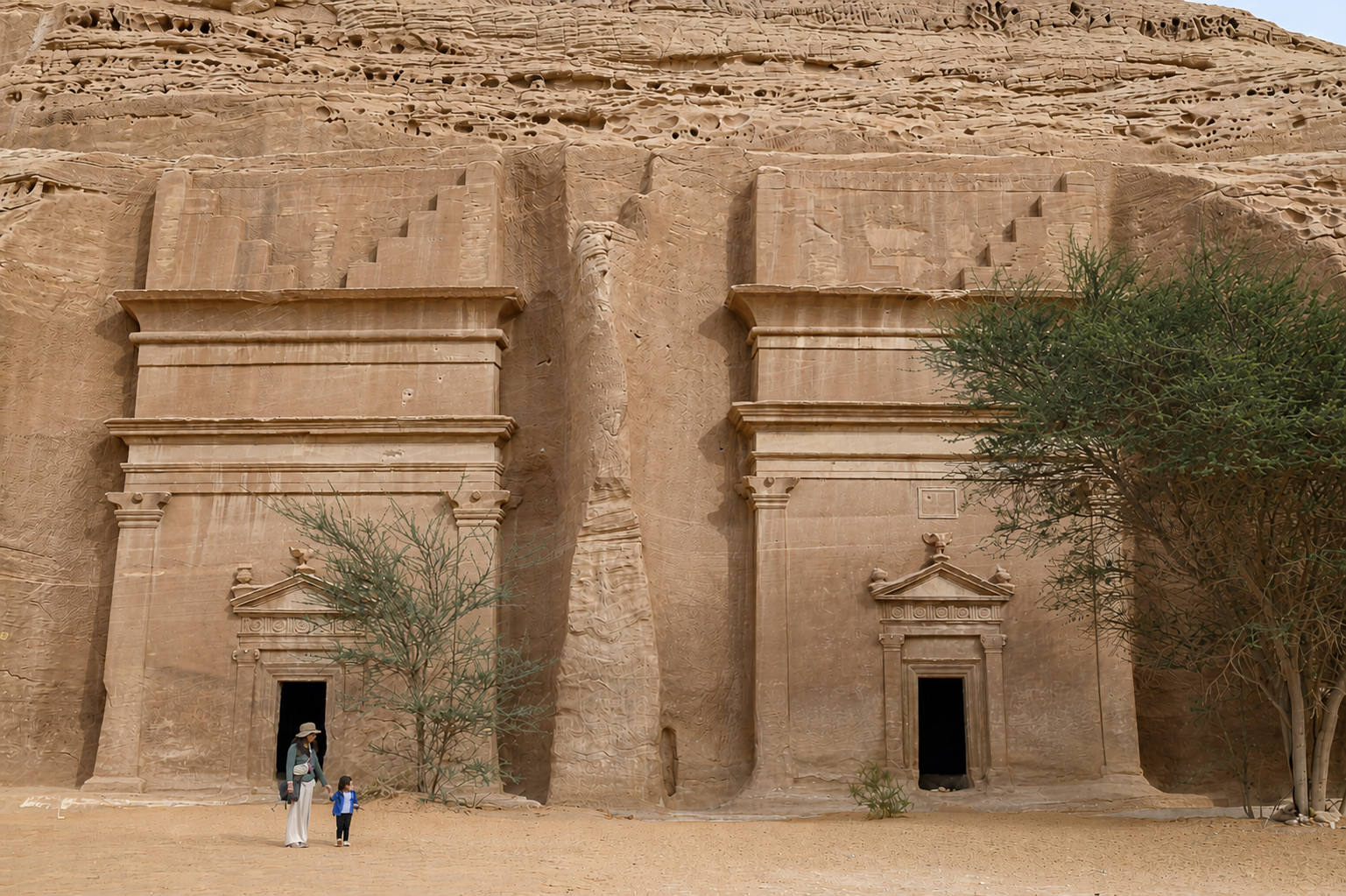
Tombs
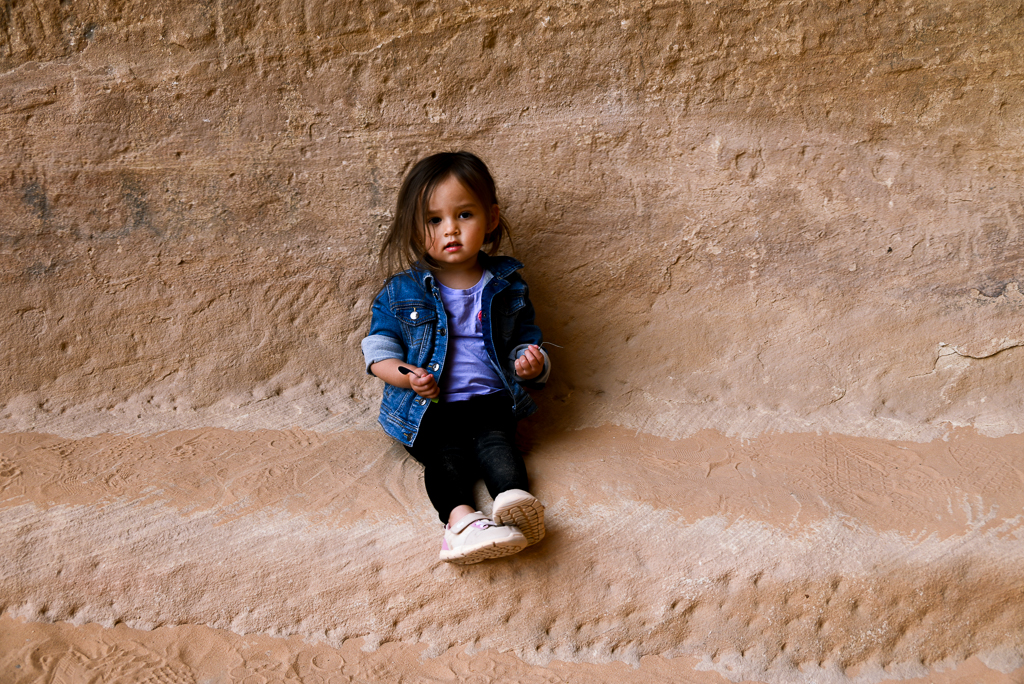
Indie next to a tomb
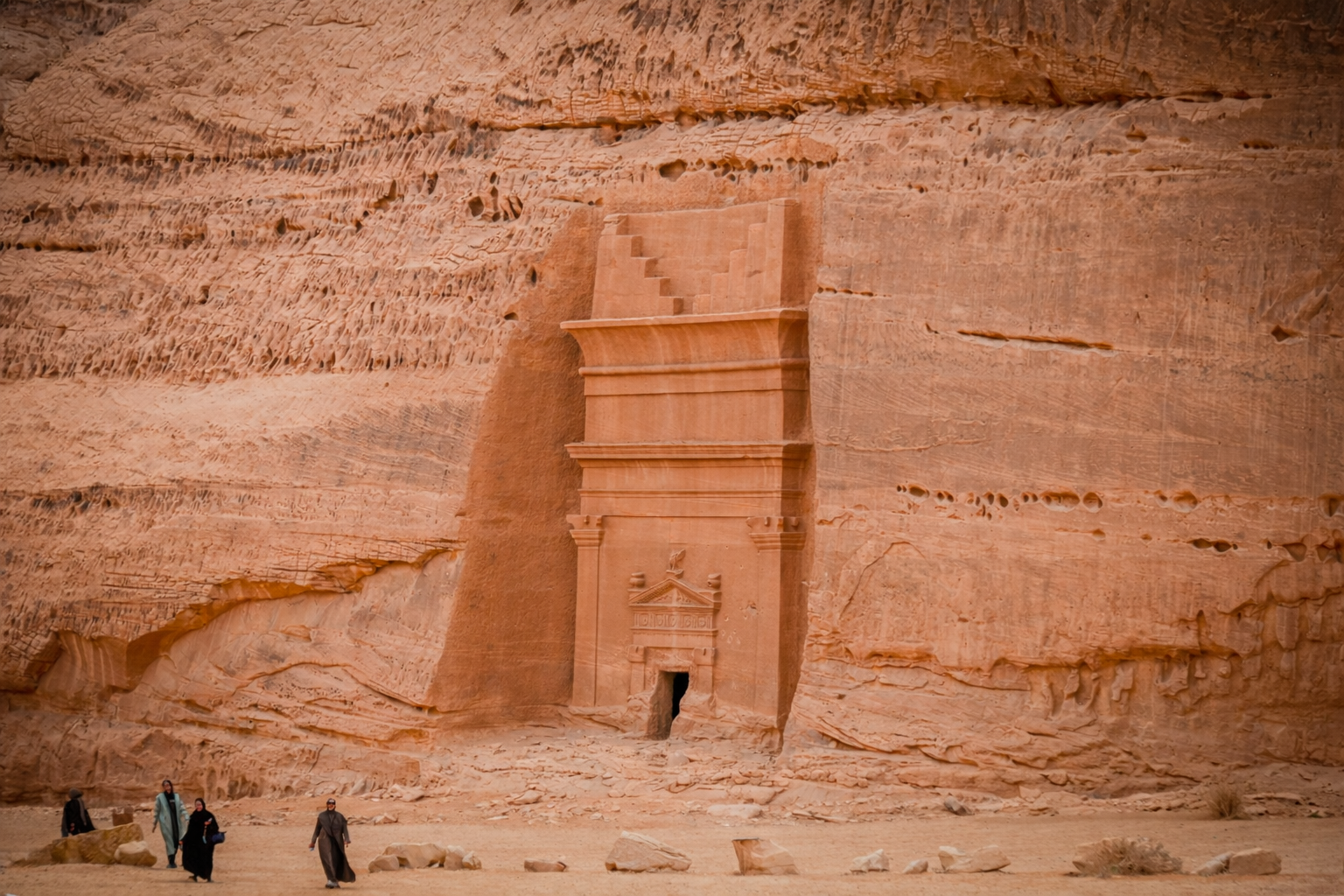
Hegra
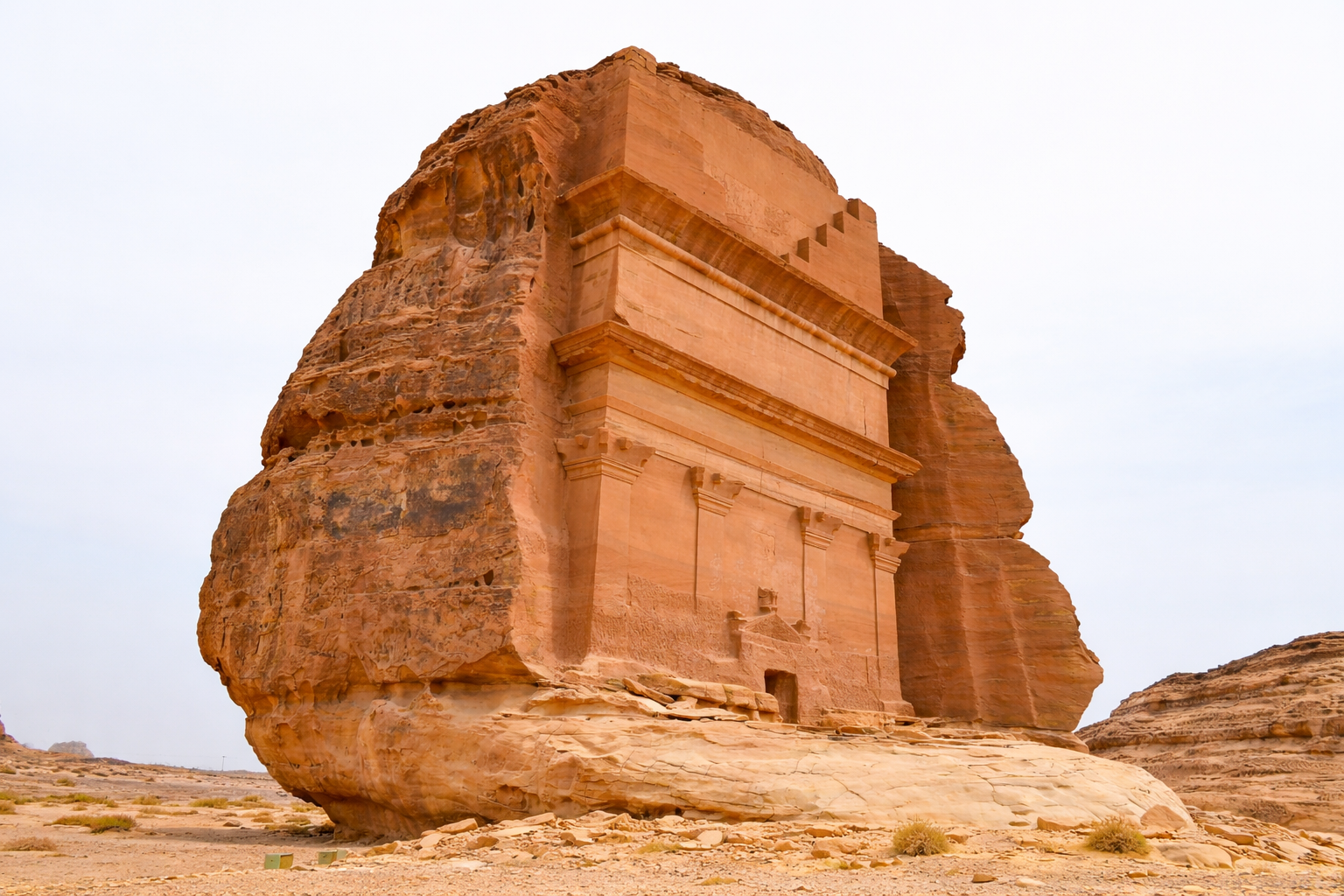
Hegra
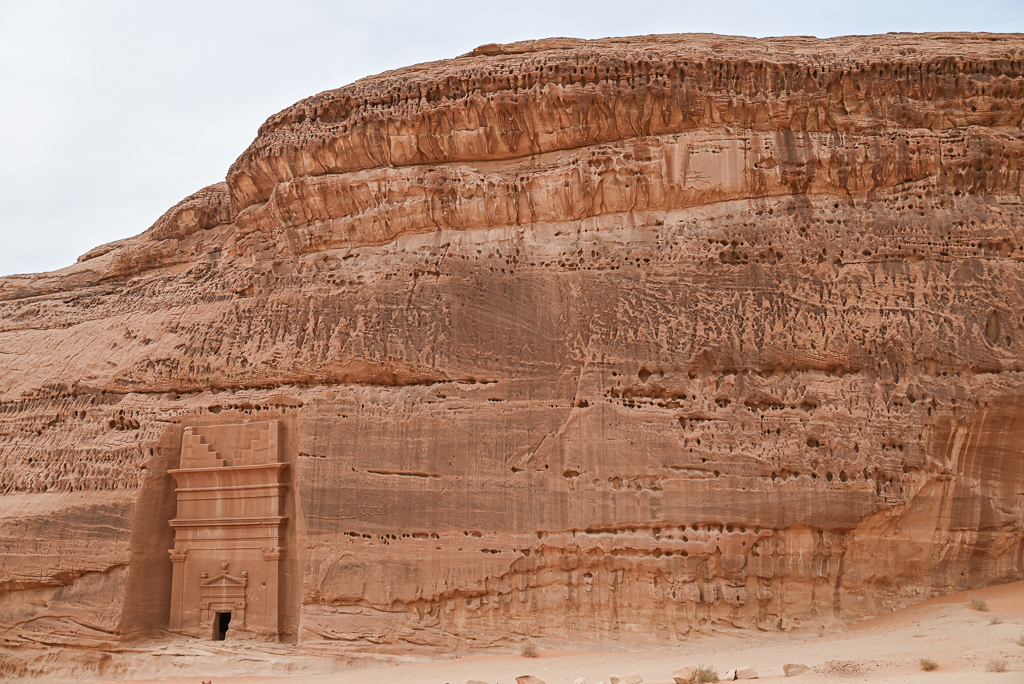
Hegra
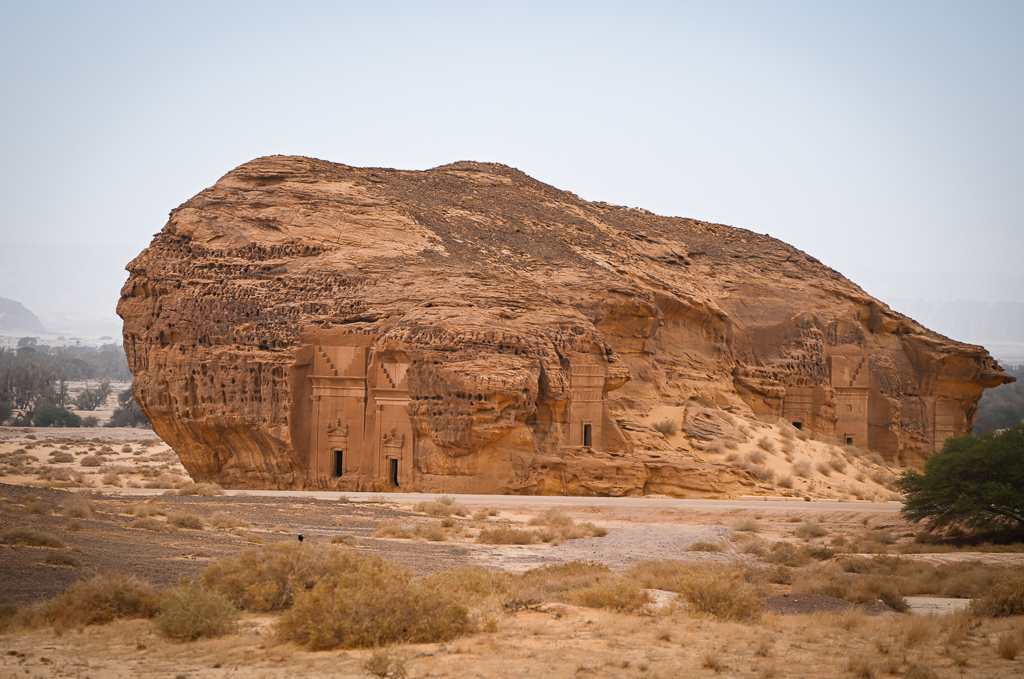
Hegra
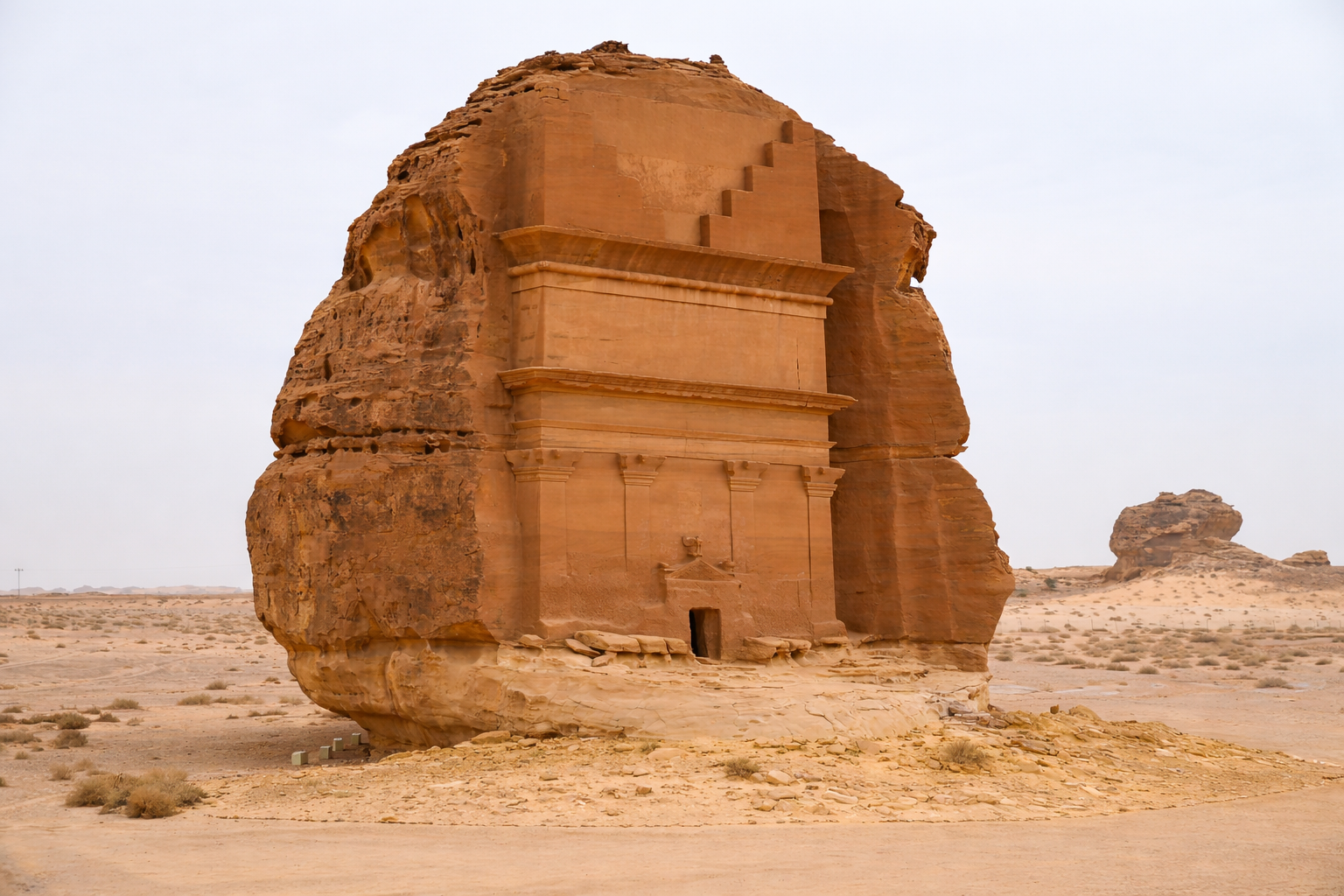
Hegra
A Change of Plans
Paula and I had originally booked a romantic night tour of Hegra, which included a candlelit dinner among the tombs. But by the end of the day, we were exhausted.
Instead, we chose a simpler plan—settling into our apartment and heading out for dinner at a local Saudi restaurant.
That night, I stayed up late dealing with another issue—our flights. I realized that the baggage policy on our budget airline wouldn’t allow enough time to collect and recheck our bags during our connection in Jeddah. It left us with two options: rebook the flight or abandon our checked luggage.
It was a frustrating reminder of why traveling with only carry-on bags is almost always the better choice.
A Morning in AlUla
The next morning, we took some time to walk around AlUla’s Old Town and enjoy a relaxed breakfast.
The area felt a bit like a curated version of itself—slightly “Disneyfied”—but still pleasant. Despite the polish, it was an enjoyable place to spend a quiet morning before continuing on.
The Final Leg of the Journey
From AlUla, we flew north through Jeddah and onward to Istanbul, beginning the final chapter of our long family adventure.
The trip had started more than two weeks earlier in Prague. Since then, we had crossed deserts, climbed mountains, explored ancient tombs, and experienced cultures and landscapes that felt worlds apart from one another.
It had been intense, unpredictable, and unforgettable.
One Last Stop: Cappadocia
Our last destination before heading home would be Cappadocia, a region famous for its surreal landscapes of stone pillars, cave dwellings, and ancient underground cities carved into the soft volcanic rock.
After Cappadocia, our long journey would finally come to an end as we returned home to San Diego — carrying with us memories from a trip that had taken us across Europe, North Africa, and the Middle East.