

Road Trip Across the Mountain Kingdom
Lesotho • November 2021 • A 3-Day Journey
November 2021: After nearly three days of travel and only scraps of sleep stolen on airplanes, we finally arrived at Maseru Airport in Lesotho on a South African Airlink flight from Johannesburg. Paula, Maricienne, and I were exhausted—and the journey was still far from over.
From the airport, I needed to pick up a rental car and drive several hours into the mountains to our hotel, Semonkong Lodge. To make matters worse, towering thunderheads hung in the distance, signaling that storms were likely imminent.
First Contact
A Country That Immediately Felt Different
I knew almost right away that I liked Lesotho.
There were no foreigners on our plane, and Maseru Airport felt small, worn, and quietly functional. In the bathroom, a hand-written sign taped above the only toilet read, “do not flush.” There was no running water. The airport ATM was not working.
Yet none of this felt frustrating or chaotic—just refreshingly honest.
At immigration, the officer asked me several questions about where I was from. Not because he was suspicious, but because he was genuinely curious. Most travelers who visit Lesotho don’t arrive by plane; they enter through the mountainous land borders on day trips from South Africa.
Flying in felt like slipping into the country unnoticed.
Renting a Car in Maseru
Rules, or a Casual Suggestion
I picked up our rental car at a small Euro-Car booth inside the airport. When I asked about full-coverage insurance, the attendant casually told me there was none and that I wouldn’t need it.
I pressed the issue.
Eventually, he relented and said he would add coverage later. When I asked for a copy of the contract, he waved off the request, assuring me it would be handled.
I couldn’t quite tell whether Lesotho’s relaxed, unhurried approach was going to be a blessing or a liability. So far, it felt more like the former.
Hitting the Road
Left-Hand Driving, No Sleep, and a Brewing Storm
We climbed into the vehicle, and I had to immediately recalibrate—driving a stick shift on the left side of the road after days without sleep, with a thunderstorm building ahead.
Before leaving Maseru, we still needed to find a working ATM and every ATM we stopped at was out of order. Outside the capital, there would be none, and cash would be essential for the days ahead.
Lesotho Background

Map of Lesotho
Lesotho at a Glance
The Mountain Kingdom
Lesotho is a small, mountainous nation completely surrounded by South Africa. Known as the Mountain Kingdom, it lies almost entirely within the Drakensberg Mountains, with most of the country above 5,000 feet and peaks rising to over 11,500 feet. It has the highest base elevation of any country in the world—there is no true lowland in Lesotho.
The population is largely made up of a single ethnic group, the Basotho, whose culture is closely tied to life at high altitude. Lesotho’s main exports reflect its geography: water, captured in vast highland dam systems and sold to South Africa, and wool and mohair from sheep and angora goats grazing the mountain slopes.
Lesotho’s survival as an independent country stems from a colonial-era protection agreement with the British, which helped shield it from absorption by neighboring South African powers, including the dominant Zulu kingdoms. Isolated, elevated, and landlocked, Lesotho endures as a nation shaped by its mountains.
Driving Through the Mountains
Into the Highlands
Leaving Maseru Behind
We finally found a working ATM and set off for the long drive into the mountains as lightning as big as anything I had ever seen split the sky and rain pissed down. Once outside the city limits, Maseru quickly faded away, replaced by open countryside and long, quiet stretches of road with few other vehicles in sight.
The Road Into the Mountains
For the most part, the road was paved and in surprisingly good condition—broken only by sneaky potholes and sudden, oversized speed bumps that could easily destroy a car if you weren’t paying attention. This route is one of the only paved roads outside the capital that cuts deep into the mountains, and it was only completed a few decades ago.
Access and Isolation
The arrival of this road brought electricity and basic access to many villages scattered across the countryside. Still, not all were reached. In the highlands, entire communities remain beyond the power grid, tucked away among the mountains and seemingly untouched by modern infrastructure.

Sheep crossing the road were a common road hazard
The Long Climb to Semonkong
Slow Roads and Steep Passes
The drive wound through beautiful rolling mountains, but the small four-cylinder rental car struggled badly on the steep passes. Much of the time I was stuck in first gear, crawling uphill at a painfully slow pace alongside other drivers dealing with the same limitations. It confirmed something I’d already suspected: the two slowest places I’ve ever driven are Western Samoa and Lesotho.
Hazards on Every Curve
I found myself constantly passing even slower vehicles, though speed was never really an option. The road was scattered with falling boulders, and around nearly every bend were herds of sheep. On one sharp turn I had to brake hard to avoid a collision with both a sheep and its shepherd—a reminder that in Lesotho, the road belongs to everyone.
Finding Semonkong
After roughly three hours, we reached the rustic mountain village of Semonkong. From there, we navigated muddy, potholed roads, stopping repeatedly to ask locals for directions. Eventually we found our inn tucked away at the bottom of an extremely steep, muddy hill.
A Warm Night at Last
Firelight, Food, and Plans for Tomorrow
Rain hammered down throughout the night. Inside, we lit wood fires in our rooms and shared a large meal with wine in the candlelit dining room. For the first time in days, we could finally relax.
Before turning in, I made tentative plans with the inn to attempt a 600-foot abseil down the waterfall the following day—weather permitting.

We arrived at our inn late in the evening, stepping out into the freezing mountain air. Inside our room, a wood fire crackled in the fireplace, its warmth slowly pushing back the cold and making the long, stormy drive feel suddenly worth it.
Morning in Semonkong
Sun, Clouds, and Changing Plans
The morning began clear and hopeful, the sun breaking through as if we might get lucky. But almost as quickly as it appeared, dark rain clouds rolled in to replace it. Our guide confirmed what the sky was already suggesting—abseiling wasn’t going to happen that day. I was disappointed but also relieved.
To the Falls Instead
A Drive with the Lodge Owner
We settled in for breakfast and made alternative plans to visit the falls with the lodge owner, a white man whose family had lived in Lesotho for generations and who owned Semonkong Lodge. He was deeply devoted to both the local culture and the surrounding wilderness and shared his knowledge freely as we set off in his four-wheel-drive truck.
As we drove through the mountains, we passed scattered villages clinging to the highlands along the way to the waterfall. Many of these settlements sit so high and so remote that no roads reach them at all. Horses and donkeys remain the only way in or out.
Life Beyond the Roads
Villages Lost in the Highlands
Seeing these isolated communities made me wish we had more time—to hike out to the furthest villages, to stay in them, and to experience life deeper in Lesotho’s mountains, beyond the end of the road.

Sunny morning at the Semonkong Lodge after a long night of rain

The traditional house in Lesotho is designed with rocks sealed with cow dung in between them to create more insulation to trap heat in the cool weather.

Traditional village in Lesotho

Typical scene: A man riding a horse in Lesotho overseeing his flock of sheep
Maletsunyane Falls
At the Canyon’s Edge
First View of Maletsunyane Falls
We parked the vehicle and hiked about a mile to the edge of the canyon, where one of the most beautiful landscapes I’ve ever seen suddenly opened up before us. Although the rain held off, the sky stayed heavy and overcast—perfect conditions for photography. With no harsh shadows, Maletsunyane Falls appeared clean, dramatic, and unobstructed.
Above the Abyss
Wind, Water, and Vultures
We stood nearly a thousand feet above the canyon floor, peering straight down at the falls as endangered bearded vultures and Cape vultures glided overhead, riding the wind with effortless grace. The scale of the place was overwhelming—raw, vertical, and silent except for the distant roar of falling water.
An Unsettling Backdrop
Development on the Horizon
Behind us, however, the mood shifted. A large modern building was under construction in what would otherwise have been an untouched wilderness. Plans were already in motion for a tourist center and a new road designed to bring mass tourism to the falls. It was hard not to feel uneasy, knowing how dramatically this development would alter such a pristine and fragile place.

Paula and her mom at Maletsunyane Falls

Canyon Around Maletsunyane Falls

Bearded Vulture at Maletsunyane Falls

Maletsunyane Falls
Community Sheep Shearing Center

Sheep holding pen with a big ram in the middle
Wool of the Highlands
A Village Economy in Motion
A highlight was visiting the community sheep station. Lesotho’s wool is highly prized on the international market and remains one of the country’s most important exports. In the highland villages, the sheep belong to individual families, forming the backbone of local livelihoods.
In this village, workers were hired by the sheep owners to shear the animals and gather the wool, which would later be processed for export. We stopped to watch the operation unfold, and it was fascinating to see the efficiency of the process—and how unexpectedly calm and submissive the sheep were as they were shorn.
.
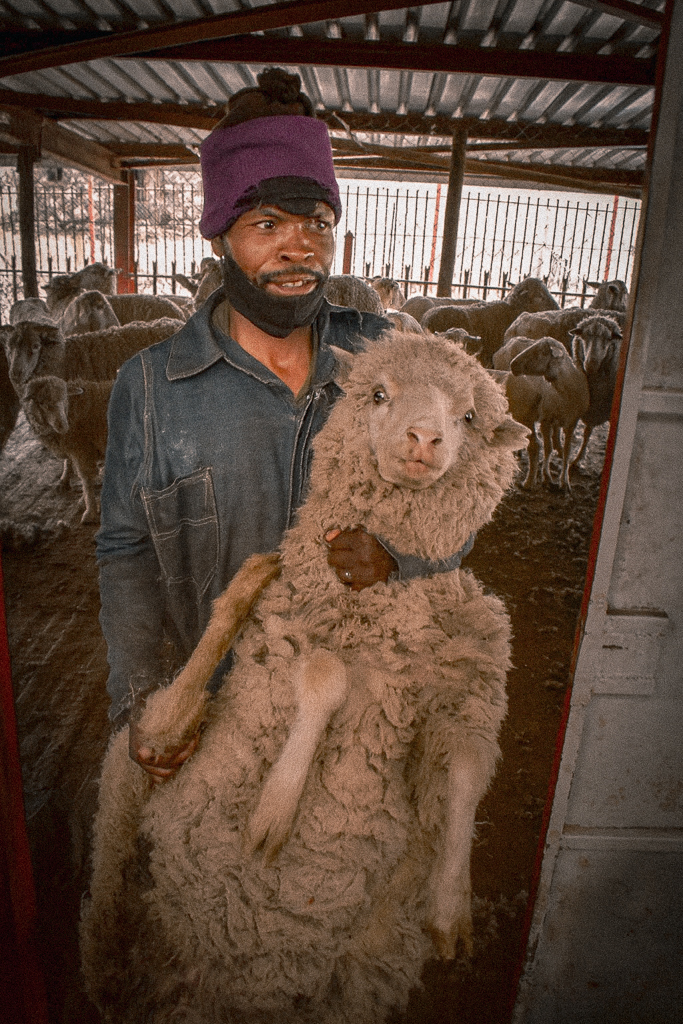
Worker transferring the sheep and carrying it like a giant teddy bear from the holding pen to the shearing area

Sheep submitting to the shearers
The Shearing Process
Speed, Skill, and Stones
The shearers selected the sheep one by one, lifting and carrying them like oversized teddy bears. In just a few minutes, each animal was shorn down to the skin, sometimes leaving small bleeding nicks—evidence of how fast and precise the work had to be.
Once a sheep was finished, a manager dropped a stone into the shearer’s bucket. The stones became a simple accounting system. At the end of the day, each shearer’s pay was determined by the number of rocks they had collected.

Each sheep shearer received one stone when a sheep is finished and at the end of the day they are paid by the amount of stones in their bucket

Wool sorting area
Donkey Pub Crawl
Back to Semonkong
An 8,000-Foot Trading Post
We returned to Semonkong village, a small settlement of ramshackle aluminum sheds perched at nearly 8,000 feet. Villagers travel in from remote mountain communities to trade and sell goods at the market, and children from outlying areas come here to attend school. Despite its rough appearance, Semonkong functions as a vital hub for life in the surrounding highlands.
Donkeys of the Mountains
Transport, Livelihood, and Tourism
We arranged to hire donkeys to ride around town and visit a few local pubs. In the mountains of Lesotho, donkeys—prized for their strength and endurance—are essential for hauling goods across terrain unreachable by vehicles.
At Semonkong, the lodge had created a system in which villagers were paid on a rotating basis to rent their donkeys to guests. It provided income for local families while giving visitors a taste of traditional mountain transport.
A Ride Gone Wrong
At the Mercy of the Donkey
The donkeys, however, were not particularly friendly. With no reins to control them, we were entirely dependent on a handler who followed behind us on foot, trying to keep the animals in line.
Everything was going smoothly—until my donkey suddenly bolted. It charged downhill at full speed, braying wildly and seemingly intent on killing me. In that moment, it became very clear who was actually in control.

Paula on her donkey

Rustic town of Semonkong

I couldn’t help but to feel a little oversized for the poor donkey but the donkey had his revenge on me.

Man in traditional Lesotho outfit

Village Boy
Drive Back to Maseru
The Road Back to Maseru
Clear Skies and Lingering Miles
On the drive back to Maseru, we slowed down and took our time, finally able to savor the mountain scenery. The rain had eased, allowing us to stop more frequently and take photos as the road unfolded through the highlands.
A Broken Gauge
Fuel, Uncertainty, and Calculations
After hours of driving, I noticed something unsettling: the fuel gauge was still reading full. It quickly became clear that it wasn’t accurate. Gas stations are few and far between in the mountains, and fuel is often sold in containers at roadside villages rather than from proper pumps.
I figured we’d be fine if we ran low, but I also calculated that, as long as we avoided major detours, we should be able to make it back to Maseru.
Departure Point
Beating the Storm
We rolled into Maseru just ahead of a massive rainstorm and checked into a locally run guesthouse for the night. Early the next morning, we were up and on our way to the airport for our 8 a.m. flight to Johannesburg, continuing onward to explore the Kalahari Desert in Botswana.

Shepherd Boy with his flock of sheep. Shepherd life is an essential aspect of the Basotho culture and as a rite of passage into manhood, adolescent youths are tasked with going solo into the mountains with a flock of sheep for weeks.

Mountain Passes Back to Maseru

Kids we met on the side of the road asked us for candy. I gave them printed photos of themselves instead.