
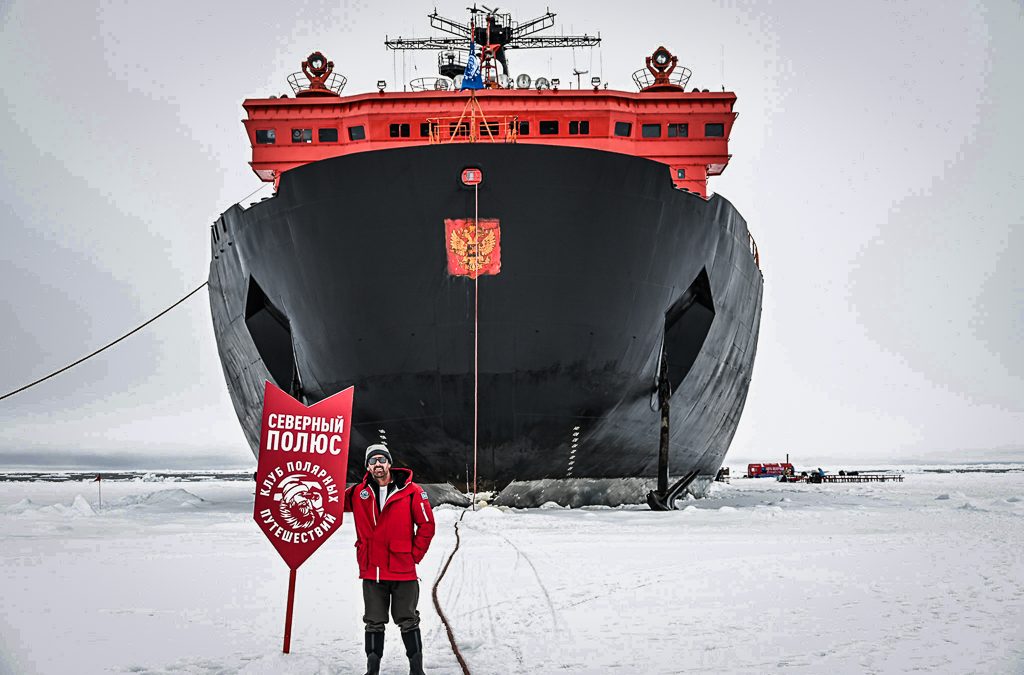
Journey to the Top of the World
The Last Great Unknown
During my travels, I have been fortunate to visit places that have long ignited both the human imagination and my own—Timbuktu, Antarctica, the Himalayas, the Amazon, Lac Télé in the Congo and countless others.
Then, during my 49th year of life, an opportunity arose to visit the North Pole—a place belonging to an entirely different category of travel.
The poles are among the most remote, desolate and hostile places on Earth. These frozen worlds lie so far beyond civilization that humans reached them only relatively recently.
During the heroic age of exploration in the 1800s and early 1900s, explorers ventured into the last unknown corners of the planet. Jungles were crossed, mountains climbed, deserts traversed and oceans charted. Yet the poles—the very top and bottom of the Earth—remained mysterious and almost unreachable.
This was an era before satellites, GPS and reliable radio communication. No one knew exactly what awaited explorers at the ends of the Earth.
The Race for the South Pole
The South Pole was the first of the two poles to be verifiably reached. Both presented enormous challenges, but in one important respect, the South Pole was more straightforward: it was located on land.
That land, however, was buried beneath nearly two miles of ice and stood more than 9,000 feet above sea level. Because the atmosphere is thinner near the poles, the physical effects could feel like being at an elevation exceeding 11,000 feet. Temperatures routinely plunged below -30 degrees Fahrenheit.
As with many great expeditions, reaching the pole became a competition among explorers and nations seeking glory and a place in history. Many who entered the polar regions met grisly fates, dying from exposure, starvation, disease or accidents. Despite the dangers, there was never a shortage of people willing to gamble their lives.
Norwegian explorer Roald Amundsen and his team became the first people confirmed to have reached the South Pole, arriving on December 14, 1911.
The Mystery of the North Pole
The North Pole presented an entirely different challenge.
Unlike the South Pole, it does not sit on solid land. It lies in the middle of the Arctic Ocean beneath constantly drifting sea ice. Wooden ships attempting to penetrate the Arctic were regularly trapped or crushed. Explorers sometimes spent months—or even years—enduring darkness, starvation and unimaginable cold.
Even identifying the pole was difficult because the ice beneath an expedition was always moving. The shifting ice created pressure ridges capable of crushing ships and opened enormous stretches of water that blocked attempts to reach the pole on foot.
American explorer Robert Peary claimed to have reached the North Pole in 1909. His achievement was accepted for many years, but inconsistencies in his navigation records and questions about his reported speed have left many historians doubtful that his team reached exactly 90 degrees north.
In 1926, Roald Amundsen—who had already led the first expedition to the South Pole—joined Italian explorer Umberto Nobile and their crew aboard the airship Norge. They flew over the North Pole in what is widely regarded as the first verified journey to reach it.
The first confirmed surface expedition arrived in 1968, when American Ralph Plaisted and his team reached the pole by snowmobile.
Yet even those explorers had reached only the drifting ice or the air above it. The closest thing to permanent ground at the North Pole lay nearly 14,000 feet beneath the surface of the Arctic Ocean.
Explorers did not reach that ocean floor until August 2, 2007, when the Russian Mir-1 and Mir-2 submersibles descended beneath the geographic North Pole. Mir-1 reached the seabed at a depth of approximately 13,980 feet and planted a titanium Russian flag.
It was the first manned descent to the ocean floor beneath the North Pole—and, in one sense, the first time anyone had reached the only fixed surface at the top of the world.
My Chance to Reach the North Pole
For generations, the North Pole has captured the imagination of explorers.
As a child, I heard stories about the people who tried to reach it—many suffering terribly or perishing from starvation, exposure and shipwreck. Some ships became trapped and were crushed by the ice. Starvation occasionally drove stranded crews to cannibalism, while man-eating polar bears standing nearly 10 feet tall represented another constant danger.
Polar bears are among the few animals still roaming the Earth that can resemble the monsters of ancient legend—enormous, powerful and capable of hunting a human across a seemingly empty frozen landscape.
Now I had an opportunity to make the same journey aboard a Russian nuclear-powered icebreaker.
The ship eliminated many of the historic dangers. We were unlikely to become permanently trapped in the ice, have our hull crushed, starve for months or be eaten by polar bears. Instead of requiring months or years, our round-trip expedition from Murmansk would last only 12 days.
Visiting the North Pole had always seemed about as realistic to me as traveling to the Moon. The extreme cost and complicated logistics made it feel nearly impossible. When an unexpected opportunity appeared, I knew I could not turn it down.
Reaching the North Pole would be only one part of what made this journey so memorable.
Choosing a Route to the North Pole
Aside from organizing your own expedition with the spare millions of dollars you most likely do not have—and accepting many of the dangers that claimed earlier explorers—there are two established routes for travelers seeking to reach the North Pole in relative safety and comfort.
Neither option is cheap, but both are considerably less expensive and dangerous than mounting an independent polar expedition.
Two Routes to the Top of the World
The first route begins in Svalbard, the remote Norwegian archipelago deep inside the Arctic Circle. From there, travelers sail north aboard the French expedition ship Le Commandant Charcot.
Unlike the Russian vessel, it is not nuclear-powered. It uses a hybrid propulsion system combining liquefied natural gas with electric power. It is also considered the more luxurious and comfortable of the two options, offering an experience closer to a high-end expedition cruise.
The second route begins in Murmansk on Russia’s Arctic Kola Peninsula. From there, travelers board 50 Years of Victory, one of the largest and most powerful nuclear icebreakers ever constructed.
The journey crosses the Arctic Ocean to the North Pole and includes a visit to Franz Josef Land, the world’s northernmost archipelago.
For me, the choice was simple. My friends traveling with me agreed: we would take the Russian route.
Why I Chose Russia
I had already visited Svalbard, and after traveling to every country in the world, Russia remained one of my favorites.
This route would allow me to experience more of the country, beginning in Saint Petersburg—Russia’s grand answer to the great cities of Europe—and continuing to Murmansk, the world’s largest city north of the Arctic Circle.
More than anything, however, I wanted to visit Franz Josef Land.
For years, I had studied this isolated archipelago near the top of the world on maps, never imagining that I would actually set foot there. Its glacier-covered islands, abandoned polar stations and position near the edge of the permanent Arctic ice made it feel like one of the most mysterious places remaining on Earth.
Aboard a Working Nuclear Icebreaker
I also wanted to make the journey aboard a Russian nuclear icebreaker.
Ever since I was a kid visiting Duluth, Minnesota, and watching enormous iron ore boats enter and leave the harbor, I had dreamed of traveling aboard a massive working ship like one of them.
This was my opportunity—and 50 Years of Victory was not just any ship.
Russia pioneered nuclear-powered icebreaking and became famous for constructing enormous vessels capable of crushing through Arctic ice that would stop almost any conventional ship.
What made 50 Years of Victory especially appealing was that it had not been designed simply as a cruise ship for tourists like Le Commandant Charcot. It was a working nuclear icebreaker operated by a professional Arctic crew.
The ship and its crew were built to break paths through ice-covered seas. For almost nine months of the year, it escorted cargo and merchant vessels through frozen Arctic waters that would otherwise be nearly impossible to navigate.
During a short window in summer, the icebreaker carried expedition passengers to the North Pole, generating additional revenue while introducing travelers to a world normally reserved for polar crews and scientists.
We would not be aboard a conventional cruise ship whose crew spent the year serving tourists. We would be passengers aboard a specialized industrial vessel, briefly entering the extreme environment for which it had been constructed.
The ship was originally laid down in 1989 during the final years of the Soviet Union. It was later renamed 50 Years of Victory to commemorate the 50th anniversary of the Soviet victory over Nazi Germany in World War II.
Even the vessel itself was part of the adventure. Traveling aboard one of the most powerful icebreakers ever constructed—through Franz Josef Land and onward to the North Pole—felt like the only way I wanted to make this journey.
Traveling Through a Country at War
Beyond all these reasons, Russia was engaged in the bloodiest war Europe had experienced since World War II.
I wanted to see firsthand how the war with Ukraine was affecting everyday life inside Russia and, if possible, hear directly from Russians about what they were experiencing.
The United States was providing extensive support to Ukraine, and relations between the American and Russian governments had deteriorated dramatically. Sanctions, travel restrictions and political hostility would complicate nearly every stage of our journey.
That reality added another unpredictable dimension to an expedition already unlike anything I had ever attempted.
The journey to the top of the world was about to begin.
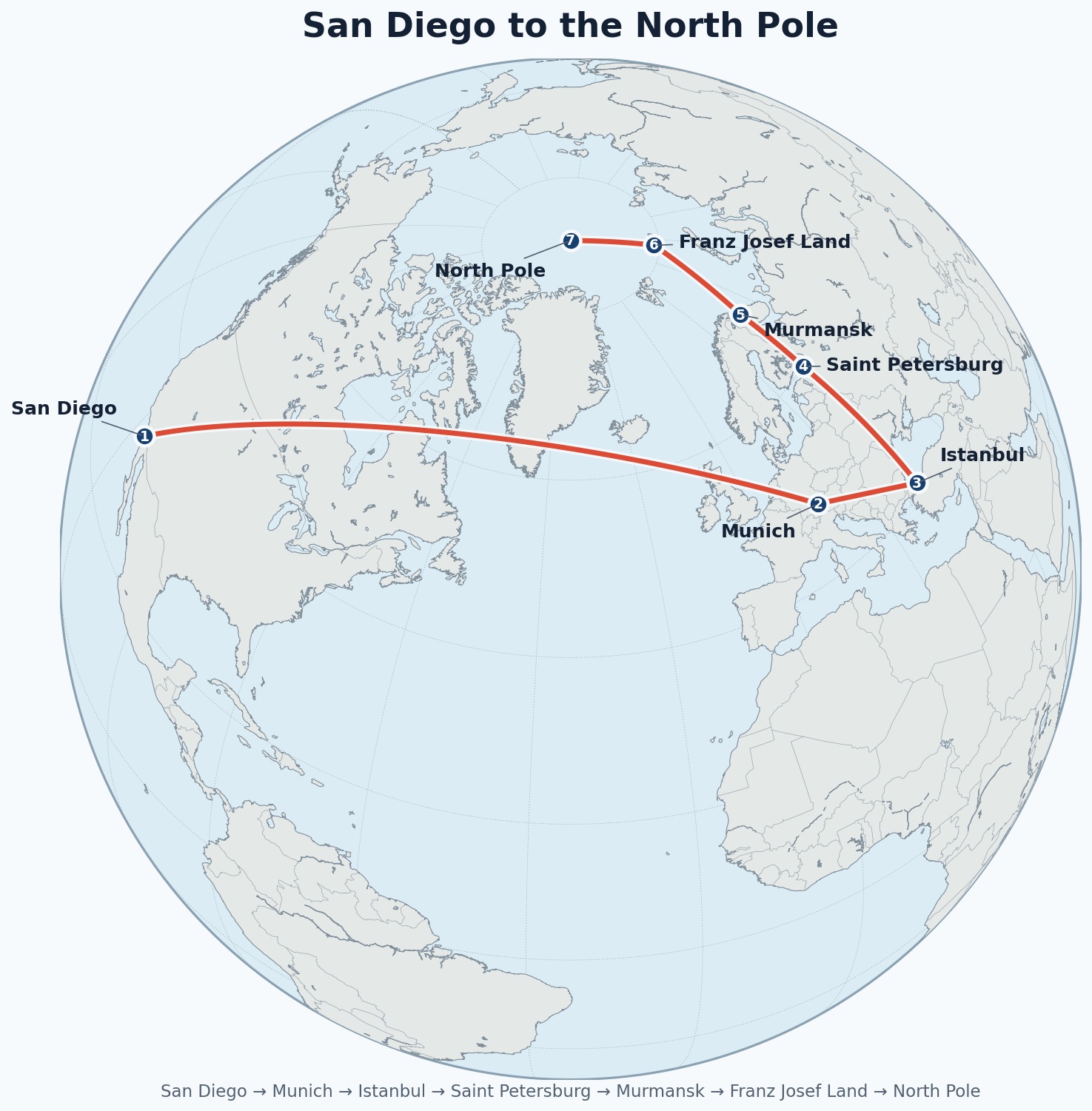
My route from home to the North Pole
Visiting Russia During a Time of War
Traveling to the North Pole through Russia presented challenges that went far beyond ice and weather.
Relations between Russia and the United States were especially strained because of the war in Ukraine and American support for the Ukrainian government. Sanctions imposed by the United States and other countries made it difficult to send money to Russia or access money once there. American credit cards and ATM cards did not work, so nearly every expense had to be planned and paid for in advance or covered with cash.
The sanctions also complicated our travel arrangements. Flights to and from Russia—as well as domestic flights within the country—could not be purchased normally from the United States using American credit cards. Our Russian flights had to be purchased from inside Russia, adding another logistical hurdle to a trip that was already difficult to organize.
Communication presented another challenge. Services I normally relied upon while traveling—including Facebook, WhatsApp and other Western platforms—were blocked or unreliable. My regular American cell phone service worked poorly, when it worked at all.
Traveling Beyond Politics
Visiting a country at odds with my government was nothing new for me. I had traveled to Afghanistan as one of the first American tourists to visit after the Taliban returned to power. I had also visited Iran, Libya under Muammar Qaddafi, North Korea and several other countries with strained or openly hostile relations with the United States.
Those experiences had taught me the importance of careful research, respecting local laws and remaining aware of the political environment around me. They had also reinforced something I had witnessed throughout my travels: most people are capable of separating individual civilians from the actions of their governments.
I hoped Russians would make that same distinction with us. We were not arriving as representatives of the United States government or its policies. We were travelers who wanted to experience their country, meet its people and journey through the Russian Arctic.
The Russian Visa
I knew Americans were still permitted to visit Russia, but obtaining a visa was no longer a simple or predictable process.
Before the war, a Russian visa could sometimes be processed relatively quickly. Now I expected it to take more than a month, with no guarantee that it would be approved. In the end, obtaining my visa through the Russian Consulate in Houston took nearly two months.
Receiving the visa was a major relief, but it did not eliminate my biggest concern: What would happen when I reached Russian immigration?
Preparing for Immigration
The experiences reported by American travelers varied dramatically. Some entered Russia without any difficulty. Others described being detained and questioned for hours, having their phones searched for messages or material related to Ukraine, or having their devices temporarily seized. A few travelers reported being denied entry and deported.
In the back of my mind was also the possibility—however remote—of being detained and used as leverage during a period of intense political hostility, as other Americans had been.
My goal was to follow every rule and ensure that neither my friends nor I gave the authorities any reason to question us. We did not have Ukrainian contacts or sensitive material on our phones, but I still carefully reviewed everything I planned to bring into the country.
I even left my sleeping medication at home. I often carried it to help me sleep on long flights, but zolpidem was regulated in Russia and could require specific medical documentation. It was not worth introducing an unnecessary complication.
Americans Traveling on Dominica Passports
Another unusual element added to the uncertainty. My friends were American citizens, but they would be entering Russia with passports from Dominica—which, strangely enough, allowed them to visit Russia without visas.
We joked that they might be among the first Dominica passport holders ever to visit Russia. They were almost certainly among the first to carry Dominica passports all the way to the North Pole.
None of us knew exactly how Russian immigration officials would react to three Americans arriving together—one carrying a Russian visa and two traveling visa-free on passports from a tiny Caribbean island.
Still, we were hopeful that everything would work out.
The Hardest Part of Leaving
Departing for this trip was not easy. It would be the longest I had been away from my daughter since she was born.
To make my absence easier for her to understand, I began preparing her in advance by explaining that I was going to the North Pole to see Santa Claus.
Her response was always some version of the same two thoughts:
“Daddy, I’m going to miss you. Get me some presents.”
Once aboard the ship, communication with my family would be almost nonexistent. Bringing a personal satellite communicator into Russia involved restrictions and risks I was unwilling to take. There would be no regular phone service or WhatsApp in the middle of the Arctic Ocean.
The ship had a satellite phone in the radio room near the bridge, but calls were extremely expensive and available only during limited hours. Because of the time difference, those hours generally fell in the middle of the night back home in San Diego.
I knew I would struggle with separation anxiety and with being unable to see or speak regularly with my family. Of all the uncertainties surrounding the expedition, being cut off from my wife and daughter concerned me the most.
When it was finally time to leave for the airport, my daughter cried and begged me not to go. Watching her cry made an already difficult departure even harder.
I carried a small money belt she had decorated for me at school. On the front was a painted shark created from the outline of her handprint. It was a simple object, but in the farthest reaches of the Arctic, it would give me something tangible to hold and remind me of her.
The Journey Begins
My journey began with a Lufthansa flight from San Diego to Munich and the flashy AI-created itinerary shown below. I would soon learn just how quickly that carefully planned itinerary could change.
I was supposed to have an almost eight-hour layover in Munich before continuing to Istanbul. Instead, an unexpected diversion consumed nearly all of it. I came dangerously close to missing my connecting flight—and possibly the entire North Pole expedition.
The reason for the diversion was something I had never experienced during more than 1.5 million miles of flying: A passenger died aboard the plane.
A Death on the Airplane Over Canada
By an extraordinary coincidence, I was seated beside a doctor and her husband. Earlier in the flight, we had been discussing medical emergencies aboard airplanes. She told me that she always responded when the crew requested medical assistance and hoped there would not be an emergency on this flight.
Only a few hours later, while we were flying through the night over a remote part of northern Canada, an announcement came over the intercom asking whether any medical professionals were aboard.
The doctor beside me immediately got up to help.
For more than an hour, she and a firefighter—another passenger aboard the flight—desperately tried to save a man in first class. They performed CPR, used the plane’s automated external defibrillator and administered emergency medication.
Nearby, the man’s wife and two 11-year-old daughters could do nothing but watch in horror.
Eventually, the doctor returned to her seat. She quietly told me that, despite everything they had tried, she believed the man had already been dead when she first reached him.
She was clearly shaken. I did my best to comfort her and told her how much I admired her courage in trying to help the man and his family.
Moments later, the captain announced that the passenger had passed away and that we would divert to Chicago—the nearest suitable major airport in the United States—so the man and his family could leave the aircraft.
A Layover Lost—but Put Into Perspective
The diversion consumed almost all of my eight-hour layover in Munich and placed my connection to Istanbul in jeopardy. Missing that flight could have disrupted every carefully arranged stage of my journey to Russia and the North Pole.
Yet neither I nor anyone else had any right to grumble. A family had just experienced an unimaginable tragedy. Whatever inconvenience the diversion caused us was insignificant compared with what they were enduring.
I barely made my connection in Munich and eventually arrived in Istanbul. I checked into the airport hotel, slept for the night and met my friends Richard and Wes the following morning.
The itinerary below is the one I had planned before leaving San Diego, but the realities of travel would make several changes to it.
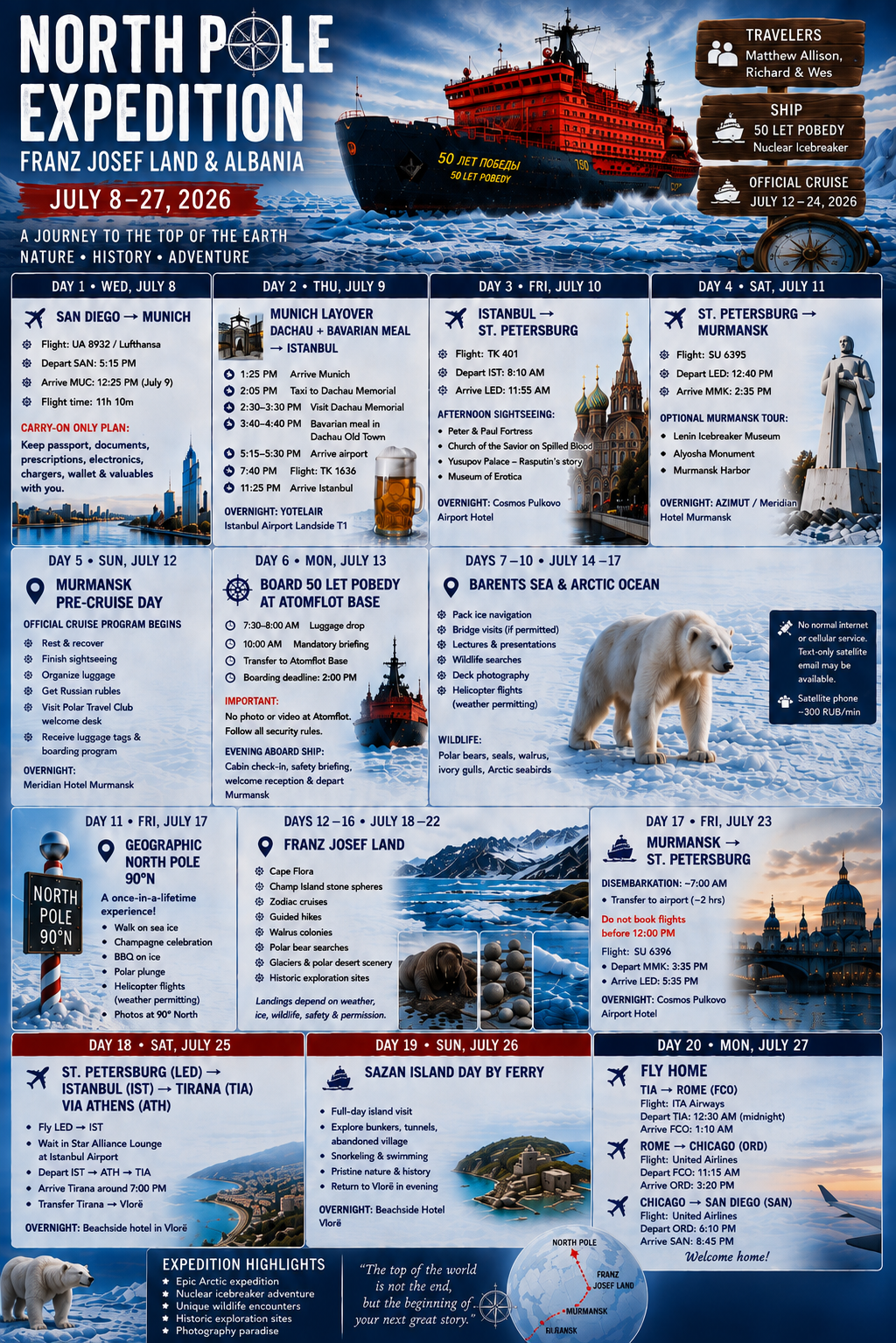
My planned trip itinerary I created with AI
Flying Into Saint Petersburg, Russia
My friends and I departed Istanbul early the following morning on a Turkish Airlines flight to Saint Petersburg.
Since the invasion of Ukraine, most European airlines had stopped serving Russia, and many Western carriers no longer flew through Russian airspace. Turkey remained one of the few practical gateways into Russia from Europe, along with Serbia.
Our flight also had to avoid Ukrainian airspace because of the dangers posed by the war, making the journey longer than it would have been before the invasion. Ukraine is a vast country located directly between Turkey and western Russia, so flying around it required a considerable detour.
There was also the possibility of a delay or cancellation caused by Ukrainian drone attacks. During the weeks before our trip, Ukraine had launched long-range drones against Russian infrastructure near Saint Petersburg, more than a thousand miles from Ukrainian-controlled territory.
When authorities detected a possible attack, Russia sometimes temporarily closed the airspace around the city.
The paranoid worrier in me imagined our plane approaching Saint Petersburg just as a drone appeared in its path, ending our journey in a midair explosion.
Thankfully, the flight was completely uneventful. We landed without delays, encountered no drones and proceeded directly to immigration.
No Issues Entering Russia
After all my worrying about interrogations, phone searches and the possibility of being denied entry, Russian immigration could not have been easier.
The officers asked us no unusual questions, and we entered the country without any problems. All the anxiety I had carried with me vanished within minutes.
We headed directly to the hotel that had been booked for us near the airport.
At Saint Petersburg’s northern latitude, the summer sun would remain in the sky until late in the evening. Rather than waste those hours inside an airport hotel, Wes and I set out to make the most of our limited time in the city’s historic center.
Peter the Great’s Window to Europe
Saint Petersburg was founded by Peter the Great in 1703 during Russia’s war against the Swedish Empire. Peter sought to modernize Russia, build a powerful navy and establish a major port on the Baltic Sea that would connect his country more directly with Europe.
After defeating Sweden and gaining control of territory along the Baltic coast, Peter ordered a new city to be constructed on marshland beside the Neva River. Thousands of laborers endured brutal, disease-ridden conditions to build his new capital from the mud.
The city became known as Russia’s “window to Europe.” Its grand palaces, canals and European-style architecture were intended to represent Peter’s vision of a modern Russia looking westward.
Saint Petersburg eventually replaced Moscow as the capital of the Russian Empire. It became the center of the Romanov monarchy, where Catherine the Great and generations of later emperors ruled from extravagant palaces.
That era ended with the Russian Revolution and the fall of the Romanov dynasty. In 1918, the Bolshevik government moved the capital back to Moscow.
More than three centuries after its founding, the city still bears Peter’s name and remains Russia’s most European-looking city.
Exploring Saint Petersburg
We used a Russian ride-share app to get around and had no problems exploring the city. Once we reached the historic center, we continued mostly on foot, walking along streets lined with some of Russia’s most beautiful and historically important buildings.
It quickly became obvious that Saint Petersburg required far more than a single day to explore properly. With limited time, we had to concentrate on only a few places.
We focused on the imperial world of the Romanovs, including the palaces and collections associated with Catherine the Great. We also sought out sites connected to one of the strangest characters in Russian history: Grigori Rasputin.
The Siberian mystic and self-proclaimed healer became remarkably close to the Romanov family, particularly Empress Alexandra, who believed he could help her seriously ill son.
Rasputin was equally famous for his bizarre behavior, religious mysticism, alleged drunken excesses and reputation as an insatiable womanizer. His influence over the imperial family made him one of the most controversial figures in the final years of the Russian Empire.
A City Without Western Tourists
The streets were bustling with Russians, but we saw few, if any, Western tourists.
The staff at our hotel told us that Western visitors had been common before the war. As with many sensitive subjects in Russia, they did not necessarily call it “the war.”
Instead, people often spoke of life “before 2022,” using the year itself to mark the dividing line between the Russia that existed before the invasion and the more isolated country that followed.
Despite reports of fuel shortages caused by Ukrainian attacks on Russian refineries, we noticed no obvious signs of a shortage in Saint Petersburg. Traffic moved normally, ride-share cars were readily available and daily life appeared to continue without interruption.
Still, we understood that we were seeing Russia only from the surface. Fuel shortages were not distributed equally across such an enormous country, and some regions were affected far more than others. Russians were also needed to fight in Ukraine, and we saw recruitment ads on tv, and billboards everywhere. I could only imagine how many families have lost their sons to the war. As tourists spending a single day in the city, we had no real understanding of the pressures Russians might be experiencing in their everyday lives.
Even from that brief visit, however, I could tell that I liked Saint Petersburg. It felt very different from Moscow and the other parts of Russia I had visited—more elegant, more European and completely deserving of a much longer stay.
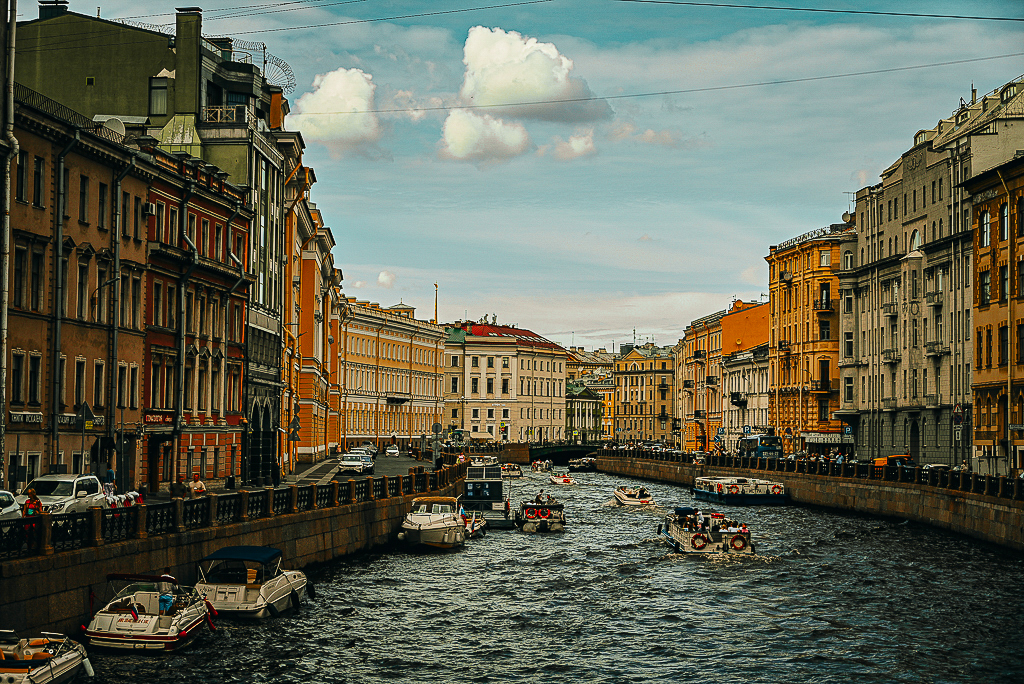
Saint Petersburg, with its canals and unique architecture, felt like Amsterdam and a mix of other European cities
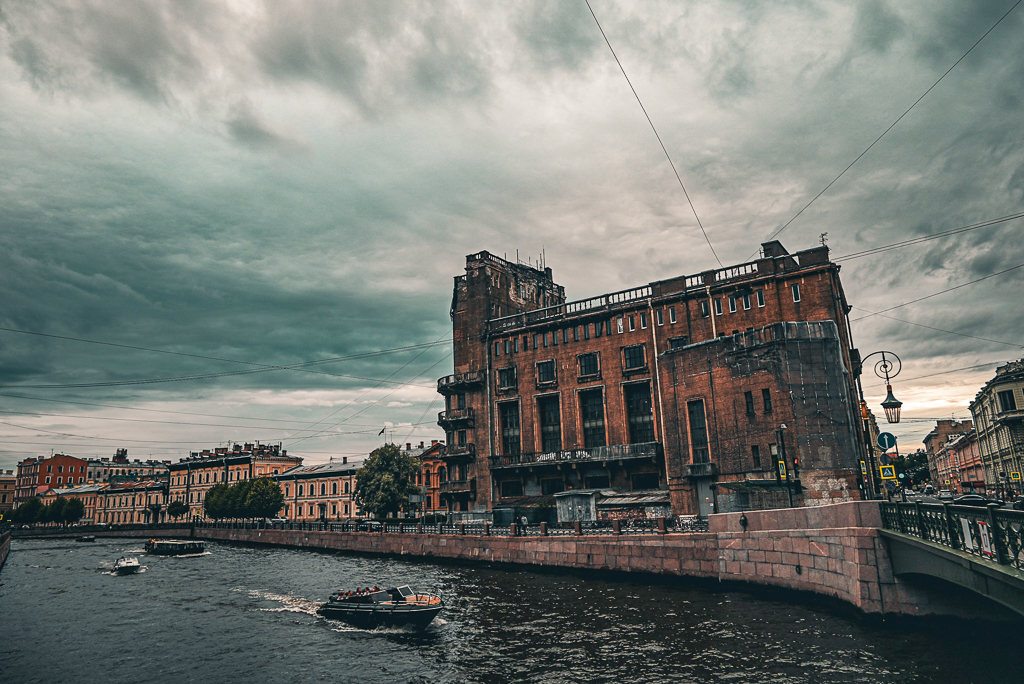
The city is flush with decorated old buildings with grand architecture but there is also evidence of drab communist era architecture throughout the city and Lenin statues
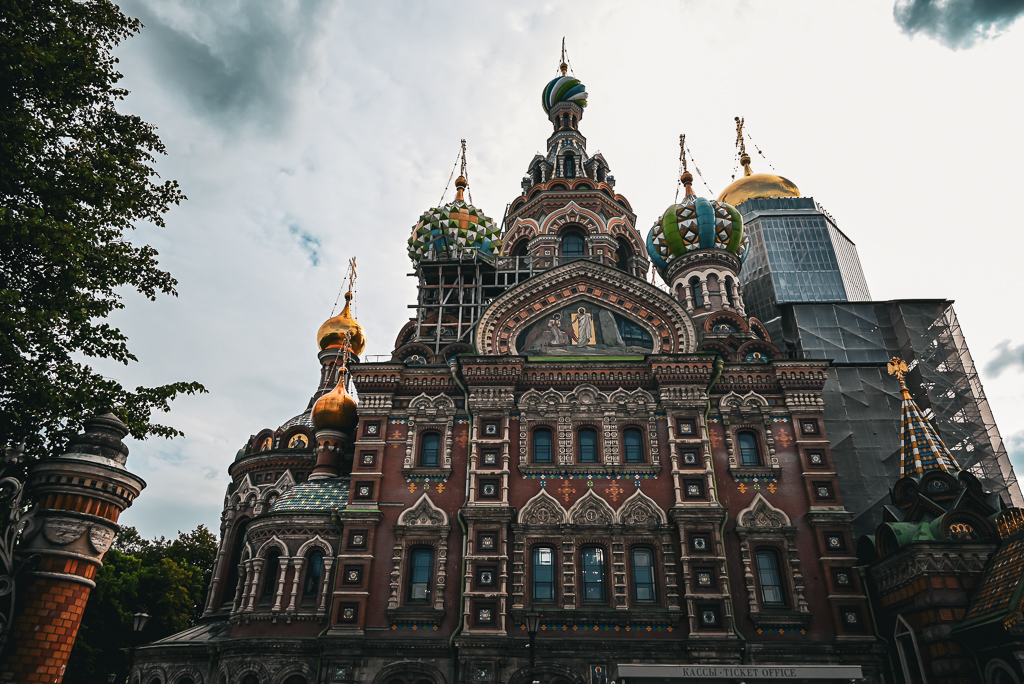
Church of the Savior on Spilled Blood where Tsar Alexandar II was assisinated
The Strange Story of Rasputin
Before the trip, I read as much as I could about the history of my destinations, as I try to do before every journey. One part of Saint Petersburg’s history fascinated me more than any other: the strange life and death of Grigori Rasputin.
Until then, I knew only that Rasputin was considered a madman who had developed a mysterious relationship with the Romanov family after seemingly helping their seriously ill son.
I also knew him from the 1970s disco song Rasputin and its description of him as “Russia’s greatest love machine.”
The more I read, the stranger his story became.
The Mad Monk
Rasputin was a peasant and religious wanderer from Siberia who traveled through Russia preaching, praying and offering spiritual guidance. Although he became known as the “Mad Monk,” he was never actually an ordained monk or priest.
His piercing stare, charisma and reputation for possessing supernatural powers attracted devoted followers. Stories circulated that he belonged to a secret religious sect whose members believed debauchery could bring a person closer to God. Tales of drunkenness, orgies and strange religious rituals followed him everywhere.
Rasputin also developed a reputation for seducing his female followers. Some women sought him out because they believed his touch or prayers could cure illnesses or infertility.
Whether he possessed any genuine healing abilities remains impossible to know, but his reputation eventually carried him into the inner circle of Russia’s imperial family.
Rasputin and the Romanovs
Tsar Nicholas II and Empress Alexandra’s only son, Alexei, suffered from hemophilia, a potentially fatal disorder that prevented his blood from clotting properly.
Alexandra became convinced that Rasputin possessed the power to ease the boy’s suffering.
On several occasions, Alexei’s condition appeared to improve after Rasputin intervened. One possible explanation is that Rasputin discouraged the royal doctors from treating the boy with aspirin. At the time, doctors did not yet fully understand that aspirin thinned the blood and could make the symptoms of hemophilia considerably worse.
Whatever the real explanation, Alexandra believed Rasputin had saved her son. Her trust gave him extraordinary access to the imperial family and a degree of political influence that alarmed members of the Russian aristocracy.
His growing power, scandalous reputation and bizarre behavior created jealousy and suspicion at a time when the Romanov monarchy was already losing the confidence of the Russian people.
Rumors even spread that Rasputin was having an affair with Empress Alexandra.
The Murder of Rasputin
In December 1916, a group of aristocrats led by Prince Felix Yusupov lured Rasputin to the Yusupov Palace and murdered him.
According to the most famous version of the story, the conspirators served Rasputin cakes and wine laced with cyanide. When the poison apparently failed to affect him, they shot him.
Rasputin then supposedly rose from the floor, attacked his killers and attempted to escape. He was shot again, beaten and thrown into the freezing river, where he finally drowned.
Much of that dramatic account has since been questioned, but it became the foundation of the Rasputin legend: the mystic who seemed almost impossible to kill.
Legend also holds that Rasputin predicted the Romanov family would not survive for two years if members of the nobility killed him.
Whether the prophecy was authentic remains disputed, but the timing was chilling. Less than two years after Rasputin’s death, Nicholas II, Alexandra and their children were executed by the Bolsheviks in a basement in Yekaterinburg.
Rasputin was dead, but his legend was only beginning.
Searching for Rasputin’s Pickled Penis
Even one of Rasputin’s most intimate body parts supposedly survived him.
A bizarre relic displayed in Saint Petersburg was claimed to be Rasputin’s preserved penis. According to one version of the story, it had been removed from his body after his murder and preserved as a fertility relic.
Other accounts suggested that the object belonged to an animal—possibly a sea creature or a donkey.
Regardless of its authenticity, I had to see it for some strange reason.
Given my tendency to seek out the world’s strangest attractions, Wes and I set off to visit places associated with Rasputin. Our plans included the Yusupov Palace, where he was assassinated, and the Museum of Erotica, where his alleged pickled penis had reportedly been displayed.
Our search led us into a shopping mall and then inside a bizarre sex shop filled with sex toys, leather outfits, whips, chains and other objects I will leave to the imagination.
A man working at the entrance spoke some English and offered us a tour of the museum. He enthusiastically explained that the experience was “interactive.”
I looked past him and saw a collection of sex dolls and other exhibits. With no interest in discovering what an interactive tour involved, I asked him the only question that mattered:
“Do you still have Rasputin’s penis?”
He smiled and told us that a Chinese businessman had purchased it.
It was gone.
Just like that, our pursuit of Rasputin’s pickled penis came to an end. We declined the interactive tour—and to this day, I still do not know what he meant by “interactive.”
From Rasputin to the Hermitage
With Rasputin’s alleged relic no longer available to admire, we returned to the more respectable side of Russian culture.
We continued to the State Hermitage Museum, founded by Catherine the Great in 1764 and housed partly inside the spectacular Winter Palace. Its enormous collection contains millions of objects, including masterpieces by some of the greatest artists in history.
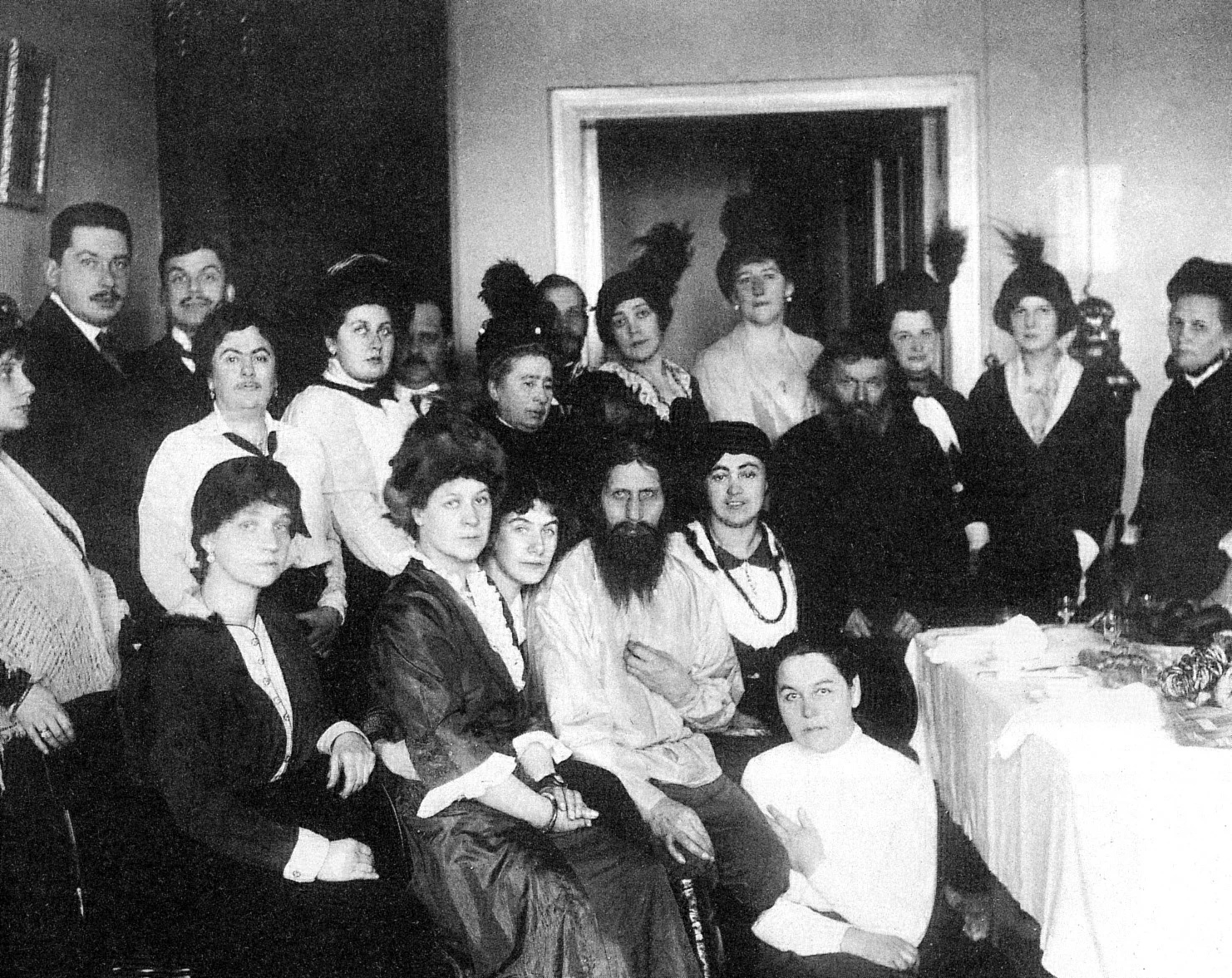
Rasputin with a gathering of women
Inside the State Hermitage Museum
The Winter Palace would be an extraordinary place even without the artwork. Its elaborate architecture, grand staircases and richly decorated rooms offer a glimpse into the immense wealth of Russia’s imperial rulers.
Today, the palace forms the centerpiece of the State Hermitage Museum, often described as the second-largest art museum in the world.
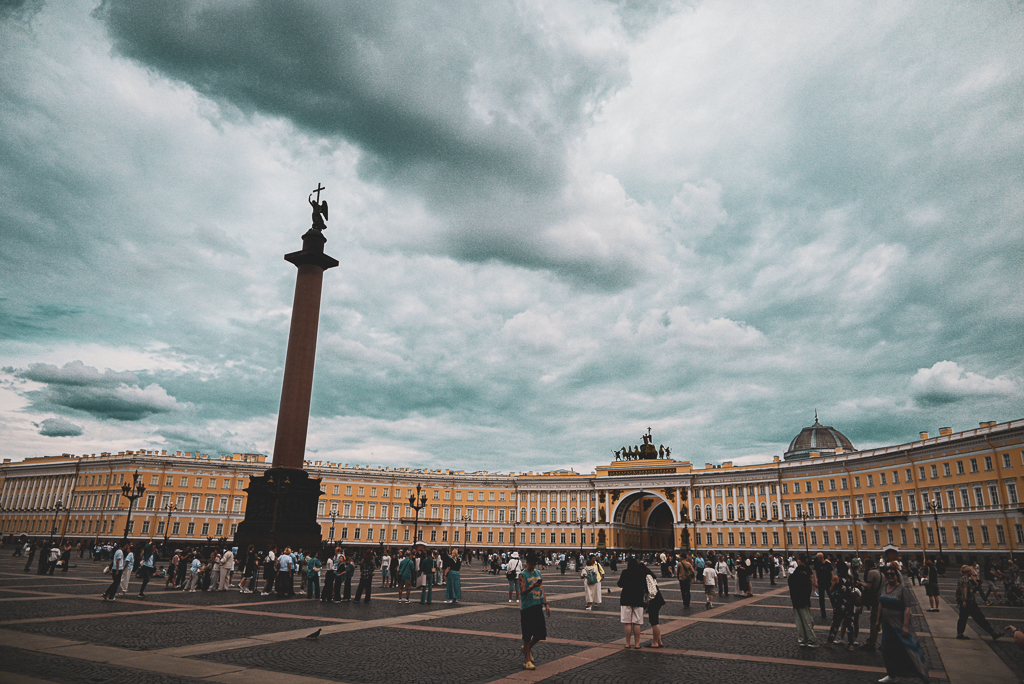
Heritage Museum Square
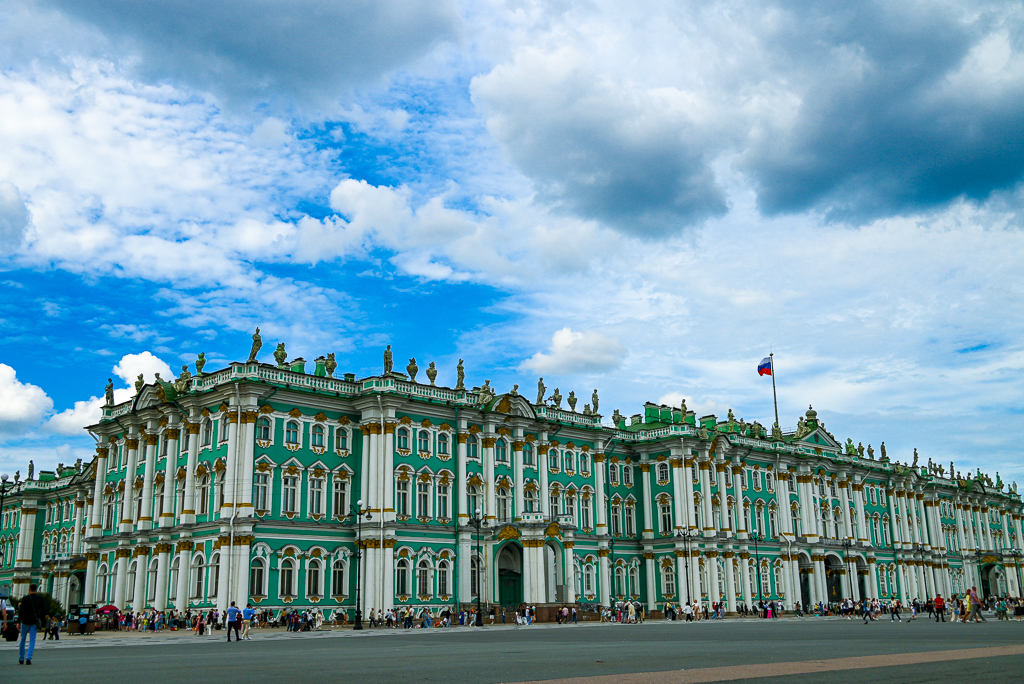
Hermitage Museum
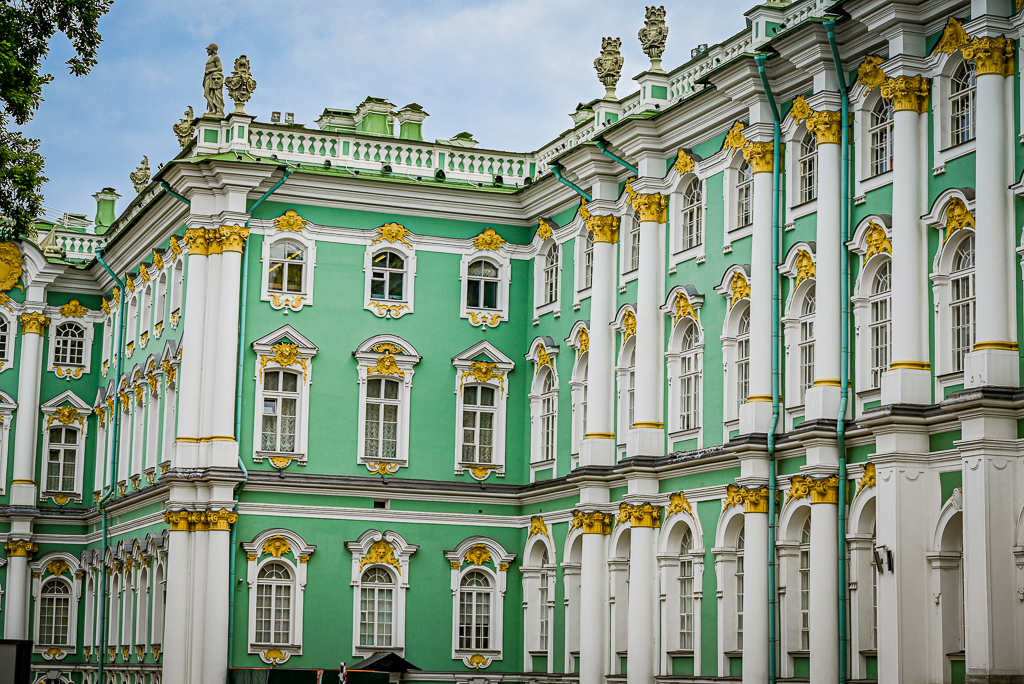
Hermitage Museum/Catherine the Greats Summer Palace
Catherine the Great’s Collection
The Hermitage traces its beginnings to 1764, when Catherine the Great began acquiring paintings from across Europe. What began as her private collection eventually expanded to include approximately three million works of art and historical objects.
The scale of the collection is almost impossible to comprehend. A popular claim says that seeing every object for only a minute would still require years. Visitors can walk for miles through room after room and see only a fraction of what the museum possesses.
Its treasures extend far beyond paintings. We passed sculptures, royal possessions and archaeological artifacts from ancient Greece, Egypt, Russia and civilizations throughout the world.
Seeing My First Rembrandt
This was also the first time I had ever stood in front of an original painting by Rembrandt. His masterpieces are among the most valuable paintings in existence, with some considered virtually priceless.
One of the most remarkable paintings in the gallery was Rembrandt’s Danaë. Its survival was almost as extraordinary as the painting itself.
In 1985, a visitor threw sulfuric acid across the canvas and slashed it twice with a knife. The acid severely damaged the central figure, particularly her face, hair, arm and legs.
Museum conservators began trying to save the painting that same day. The painstaking restoration took 12 years to complete, and Danaë finally returned to public display in 1997.
It now hangs behind protective glass. Looking at it, it was difficult to believe that one of Rembrandt’s greatest works had come so close to being destroyed forever.
A Gift From Napoleon’s Former Wife
One small object stood out to me among all the enormous paintings and lavish rooms: the Gonzaga Cameo, an ancient carved gemstone believed to date from the third century BC.
The cameo had once belonged to Joséphine de Beauharnais, Napoleon’s former wife. After Napoleon’s defeat, Tsar Alexander I visited Joséphine at her home outside Paris and offered her his protection and assistance. In gratitude, she presented him with the cameo.
I found the gesture fascinating. Here was Napoleon’s former wife giving one of her greatest treasures to the Russian tsar whose armies had helped defeat him. Perhaps it was an act of diplomacy, gratitude or self-preservation—or some combination of all three.
More than two centuries later, the gift remained in Russia, displayed inside the former palace of its emperors.
Farewell to Saint Petersburg
We spent several hours exploring the Hermitage, but even that allowed us to see only a tiny portion of its collection.
After leaving the museum, we found a local restaurant serving regional Russian food. We ate several Russian dishes and tried some local beer.
We then returned to our hotel for the night. The following morning, we would fly north to Murmansk and move one step closer to the Arctic Ocean—and the North Pole.
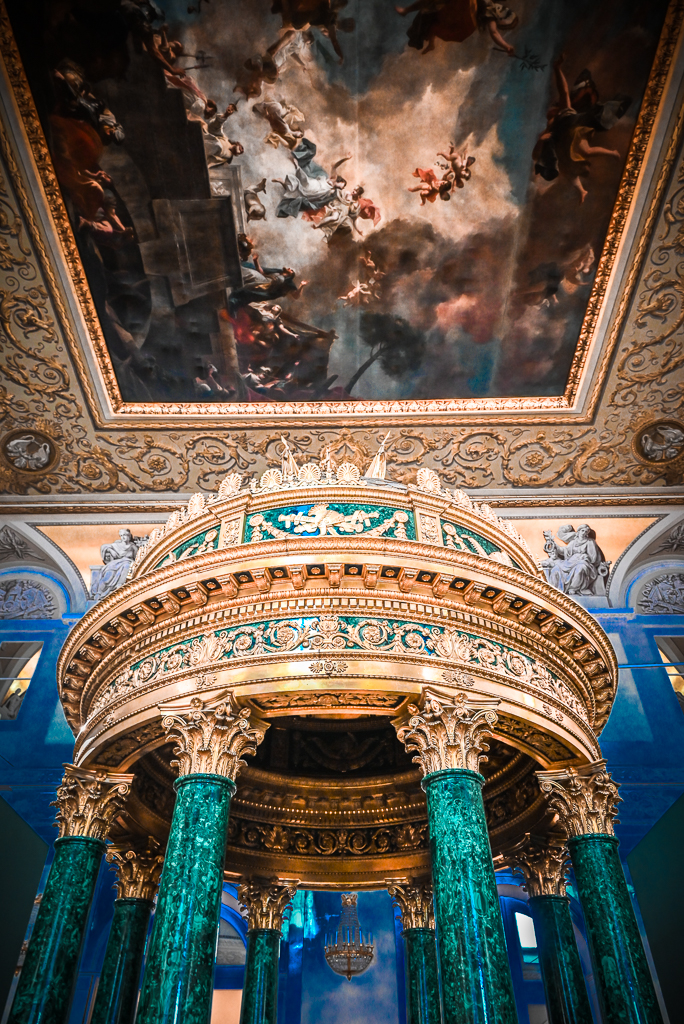
Over the top Extravagant architecture inside the palace
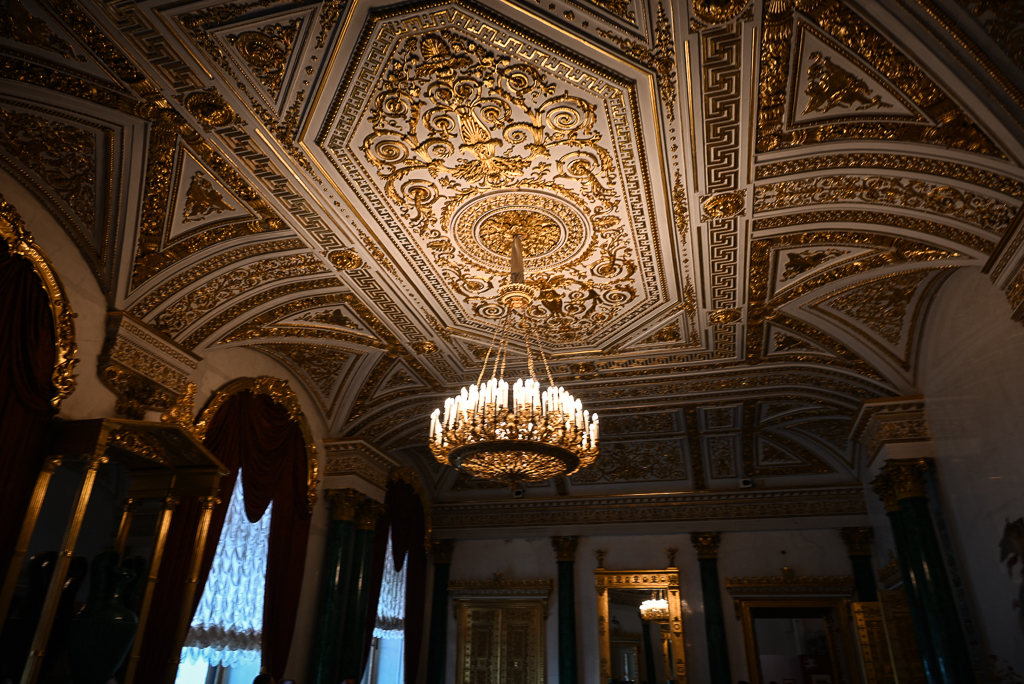
Extravagant architecture inside the palace
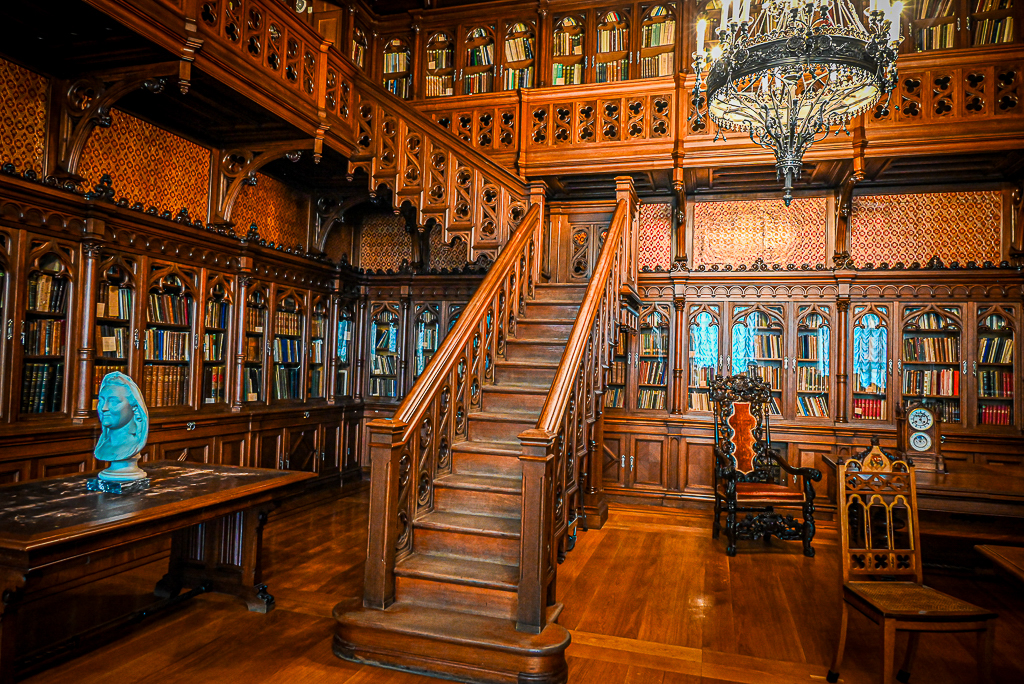
Ornate Library
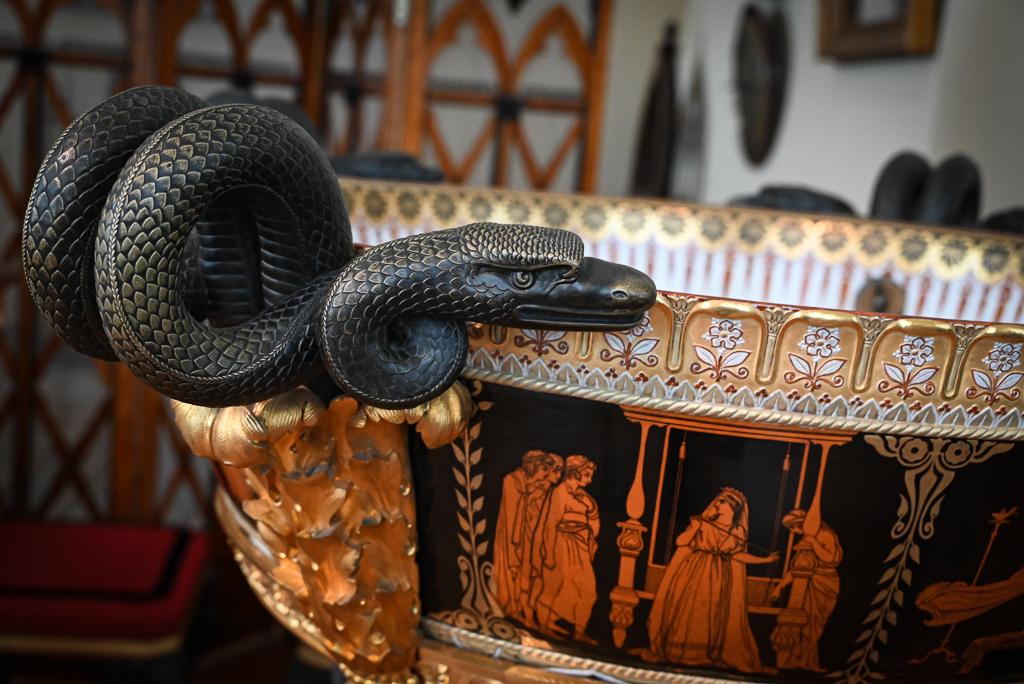
Ornate bathtub made of gold and decorated with obsidian snakes
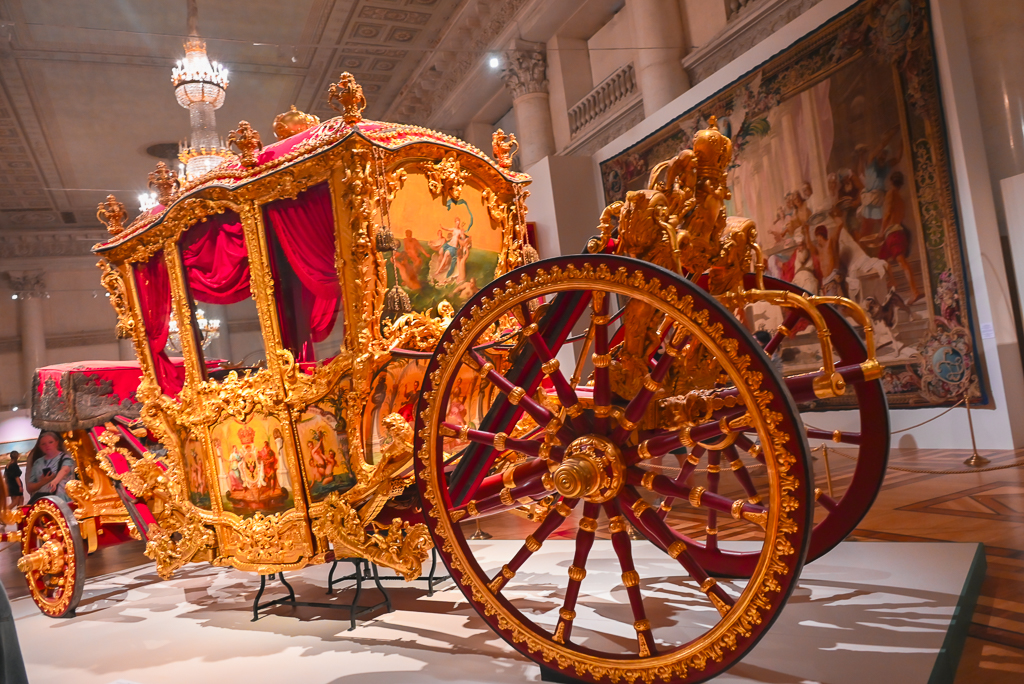
Gold buggy used by royal family
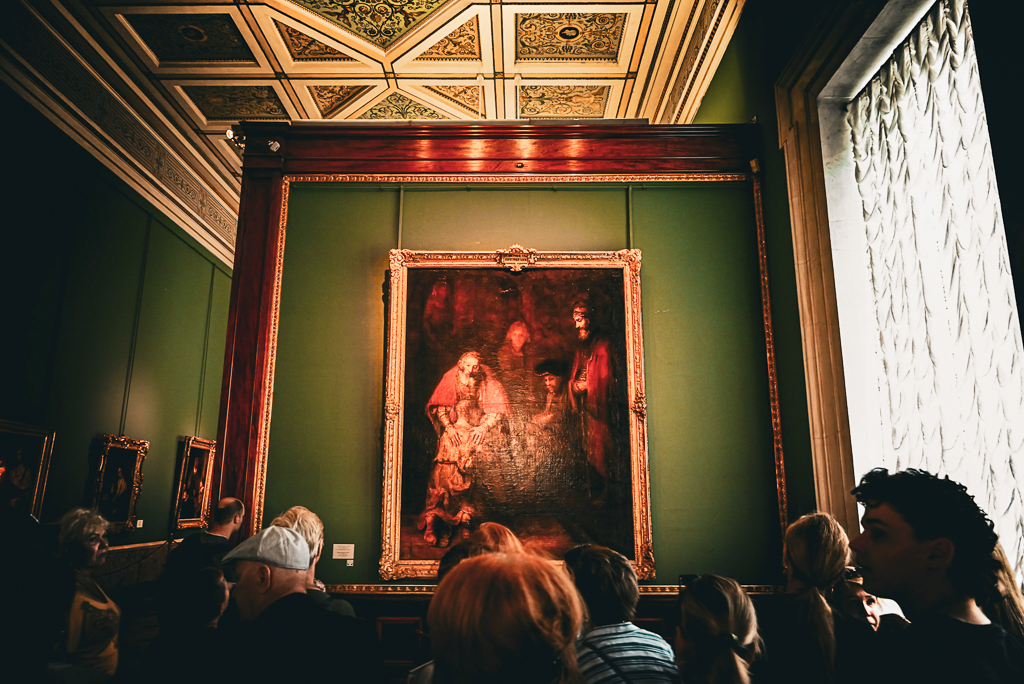
Rembrandt Danaë Painting
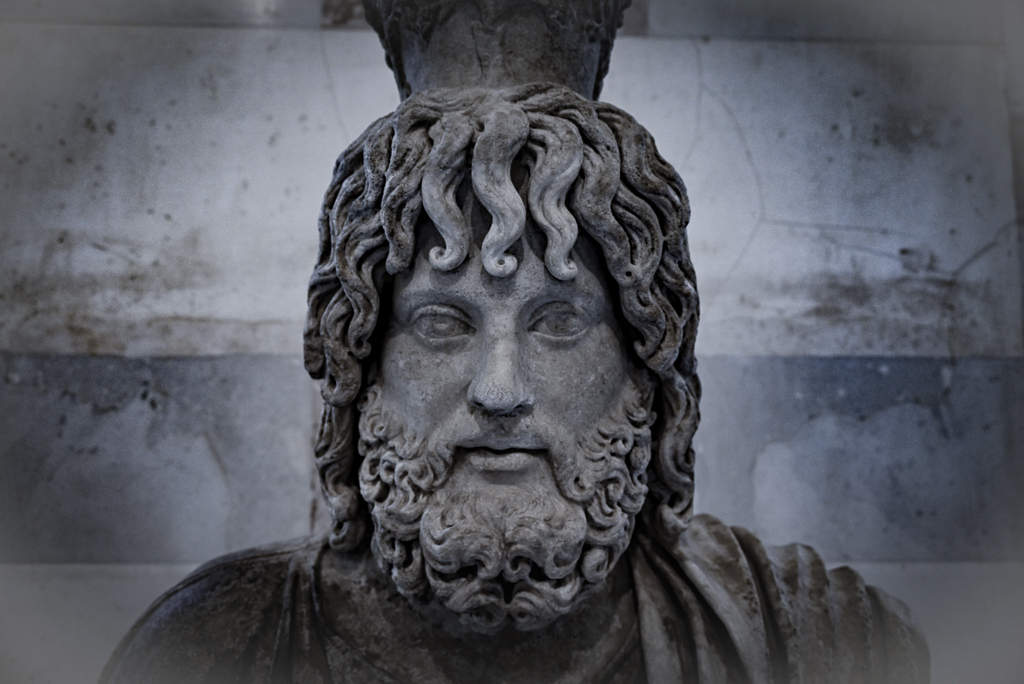
5th century B.C. Hermes statue
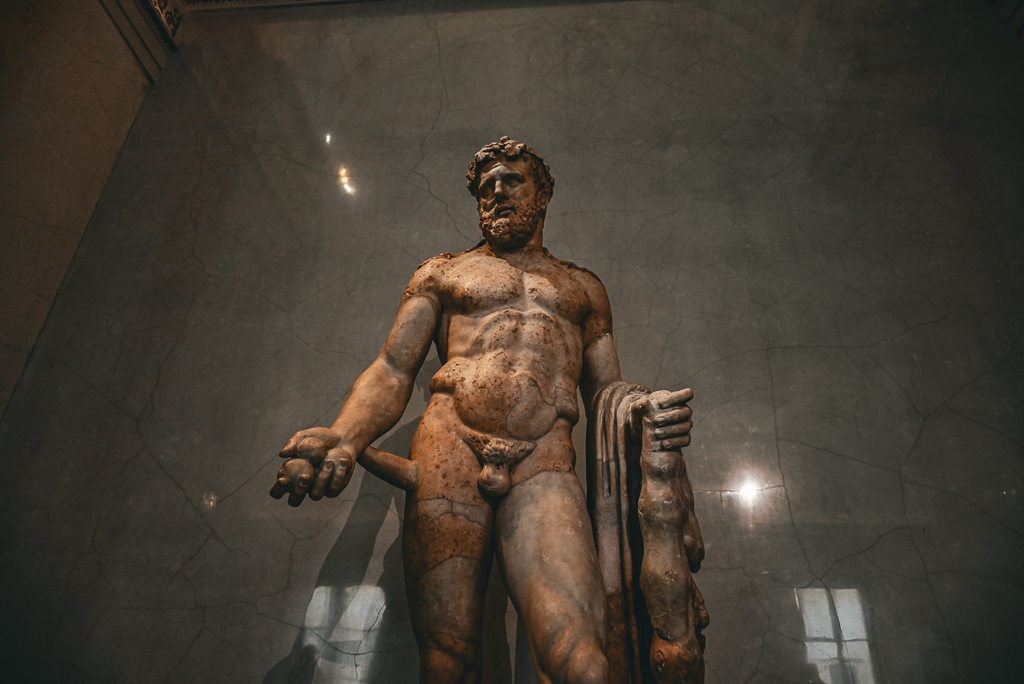
Hercules Statue also 2000 years old
Flying North to Murmansk
The following morning, we flew from Saint Petersburg to Murmansk on an Aeroflot flight operated by one of its affiliated airlines. Our aircraft was a Russian-built Sukhoi Superjet 100—a new type of plane for me.
Before departure, we changed money with the most unfriendly woman in all of Russia—and perhaps even farther beyond—drank a few shots of Russian vodka at an airport bar and browsed the Putin T-shirts and other patriotic merchandise in a nearby clothing shop. We then nearly missed our flight because the departure gate changed several times without the airport monitors being updated.
Because of our Russian travel agent’s status with the airline, we were assigned seats at the front of the aircraft in business class.
The experience was not dramatically different from economy. We sat in ordinary seats, with the only real distinction being a curtain separating us from the cabin behind. We also received an extra snack, bottled water and more attention from the flight attendant.
The flight lasted almost two hours. Through the window, we watched the landscape gradually change from countless lakes and dense boreal forest to the increasingly treeless tundra of Russia’s far north.
The World’s Largest Arctic City
We eventually landed above the Arctic Circle in Murmansk, the world’s largest city north of that imaginary line. Its population was once considerably larger, but today it remains home to approximately 270,000 people.
Despite its extreme northern latitude, Murmansk is warmer than might be expected. The North Atlantic Current moderates its climate and helps keep its port ice-free throughout the year.
Murmansk was founded in 1916 during World War I, making it the final city established under the Russian Empire. Originally named Romanov-on-Murman after the imperial dynasty, it received its present name following the Russian Revolution.
During World War II, the city’s strategic port made it a major target of Nazi Germany. Murmansk endured hundreds of air raids and widespread destruction but continued operating as an essential entry point for Allied supplies sent to the Soviet Union.
Its position on Kola Bay remains strategically important. Murmansk is a center of Russian Arctic shipping, while the nearby city of Severomorsk serves as the main base of Russia’s Northern Fleet. At a time of war—and amid the threat of Ukrainian drone attacks against military targets—security throughout the region was understandably sensitive.
An Arctic Heat Wave
I expected Murmansk to be cold, even in July. As we prepared to leave the plane, the pilot announced that the temperature outside was 29 degrees.
We instinctively assumed he meant Fahrenheit.
The last time I had visited the Russian Arctic, on the Yamal Peninsula, the temperature had reached approximately -70 degrees Fahrenheit. Cold was what I associated with this part of the world.
Through the window, we could see Russian ground workers wearing T-shirts and short sleeves. Our first thought was that they were simply tough Russians accustomed to working outside in the Arctic cold.
The moment we stepped off the plane, however, we were hit by a blast of warm, humid air unlike anything I had ever experienced in the Arctic.
The captain had meant 29 degrees Celsius—about 84 degrees Fahrenheit. Murmansk was experiencing an unusual heat wave, with temperatures approaching 90 degrees and high humidity.
We would later see locals flocking to lakes and coastal waters to swim and escape the heat. Because sustained heat is so unusual this far north, many buildings had no air-conditioning. At our hotel, we could do little more than open the windows and try to adjust to the strangely tropical Arctic weather.
Unexpected Questions at the Airport
Before reaching our hotel, we had to meet the driver we had arranged for the approximately 40-minute journey into Murmansk.
As soon as we passed through the baggage-claim area, however, several Russian security officials spotted us and waved us over. They already knew our names and appeared to have been waiting for us.
They asked why we had come to Murmansk. They were also confused by Wes’s Dominica passport and asked whether he was American. We answered honestly that he was, avoiding any appearance that we were trying to conceal something.
I explained simply that we were going to the North Pole.
That answer appeared to alleviate their concerns almost immediately. Traveling aboard the nuclear icebreaker was a familiar and accepted reason for foreigners to visit Murmansk.
I showed them our itinerary, and they asked to make a copy. The officials remained professional throughout the encounter and explained that Americans did not arrive in Murmansk every day, so they needed to complete a security check.
They told us that Western visitors had commonly traveled to Murmansk before 2022. Now they were a rarity.
As elsewhere in Russia, “before 2022” was a phrase people often used. They did not have to mention the war; everyone understood what the year represented.
The Russian government and state media officially referred to the invasion as a “special military operation,” while laws against “discrediting” the armed forces had made public criticism of the war potentially dangerous. We understood why people chose their words carefully.
After a short conversation, the officials allowed us to continue without any problems.
First Impressions of Murmansk
We met our driver outside and began the journey into the city.
My first impression of Murmansk was of a place caught between different eras. Some areas contained attractive European-style buildings, while others were dominated by drab Soviet apartment blocks.
Near the port, we passed weathered industrial structures and abandoned-looking buildings that reflected the city’s long history as a remote Arctic shipping center.
At the same time, a construction boom appeared to be underway. New buildings rose among the aging Soviet structures, creating a striking contrast between abandonment and renewal.
Once we reached the Cosmos Murmansk Hotel, Wes and I checked into our rooms, dropped off our bags and set out to explore.
Changing Money on the Street
Our first task was exchanging money. Because American ATM and credit cards did not work in Russia, we had brought cash with us.
We found local money changers standing outside what had once been a McDonald’s. They were easy to recognize by the white waist packs they wore in front, filled with the cash needed to conduct their business.
The exchange rate was fair, and no one tried to take advantage of us. That reinforced my impression that Murmansk was not a heavily touristed city where visitors were routinely treated as easy targets.
The money changers appeared to serve primarily local Russians. With concerns about inflation and the value of the ruble, some people preferred to hold more stable foreign currencies such as American dollars or euros.
The location of the exchange added another layer to the experience.
McDonald’s withdrew from Russia after the invasion of Ukraine and sold its Russian operations. The restaurants reopened under the Russian name Vkusno—i tochka, translated into English as “Tasty—and that’s it.”
From the outside, it still looked remarkably similar to McDonald’s. The menu and taste of the food also seemed almost identical, but the Western name and golden arches had disappeared.
It was another small example of how Russia had adapted to Western companies and brands leaving the country. The familiar business remained, but the Western identity had been replaced.
With rubles in our pockets, we continued exploring Murmansk.
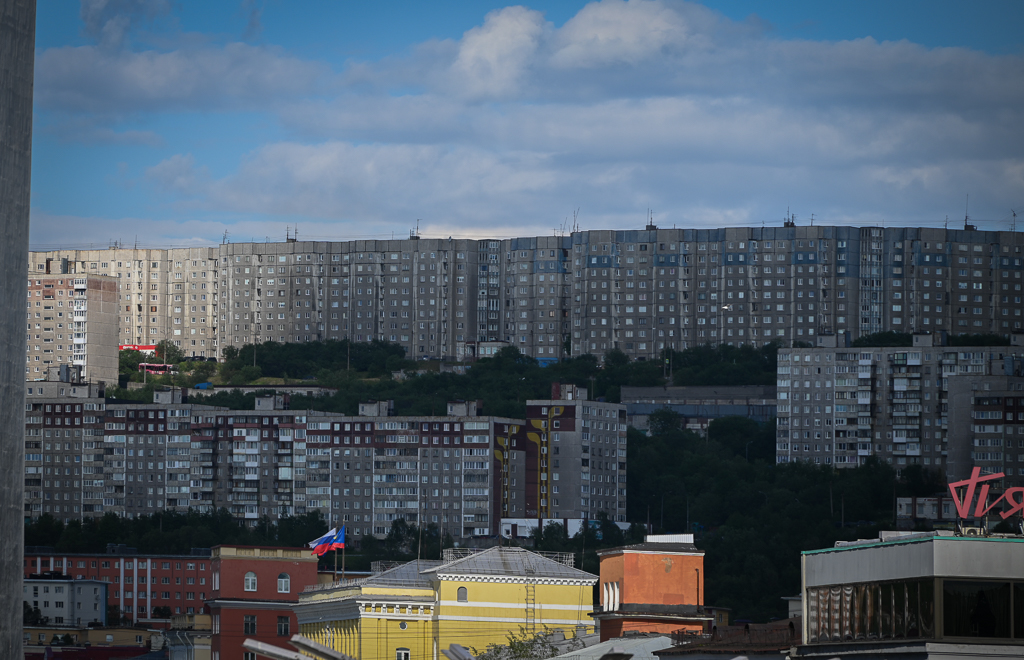
Soviet era bloc apartment buildings
Two Nights in Murmansk
We spent two nights in Murmansk, having deliberately arrived one day early as a buffer in case our flight was delayed. Missing the departure of our icebreaker would have meant missing the entire expedition.
That precaution was especially important during the war. Ukrainian drone attacks were regularly forcing Russian airports to close their airspace, sometimes creating delays lasting many hours.
Our flight arrived on schedule, but some expedition passengers traveling from Moscow were delayed for eight hours after heavy drone activity temporarily disrupted airport operations there.
Our extra night in Murmansk suddenly seemed like a very wise decision.
Our Hotel in the City Center
We stayed at the Cosmos Murmansk Hotel, one of the city’s nicer hotels. Its central location placed us near the train station and within walking distance of many of Murmansk’s principal sights.
It was also conveniently close to an Irish pub, where we ended up spending a fair amount of time.
I had hoped to leave the city and explore some of the surrounding Arctic countryside. I was particularly interested in meeting Russia’s Indigenous Sámi reindeer herders. I had encountered Sámi communities in Norway and wanted to learn how their lives and traditions differed on the Russian side of the border.
Unfortunately, our American bank cards did not work, and we could not simply withdraw more money. We had to conserve the dollars we had brought and remain focused on the North Pole expedition, which was the main purpose of our trip.
Instead of traveling into the countryside, we explored Murmansk on foot.
Murmansk’s Monument to the Soviet Arctic
One of the city’s most impressive landmarks stood on a hill overlooking Murmansk.
Officially called the Memorial to the Defenders of the Soviet Arctic During the Great Patriotic War, the monument is commonly known as “Alyosha.” Dedicated in 1974, its massive stone soldier rises more than 100 feet above the hilltop.
The memorial honors the Soviet soldiers, sailors and airmen who defended the Arctic against Nazi Germany during World War II. From its elevated position, the soldier looks out over Murmansk, the surrounding hills and the waters of Kola Bay.
Russia contains countless enormous memorials dedicated to what it calls the Great Patriotic War, but this was one of the most impressive World War II monuments I had seen anywhere in the country.
Meeting Another American
At the hotel, we met Bill, the only other American traveling aboard our icebreaker.
Together, we headed down to the waterfront one morning to see the nuclear icebreaker Lenin. Launched in 1957, Lenin was the world’s first nuclear-powered surface ship and the first civilian vessel propelled by nuclear power.
It was the predecessor of the enormous nuclear icebreaker that would soon carry us toward the North Pole.
Inside the Nuclear Icebreaker Lenin
Later that day, we joined a Russian-language tour of the ship’s interior. We could understand almost nothing the guide said, but it did not matter.
Simply walking through the vessel was fascinating. Much of the interior appeared frozen in the Soviet era, with vintage furnishings, polished wood, old instruments and Soviet emblems displayed throughout the ship.
We saw the bridge, crew areas and exhibits explaining the nuclear machinery that had allowed Lenin to break through Arctic ice without constantly needing to refuel.
The ship felt like a combination of a museum, a Cold War time capsule and a monument to Soviet engineering. Seeing it also gave us our first close look at the technology that had transformed Arctic navigation.
A Festival Beside the Ship
A festival was taking place along the waterfront in front of Lenin. Families gathered beside the harbor while musicians performed live onstage.
Vendors sold fresh seafood, enormous Arctic crabs, fish, reindeer burgers and other regional foods. The waterfront was crowded and festive, with little outward indication that the country was fighting a major war.
Murmansk turned out to be a great city, and the people we encountered were friendly. A few locals heard us speaking English and asked where we were from.
When we answered, “the United States,” their response was simple and unexpected:
“USA is good.”
Those brief encounters reinforced something I had learned during years of traveling: governments can be enemies while ordinary people remain curious, welcoming and capable of separating individual visitors from politics.
Our time in Murmansk was nearly over. Soon we would leave the Irish pub, the Soviet monuments and the crowded waterfront behind to board one of the most powerful ships ever built.
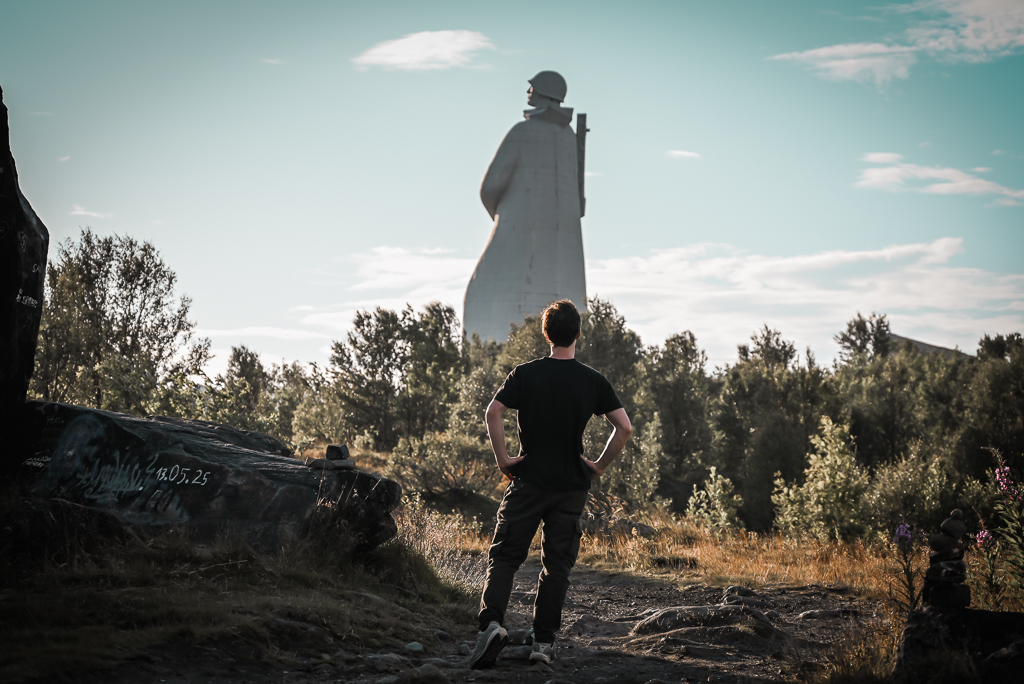
Overlooking the Arctic city of Murmansk, Russia, stands the towering World War II soldier monument
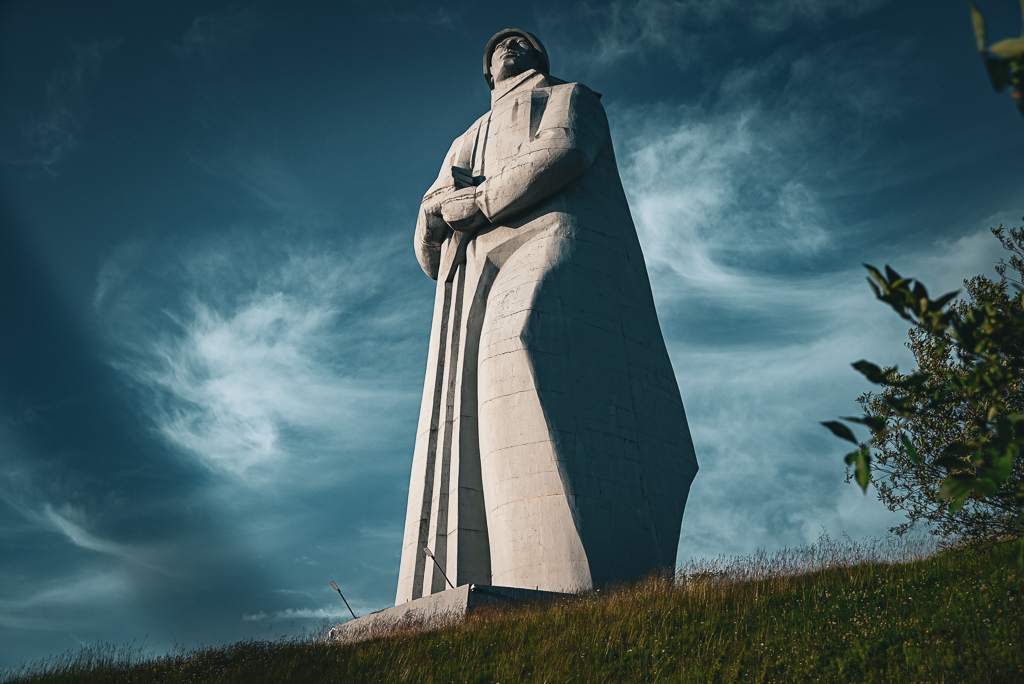
Memorial to the Defenders of the Soviet Arctic during the Great Patriotic War
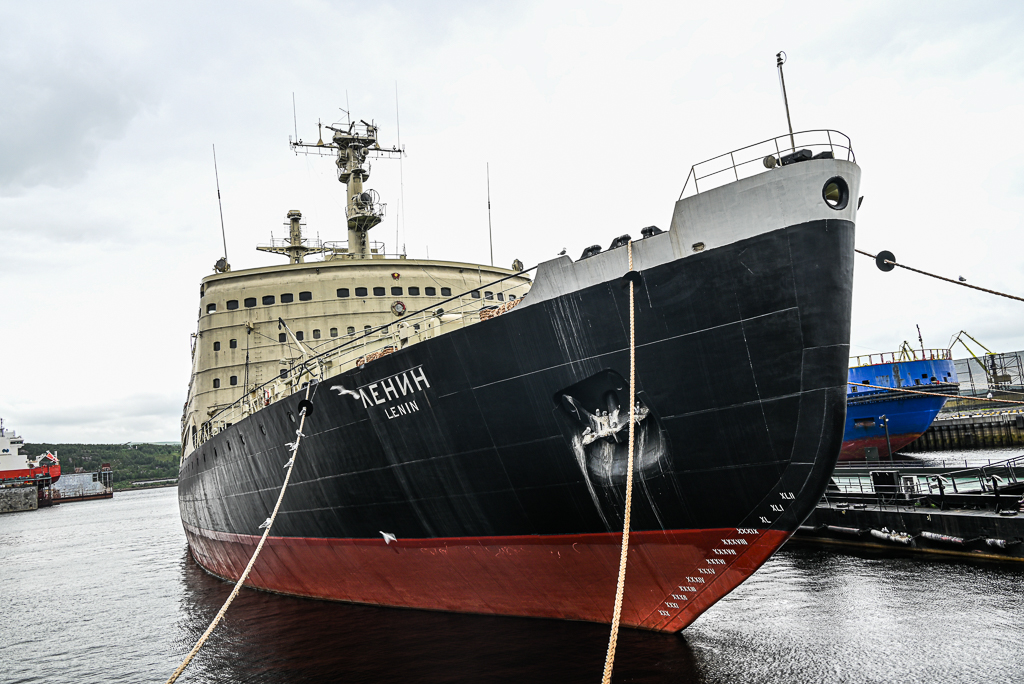
First Nuclear Ice Breaker-Lenin
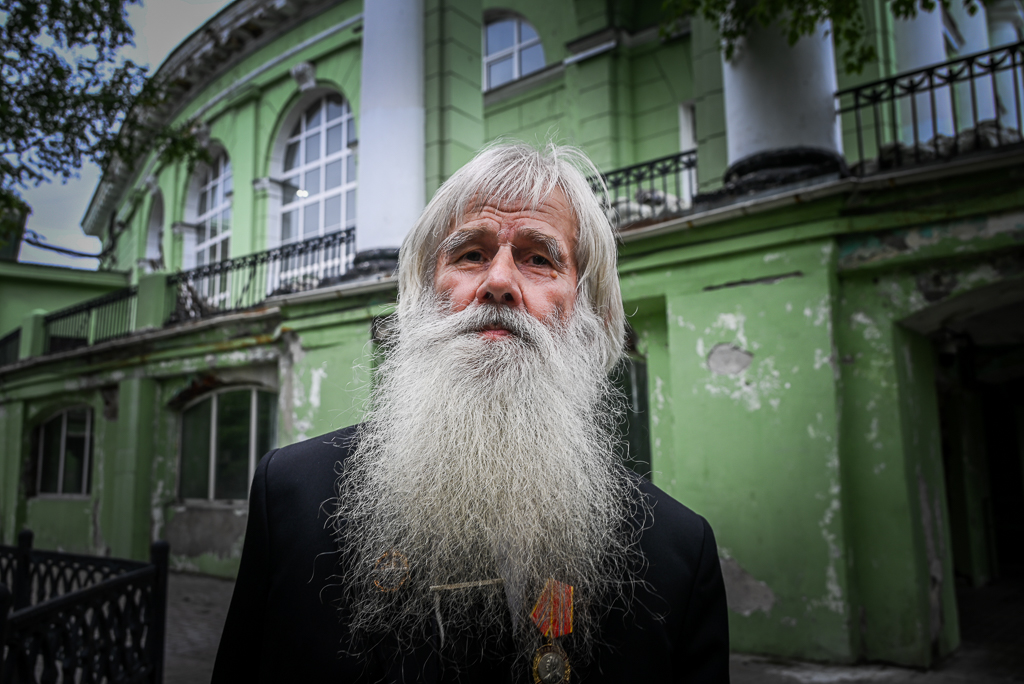
Friendly Russian: A friendly elderly man with medals, who allowed me to take photos, jubilantly handed me a few newspapers with CCP emblems on them. He only spoke Russian, so I have no idea what he said
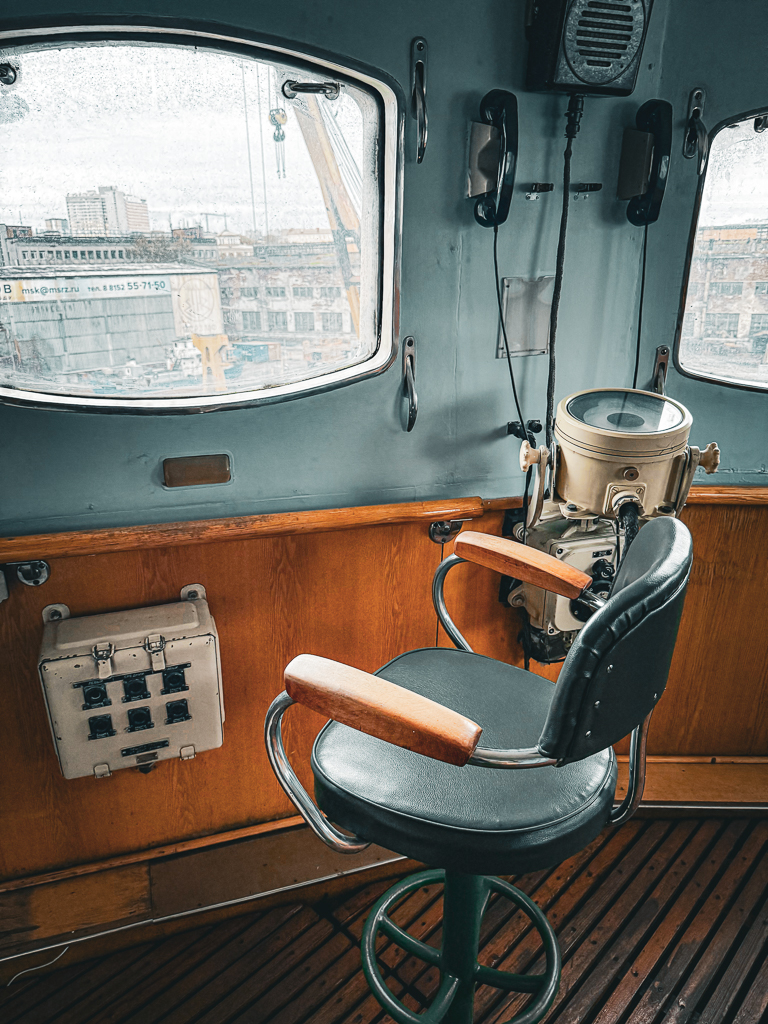
Bridge of the Lenin
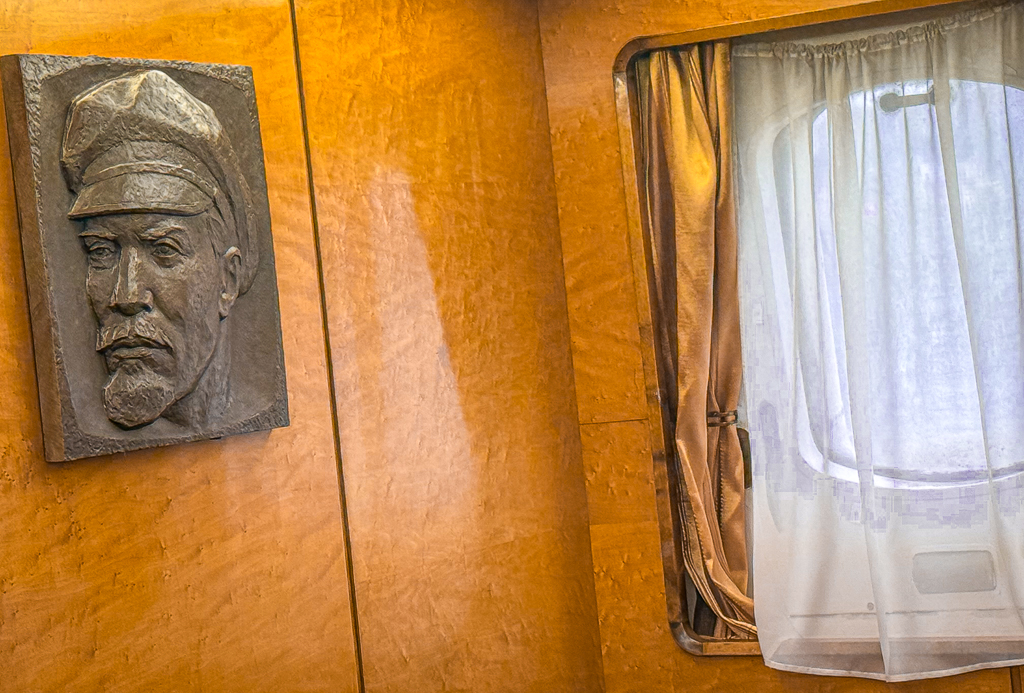
Lenin portraits in no short supply on the Lenin Boat
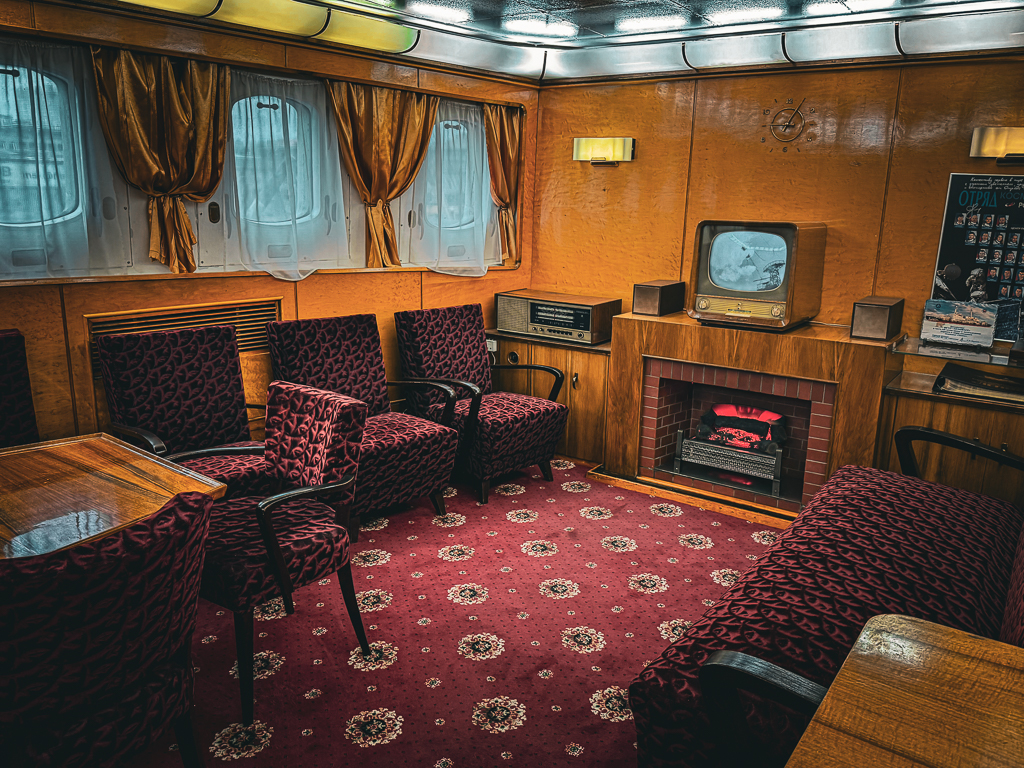
Dining area for officers
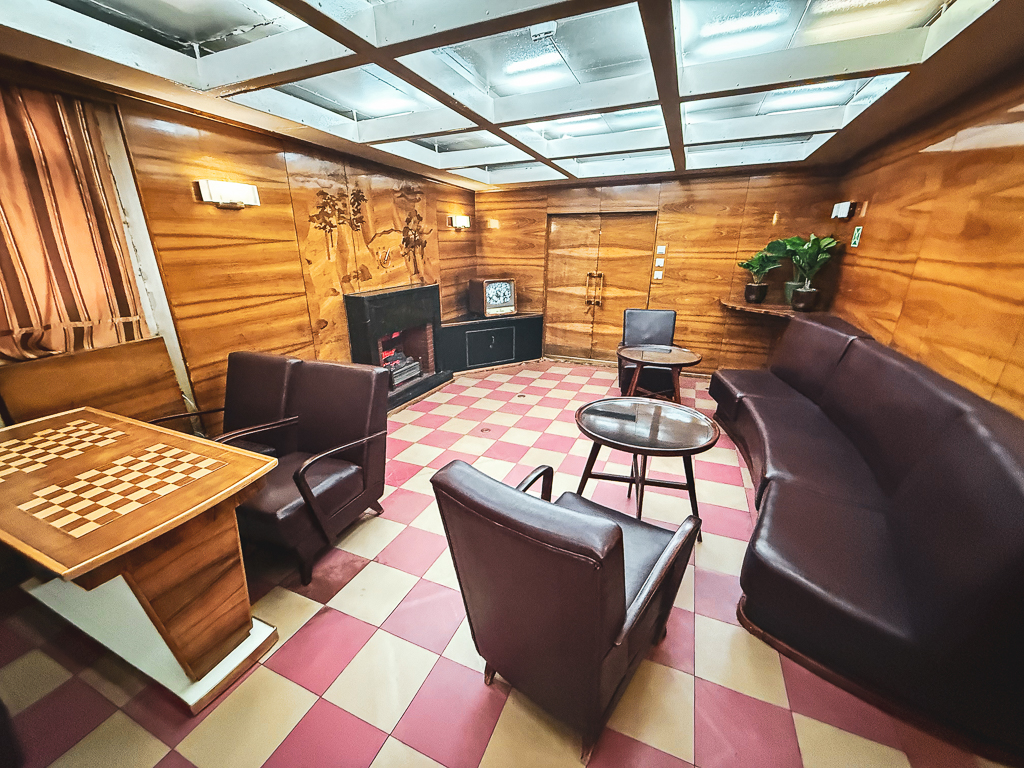
Officers leisure room
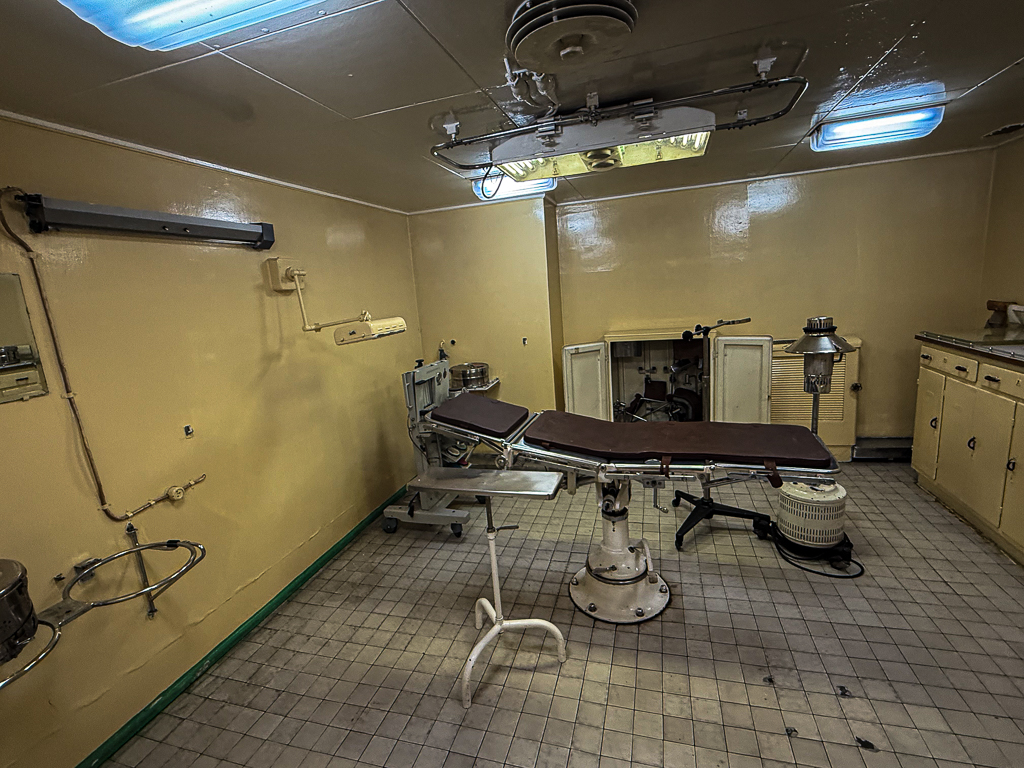
Medical room
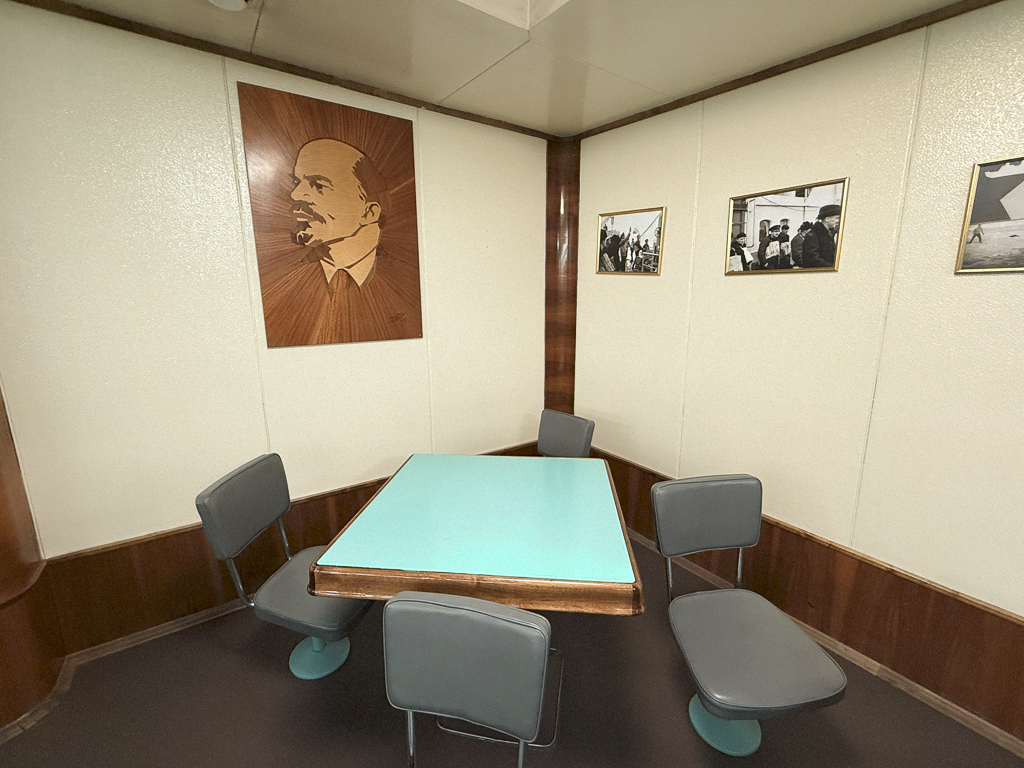
Common workers dining room
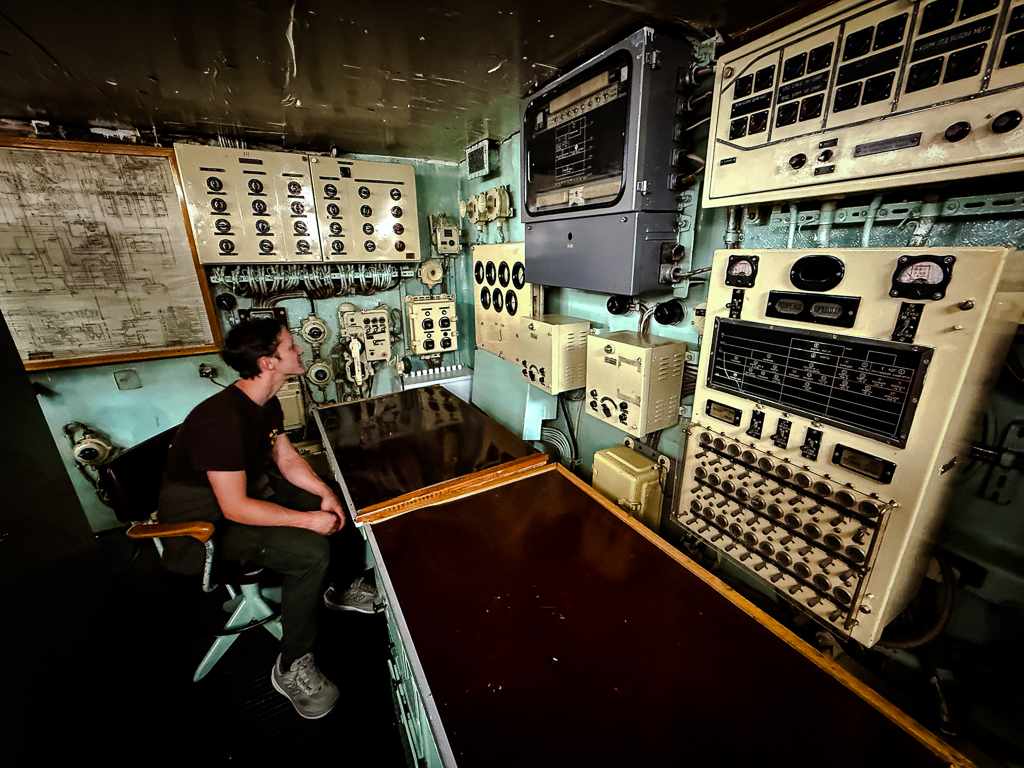
Nuclear control room
Boarding 50 Years of Victory
On the day of embarkation, approximately 100 passengers gathered at our Murmansk hotel for an orientation led by the expedition leader.
During the country roll call, he asked whether any Americans were present. When the four of us raised our hands, almost everyone in the room turned toward us with a collective expression of surprise.
The expedition leader smiled.
“Americans are welcome,” he said.
We soon discovered that Richard, Wes, Bill and I were the only Americans aboard. Aside from one Hungarian traveler and three passengers from China, nearly all the remaining passengers and expedition staff were Russian.
The Only Americans Aboard
Throughout the expedition, we gradually met the other passengers. Many spoke at least some English, and despite the strained relationship between our governments, everyone treated us with kindness and hospitality.
Nearly everyone admitted that they were surprised to find Americans traveling in Russia under the circumstances. Once the initial shock passed, however, our nationality became more of a conversation starter than a barrier.
Because we were such a small minority, nearly everything aboard the ship was presented in Russian, including lectures, announcements and daily briefings. An English-language interpreter was assigned to our group, and we listened to the translations through headsets.
Entering the Secure Atomflot Facility
That afternoon, we traveled to the secure Atomflot facility to board the nuclear icebreaker 50 Years of Victory.
Before the trip, we had been required to submit documents for security clearance—not only to board the ship but also to visit the restricted Franz Josef Land archipelago. We had heard that Americans had not been permitted to make landings there during some previous seasons, but that the restrictions had changed for our expedition.
Security at Atomflot was serious. We were warned that the facility was protected by armed personnel and that photography was strictly prohibited in certain directions. Our luggage was thoroughly inspected, and we passed through an extensive personal security screening before being allowed aboard.
Once everyone had cleared security, we walked onto the ship together. We would not set foot on continental land again for nearly two weeks.
Inside Russia’s Nuclear Fleet
Several other nuclear-powered icebreakers were docked nearby, including one of Russia’s newest and most powerful vessels. Seeing so many of these enormous ships gathered in one place reinforced just how central Murmansk was to Russia’s Arctic operations.
Across the harbor was the Admiral Kuznetsov, Russia’s only aircraft carrier, undergoing a long and troubled repair process at the shipyard.
We had been firmly warned not to photograph sensitive areas around the facility. I could not resist discreetly taking a photograph of the aircraft carrier through the partial cover of our cabin window, but I otherwise kept my camera pointed safely away from the restricted buildings.
Armed guards carrying automatic rifles watched from an elevated position on the roof of a tall blue building covered with antennas and communications equipment. I could only speculate about its purpose, but in wartime Russia, it was easy to imagine that the equipment was connected to detecting drones, disrupting GPS signals or protecting the nuclear fleet from attack.
Pulling Away From Murmansk
We gathered on deck and were introduced to members of the ship’s crew. Then it was time to depart.
Tugboats maneuvered into position and began pulling our massive icebreaker away from the dock. As we started moving, patriotic Soviet-era military music played from loudspeakers at the Atomflot facility, giving us a dramatic and unmistakably Russian send-off.
I climbed to one of the ship’s highest outdoor decks and watched Murmansk slowly recede behind us. The music carried across the water as we sailed into Kola Bay.
Our icebreaker sounded its enormous horn in farewell to the facility. It sounded again when the tugboats completed their work and broke away from us.
A Sound From My Childhood
The exchange of ship horns immediately transported me back to my childhood in Minnesota.
I had witnessed the same maritime ritual countless times at the Duluth Ship Canal. Enormous ore carriers arriving from Lake Superior—or departing for the open lake—passed beneath the Aerial Lift Bridge. The ships sounded their horns, and the bridge answered.
The deep, thunderous bass of those horns had always given me goosebumps.
Now I was hearing that same powerful sound from the deck of a Russian nuclear icebreaker beginning its journey to the North Pole. The circumstances could not have been more different, but the feeling was exactly the same.
In that moment, I understood how fortunate I was to be aboard this extraordinary vessel at such a unique moment in history.
Into the Barents Sea
For the next several hours, we sailed through Kola Bay, passing dwarf forests, military installations and remote settlements along the shoreline.
Eventually, the signal disappeared from our phones. Our last connection to home vanished as the bay widened and we entered the Barents Sea, part of the Arctic Ocean.
Ahead of us were two days of open water before we would see land again in Franz Josef Land.
The expedition had finally begun.
Meeting the Russian Crew and Boarding our ship to patriotic Soviet era military hymns
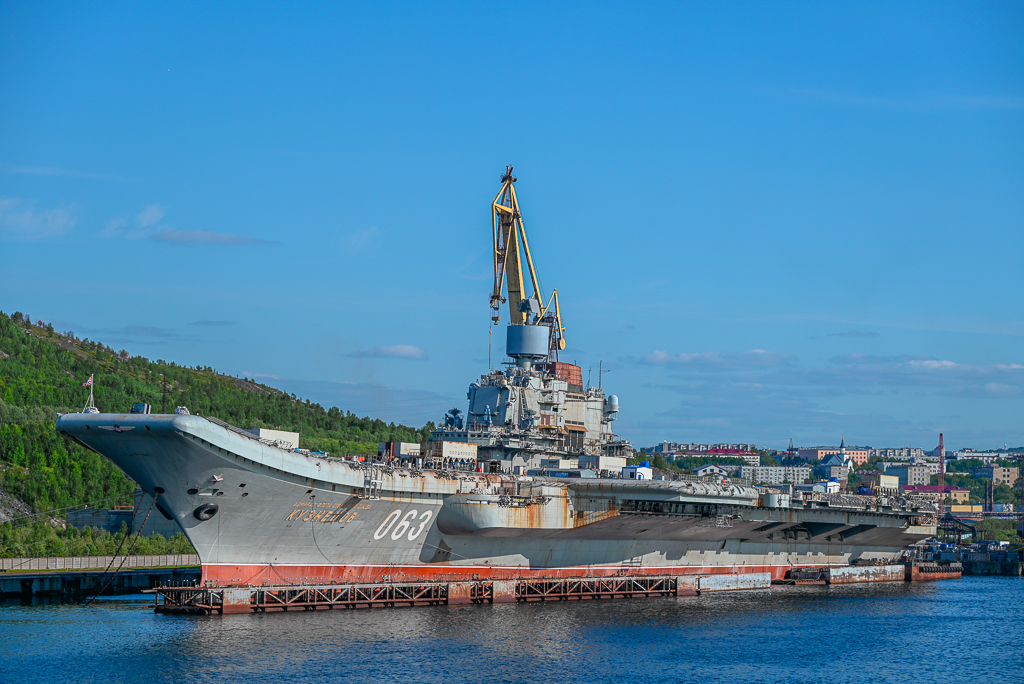
Admiral Kuznetsov, Russia’s only aircraft carrier
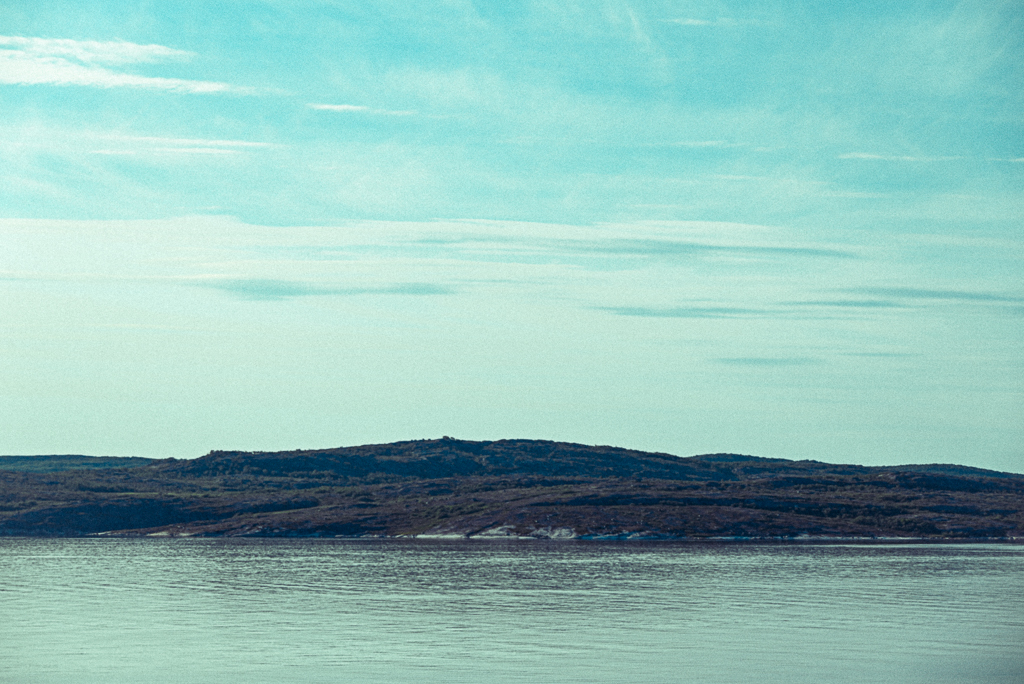
Scenery along Kola Bay
Two Days Across the Barents Sea
It took us almost two days to cross the Barents Sea and reach the islands of Franz Josef Land.
With no landings during the crossing, we had plenty of downtime to explore the ship and settle into our new routine.
50 Years of Victory was enormous. On our first day, we were warned that it was easy to become lost among the ship’s six main levels, long passageways and nearly identical staircases.
It was far larger than the expedition ships I had previously traveled aboard in Antarctica and Greenland. This was not a traditional cruise ship. It was a working nuclear icebreaker that had been adapted to carry passengers for a few weeks each summer.
Life Aboard the Icebreaker
Our days at sea included lectures about Arctic history, early polar exploration, wildlife, sea ice and weather.
We were also served three large meals every day in the dining hall. The food was excellent, and the Russian servers were always friendly and attentive.
I ate far more food than I needed—and far too much ice cream, which I definitely did not need.
Eating became an easy way to pass the time, especially when there were no landings or wildlife sightings to interrupt the daily routine.
Surprisingly, we saw very few whales. Some passengers reported spotting a few dolphins, but I did not see them. This was not Antarctica, where whales often seemed to be everywhere.
Our Cabin Aboard the Icebreaker
I shared a cabin with Wes. It was comfortable and practical, with two beds, a private bathroom and enough room for everything we had brought.
The best feature was the window, which opened completely to the outside. The interior of the ship was often surprisingly warm, so being able to let in the cold Arctic air made the cabin much more comfortable.
Because the sun never set during the Arctic summer, we had to close the heavy curtains whenever we wanted to sleep. Without them, bright daylight would have continued pouring through the window throughout the night.
A Pool, Saunas and a Gym
The ship had amenities I never expected to find aboard a working nuclear icebreaker.
There was a saltwater swimming pool, two saunas and a gym where passengers could exercise. The ship also had Ping-Pong tables and an indoor basketball court with padded walls.
Playing basketball aboard a moving ship was especially entertaining. The floor shifted beneath us as the icebreaker gently rolled, sometimes sending players in directions they had not intended to go. The padded walls proved useful.
Later in the expedition, while we were at the North Pole, I crashed into one of those walls and sprained my pinkie finger.
Passing Time at Sea
There were plenty of quieter ways to spend the crossing.
The ship had a bar, as well as a library and coffee room where we could read, talk with other passengers or simply watch the sea through the windows. At other times, I relaxed in our cabin or wandered through the passageways trying to learn the layout of the ship.
One of my favorite places was the bridge. Passengers were often allowed to visit and watch the Russian officers navigate. It offered a commanding view over the bow and the seemingly endless Arctic water ahead.
When the weather was calm, we could also walk onto the bow and stand near the front of the ship.
An Eclectic Group of Passengers
The crossing also gave us time to meet some of the other passengers. They were an eclectic and fascinating group.
The high cost of the expedition naturally limited who could afford to participate, and it was probably safe to assume that many of the passengers were wealthy. We were told that the group included Russian celebrities, prominent intellectuals, journalists, game-show hosts and other influential members of Russian society.
Two young women had recently traveled to the South Pole together and were now completing their journey to the North Pole. Several other passengers had also visited the South Pole—a considerably more expensive expedition that reportedly cost nearly twice as much as ours.
One man told us that he sold products in Africa and had previously worked with the Wagner Group. There was also an elderly woman who carried herself like a Russian baroness. She had once owned a pet tiger, but when it became too difficult to control, she donated it to a zoo in North Korea.
The expedition staff had equally remarkable stories. Some had worked among walrus colonies in remote corners of the Arctic, while others had accumulated countless experiences in places most people would never visit.
A Surprisingly Calm Crossing
The Barents Sea remained mostly calm during our summer crossing. The immense weight and size of the nuclear icebreaker made it feel far more stable than the smaller expedition vessels I had traveled aboard elsewhere.
The Barents Sea was not always so forgiving. We were told that waves in this part of the world could sometimes rise to approximately 40 feet.
During our crossing, however, there were moments when it was easy to forget that we were aboard a ship at all.
Remembering the Kursk
Later in the crossing, we passed through the approximate area of the Barents Sea where the Russian nuclear submarine Kursk had sunk in 2000.
The submarine was participating in a Russian naval exercise when a torpedo exploded inside its bow. A second, much larger explosion tore through the vessel and sent it to the seafloor. Some sailors survived the initial explosions, but rescue efforts failed to reach them in time. All 118 people aboard eventually died.
As we passed near the area of the disaster, a memorial song played over the ship’s intercom. Everyone aboard observed a moment of silence in honor of the lost crew.
Conversations stopped, and the atmosphere throughout the ship became solemn. Surrounded by the cold, seemingly endless Barents Sea, it was impossible not to imagine the submarine resting on the bottom beneath those same waters.
When the music ended, the normal rhythm of the ship gradually resumed.
For two days, our world had consisted of meals, lectures, basketball, visits to the bridge and the open sea. Then islands began to appear on the horizon.
We were finally approaching Franz Josef Land, but there would be no stopping yet.
For now, it was full speed ahead to the North Pole.
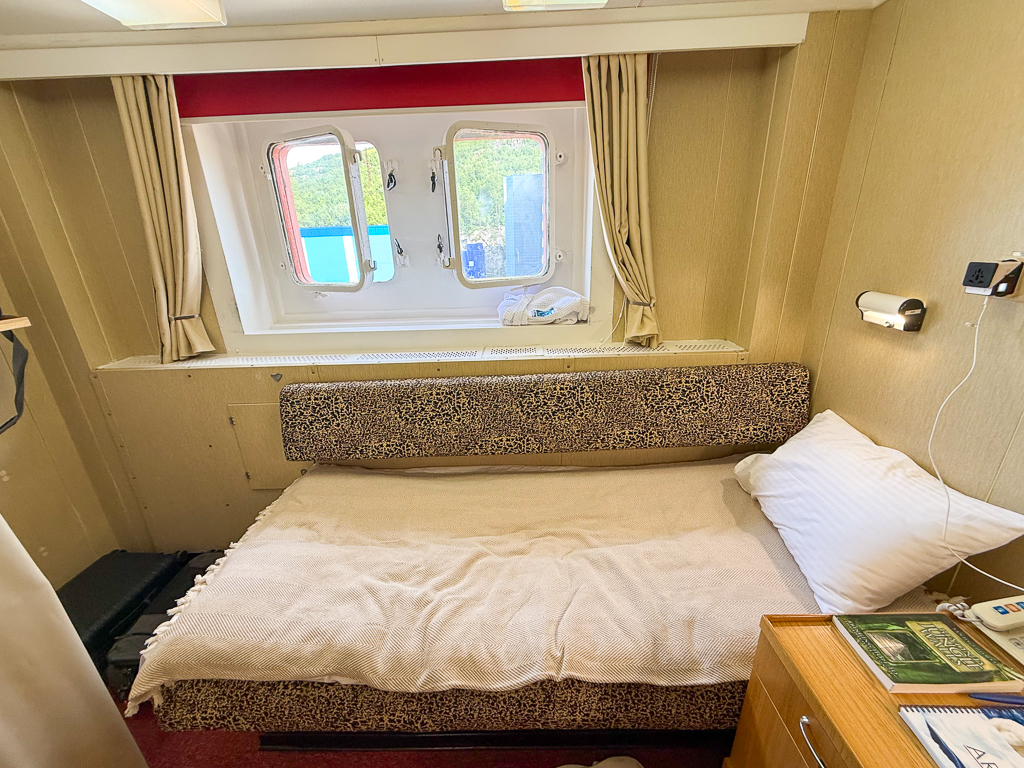
My room
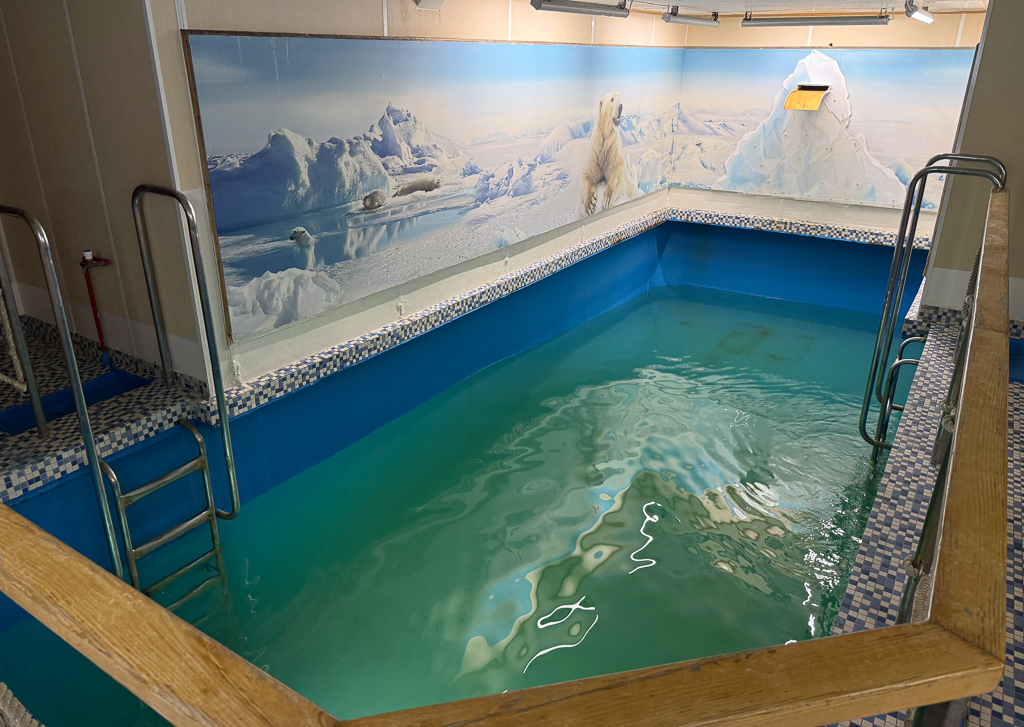
Saltwater pool at the bottom of the ship that used heated water from the Arctic Ocean
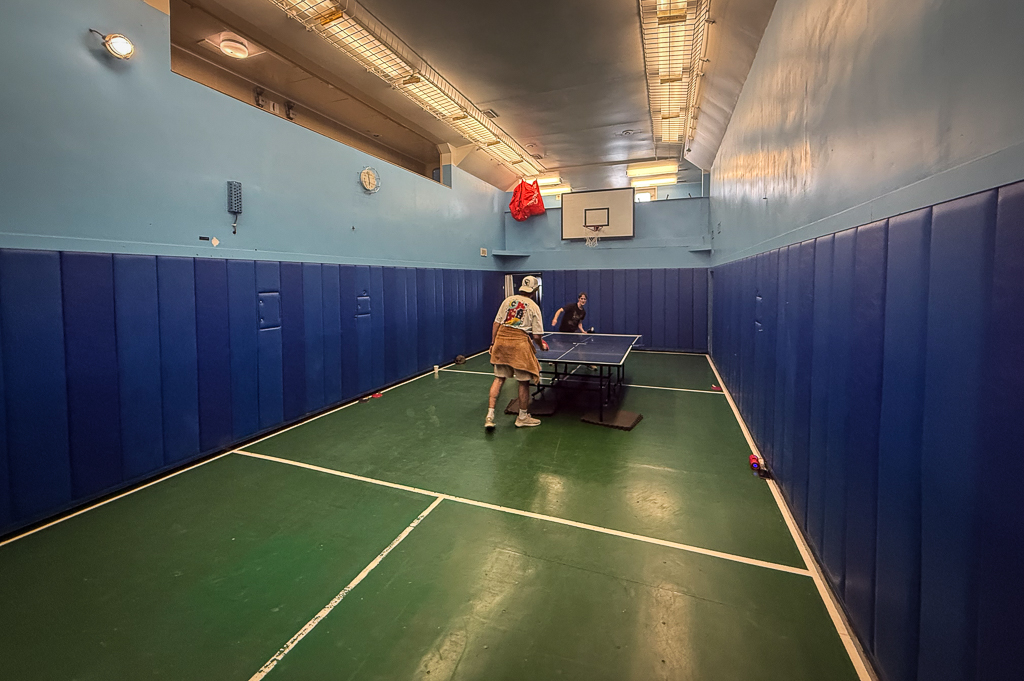
Basketball court also where ping pong was played
Touring the Engine Room
Another highlight of our time aboard 50 Years of Victory was touring the ship’s engine room and meeting the Russian captain and the ship’s chief nuclear specialist for a question-and-answer session.
Unlike most of our lectures, the meeting—not the engine room tour—included a generous supply of alcohol. Passengers gathered with drinks while the captain and nuclear specialist answered questions about the vessel, its crew and the enormous power required to break through Arctic sea ice.
During the presentation, the captain showed us a selection of medals and awards the ship had received for its service, along with a photograph of Russian President Vladimir Putin aboard 50 Years of Victory during an earlier visit. It was another reminder of the ship’s importance to Russia—not only as a working icebreaker but also as a symbol of the country’s power and ambitions in the Arctic.
The captain was understandably careful when discussing certain technical details. When asked about the type and enrichment level of the uranium used aboard the ship, he explained that the information was classified.
Built to Crush Arctic Ice
The captain also explained the ship’s specifications and what made it so effective at breaking ice.
The bow was shaped somewhat like a giant spoon. Instead of simply smashing head-on into the ice, the curved bow allowed the ship to slide partially on top of it. The immense weight of the vessel then fractured the ice beneath it.
Water could also be transferred between the ship’s ballast tanks, shifting additional weight toward the bow when greater crushing force was needed. Similar transfers between tanks on opposite sides could help the ship rock itself free if it became trapped.
The bow was protected by reinforced steel nearly two inches thick. The three enormous propellers and rudders at the stern were also designed to withstand contact with ice, although they could still occasionally be damaged.
We were told that the ship carried spare propellers and had a crane capable of helping replace one. However, it did not carry a specialized ice diver who could perform such a repair beneath the frozen surface, making serious propeller damage a complicated problem.
What truly separated 50 Years of Victory from conventional icebreakers was its power. Its two nuclear reactors supplied the energy for a propulsion system producing approximately 75,000 horsepower.
Nuclear reactors were more expensive to construct than diesel engines, but diesel power would be far less practical for repeated voyages deep into the Arctic Ocean. A conventional ship would need to carry an enormous amount of fuel, while the extraordinary energy density of uranium allowed the icebreaker to operate for years between reactor refuelings.
We were told that even a single gram of uranium could release an immense amount of energy—far beyond what could be produced by the same amount of diesel fuel.
That power allowed the ship to drive its spoon-shaped bow onto the ice and crush through conditions that would stop most conventional vessels. It also gave 50 Years of Victory greater raw icebreaking power than the French expedition ship Le Commandant Charcot, which uses a combination of liquefied natural gas and electric propulsion rather than nuclear power.
Into the Bowels of the Ship
During our tour of the engine room, we descended deep into the bowels of the icebreaker, entering a hot, noisy industrial world far removed from the passenger cabins and lounges above.
We saw the ship’s enormous steam turbines, electrical equipment and massive propeller shafts. These shafts extended toward the stern, where they connected to three giant propellers that drove the ship through the Arctic ice.
We were also shown the outside of the nuclear control room, where trained specialists continuously monitored the reactors and the complex systems surrounding them. We were told they were too busy for us to enter.
I suspected they simply did not want one of us accidentally pressing the wrong button.
How a Nuclear Icebreaker Works
Behind heavily protected walls were the ship’s two nuclear reactors.
The basic principle was easier to understand than I had expected. Nuclear fission inside the uranium fuel produced enormous amounts of heat. Control rods regulated the reaction by absorbing neutrons and could be inserted farther into the reactors whenever less power was required.
Heat from the reactors generated steam within a closed system. The steam drove turbines that produced electricity for the ship. Powerful electric motors then used that energy to turn the three propeller shafts.
In other words, 50 Years of Victory was not merely a ship with powerful engines. It was a floating nuclear power plant capable of producing the immense energy needed to force its way through thick Arctic ice.
More Electricity Than We Could Use
The ship generated far more electricity than its passengers could ever consume.
At one point, our expedition leader told us not to worry about switching off the lights when we left our cabins. Conserving electricity was not a serious concern aboard a nuclear-powered icebreaker. For the electricians, fixing broken light switches was the greater concern.
Nuclear Risk Far From Help
The possibility of a nuclear accident had definitely been on my mind before the trip.
When you are more than a thousand miles from the nearest meaningful assistance and something goes wrong with a nuclear reactor, there are not many good options. Nuclear accidents have occurred at power plants on land, but they have also happened aboard ships and submarines.
The Soviet icebreaker Lenin experienced serious reactor incidents during its years of operation. It was a much older pioneering vessel, however, and nuclear technology and safety systems had improved considerably by the time 50 Years of Victory entered service.
The broader Soviet and Russian nuclear fleets had also experienced fires, collisions and coolant-system failures. In some individual incidents, officials reported that no radiation had been released, although the history of Soviet nuclear submarines included far more serious accidents.
Before our trip, we had also read about a collision involving 50 Years of Victory and the cargo ship Yamal Krechet in the Kara Sea. The icebreaker had been assisting the cargo vessel through the ice when the two ships collided, tearing a large opening in the icebreaker’s outer hull near the bow.
The reactors were not damaged, no one was injured and the ship remained operational, although the hull later required repairs.
We considered asking the captain about the collision but ultimately decided it might be better to avoid the subject.
According to the captain, 50 Years of Victory itself had never experienced a nuclear accident. The reactors were surrounded by multiple layers of containment, and critical areas were maintained under strong negative pressure. If a leak occurred, contaminated air would be drawn inward rather than escaping into other parts of the ship.
Highly trained nuclear specialists monitored the reactors around the clock and remained prepared to respond if something went wrong.
All of that was reassuring, but it did not completely eliminate the thought from my mind.
We were traveling through one of the most remote regions on Earth, days away from outside assistance. If a serious nuclear emergency forced us to abandon the ship, we might find ourselves crowded into small lifeboats or life rafts in the middle of the Arctic Ocean, waiting days for help to arrive.
It was not a comforting possibility to imagine.
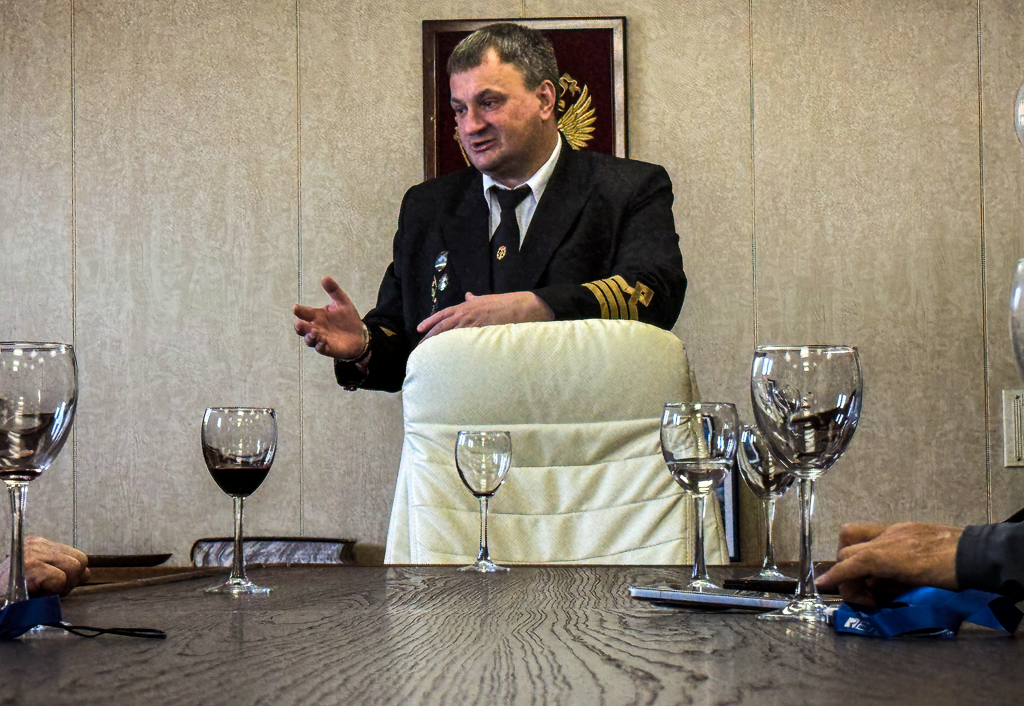
Meeting the captain
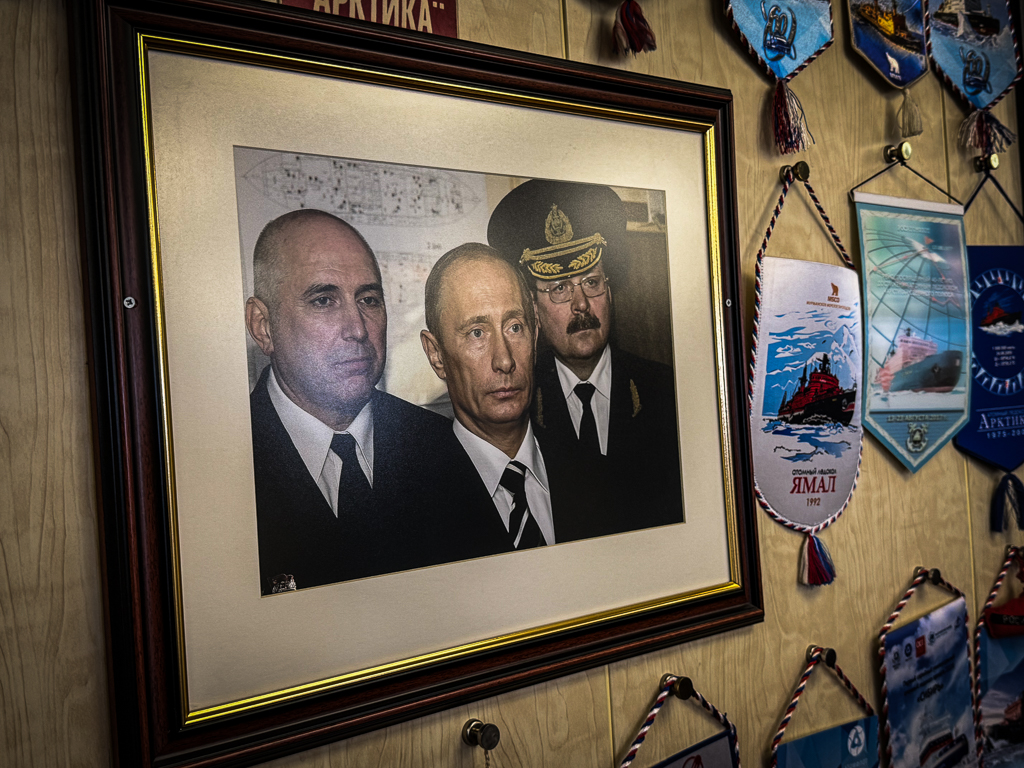
Portrait of Putin when he visited the ship
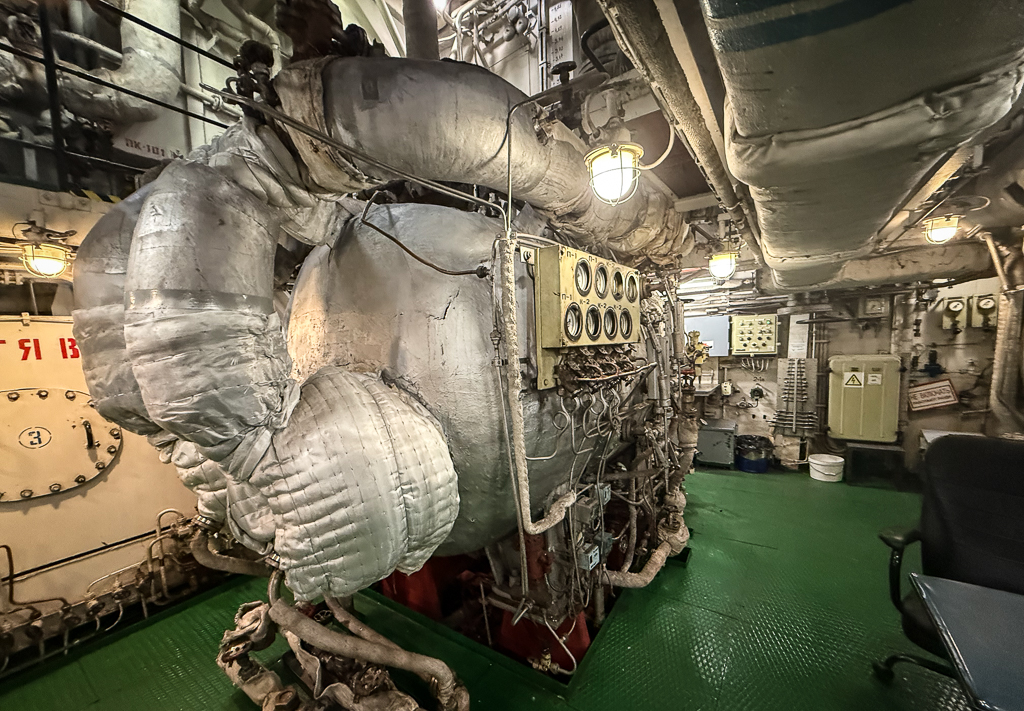
Engine room tour
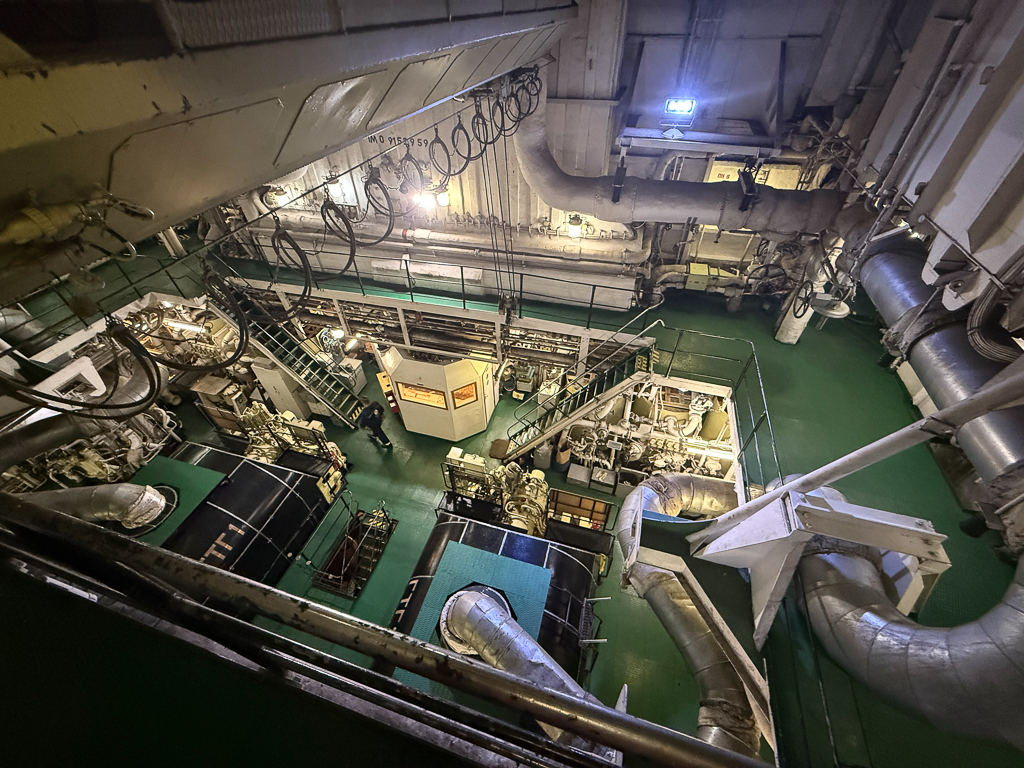
Engine room tour
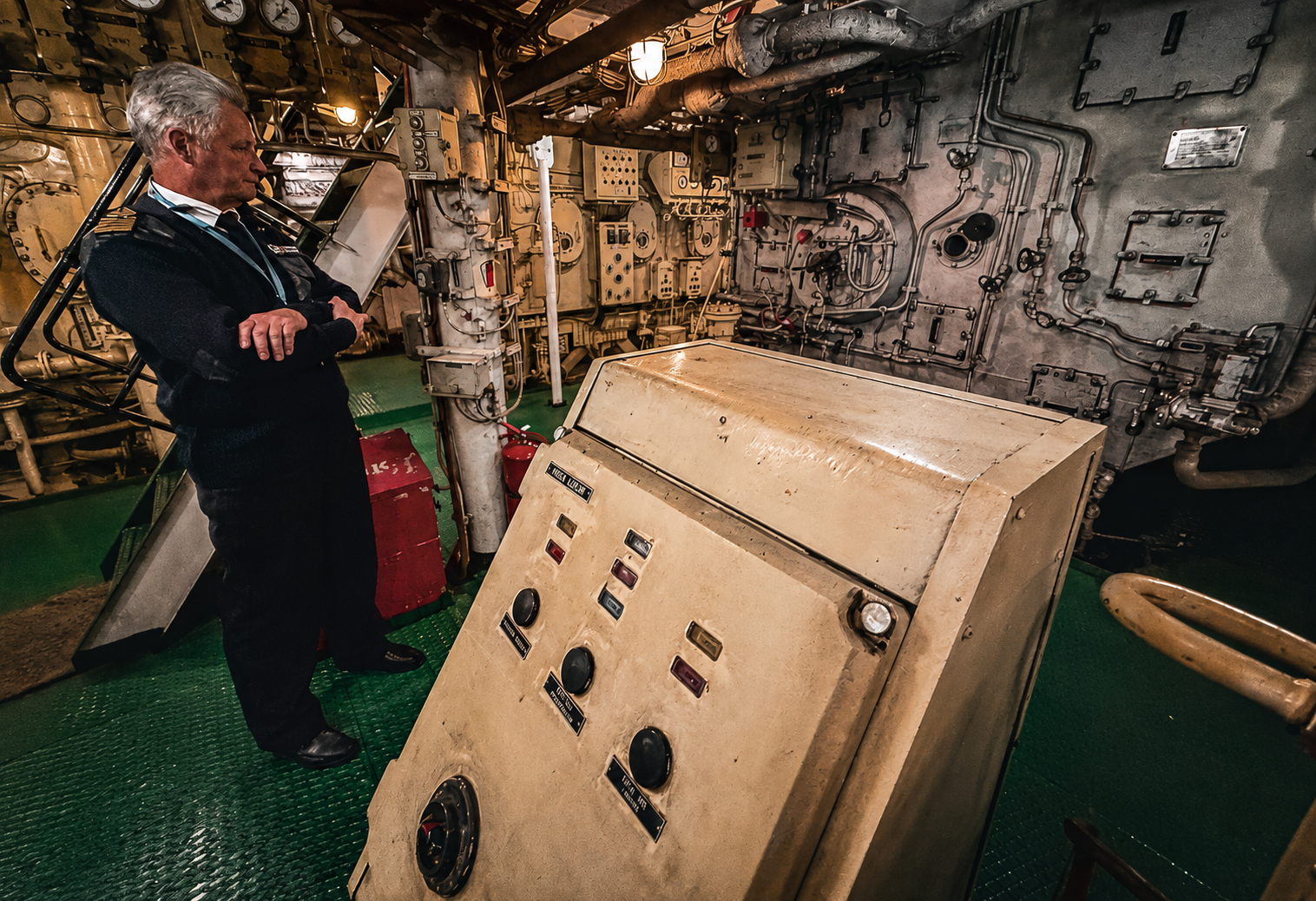
Chief Physicist in a Control Room
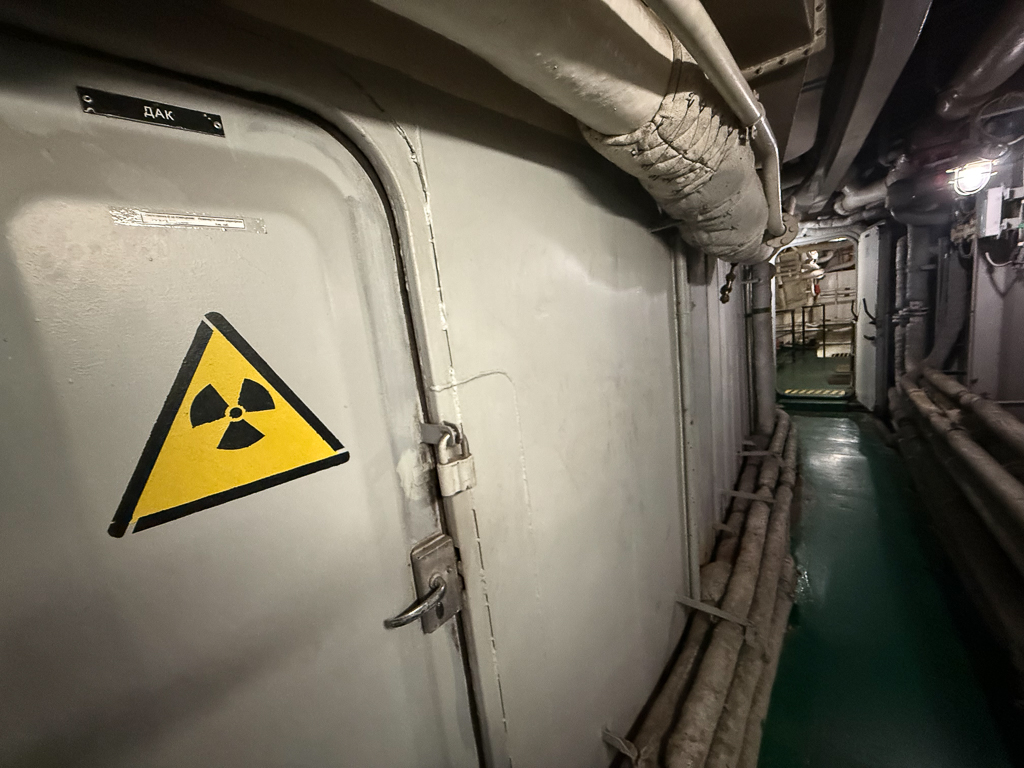
Radiation warning sign near nuclear reactors
Reaching the Arctic Ice
The passengers from the previous week’s expedition had encountered the edge of the Arctic sea ice near the middle of the Franz Josef Land archipelago.
Under more typical conditions, the crew told us, the ship would begin encountering sea ice before reaching the islands. On our voyage, however, we sailed a couple of hours north of Franz Josef Land before finding the main ice edge.
Veteran crew members described this as extraordinary. To them, it was another visible sign of how rapidly the Arctic climate was warming and changing.
The First Collision
We were eating dinner when 50 Years of Victory struck the first substantial ice.
We did not need an announcement to know what had happened. The impact traveled through the entire ship, followed by vibrations that felt like severe turbulence aboard a wide-body jet.
The ship shook and occasionally shuddered as its reinforced bow rode onto the ice and crushed it beneath its immense weight. Each impact produced a deep grinding sound that reverberated through the hull.
After two calm days crossing open water, we had finally entered the environment this ship had been built to conquer.
Breaking Through Ten-Foot Ice
As we continued north, the ice became thicker and more continuous. Some sections and pressure ridges were reportedly as much as ten feet thick.
Even aboard one of the world’s most powerful icebreakers, moving through ice of that thickness was not effortless. The impacts shook our cabins, rattled objects and sent vibrations through the floors and walls.
From that point until we reached the North Pole, sea ice would surround us. The farther north we traveled, the fewer stretches of open water remained.
Finding the Easiest Route North
The crew did not simply point the ship north and smash through everything in its path.
From the bridge, the officers searched for natural openings, fractures and weaker areas between the ice floes. Whenever possible, they guided the ship through these open leads, conserving time and reducing the strain on the vessel.
I watched the officers use the ship’s specialized ice radar to help chart a course through the frozen ocean. I learned that much of the navigation was still done visually, with experienced officers studying the color, texture, and movement of the ice ahead.
The radar provided another layer of information, helping the crew identify unusually dense or thick concentrations of ice that might damage the ship or leave it temporarily trapped.
When no open route existed, 50 Years of Victory did what it had been built to do: it drove its massive spoon-shaped bow onto the ice and crushed a path forward.
If the ship encountered ice too thick to break on the first attempt, it could reverse, gather momentum, and ram the same section repeatedly. If that still failed, the crew would back away, change direction and search for a weaker route. Although this didn’t happen to us, I was told it does occur.
I was told that even this enormous icebreaker was not guaranteed to reach the North Pole. On at least one expedition during the previous decade, exceptionally difficult ice conditions had reportedly prevented the ship from reaching exactly 90 degrees north.
Watching the Ice Break
Enormous chunks of blue ice—some seemingly as large as houses—rose, twisted and shattered beneath the massive steel bow of 50 Years of Victory. Other pieces rolled onto their sides, briefly revealing deep shades of blue that had been hidden beneath the surface.
The cracking and grinding reverberated through the hull as the ice broke apart and disappeared beneath the ship. From inside our cabins, we could feel the vibrations traveling through the floors and walls.
Watching this spectacle quickly became one of our favorite ways to pass the time. We spent countless hours on the bridge looking over the bow, standing outside near the front of the ship and watching the ice pass directly beneath our cabin window.
Each location offered a different perspective, and no matter how many hours we watched, the sight of those enormous blocks of ice breaking beneath the ship never became ordinary.
Alone in a Frozen World
The world surrounding us was surreal. In every direction, broken sheets of sea ice stretched toward the horizon beneath the endless daylight of the Arctic summer.
The ship appeared nearly indestructible as it forced its way forward, but we were profoundly isolated. There were few other vessels anywhere near us and almost no one who could come quickly to our rescue if something went seriously wrong.
The ice that had stopped, trapped and destroyed the ships of earlier explorers was now beneath us. Yet even aboard one of the most powerful icebreakers ever constructed, the Arctic remained a place where nature ultimately determined whether we could continue.
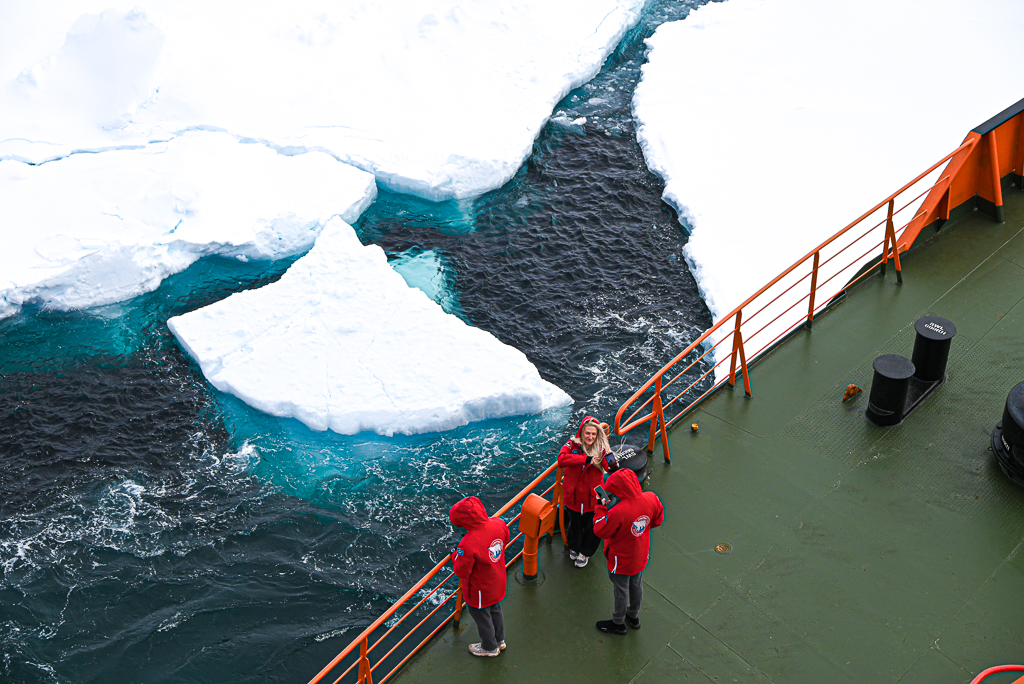
Watching the ship break ice
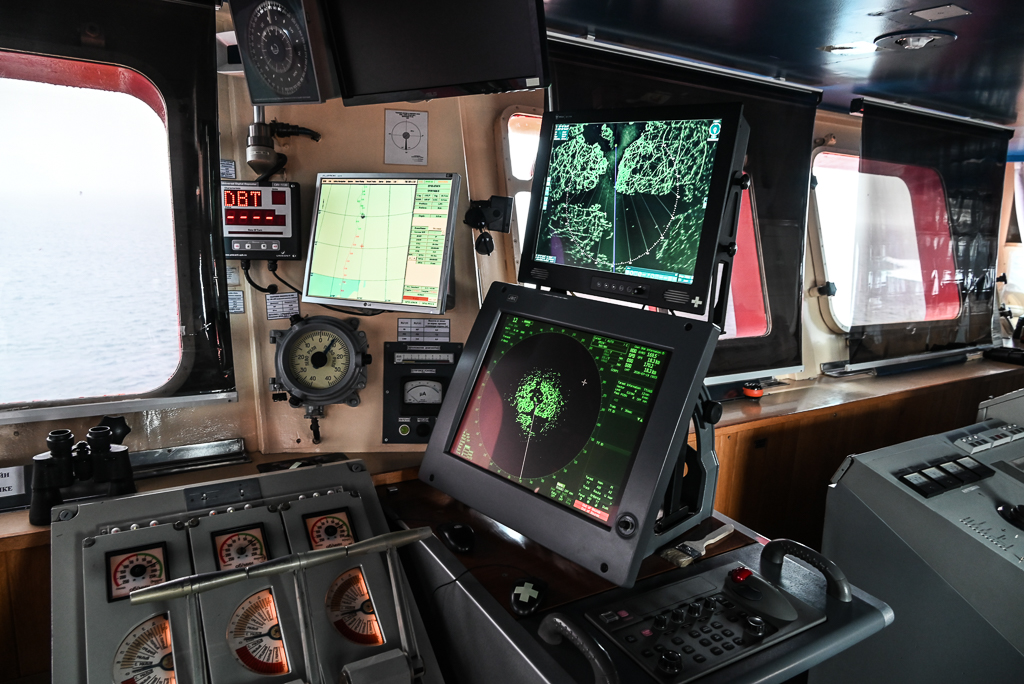
Ice radars in the bridge
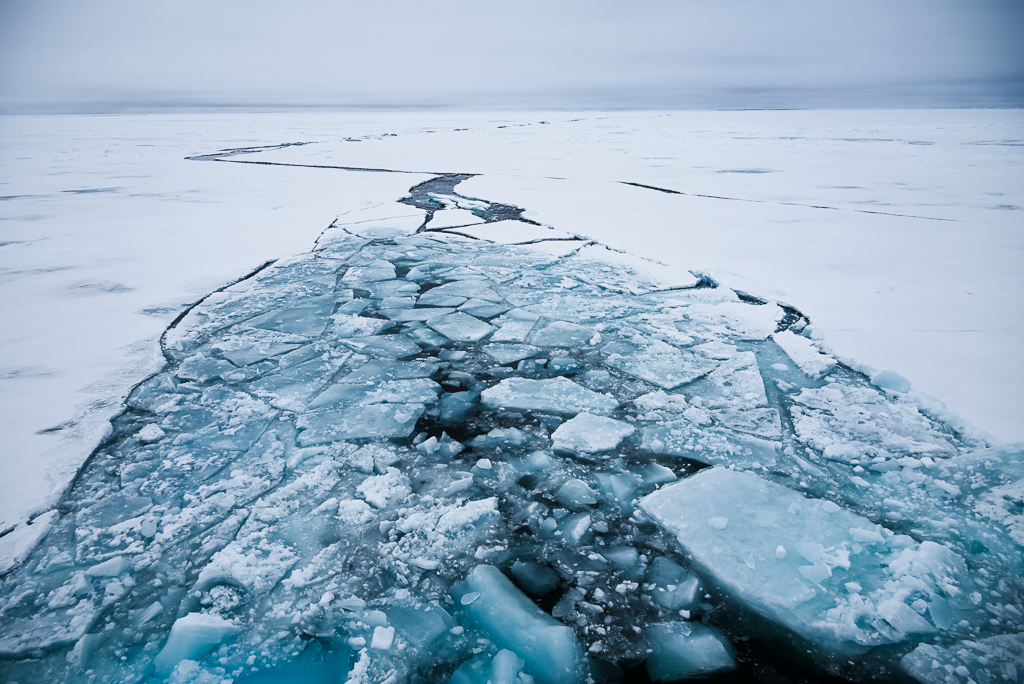
Our wake of broken ice
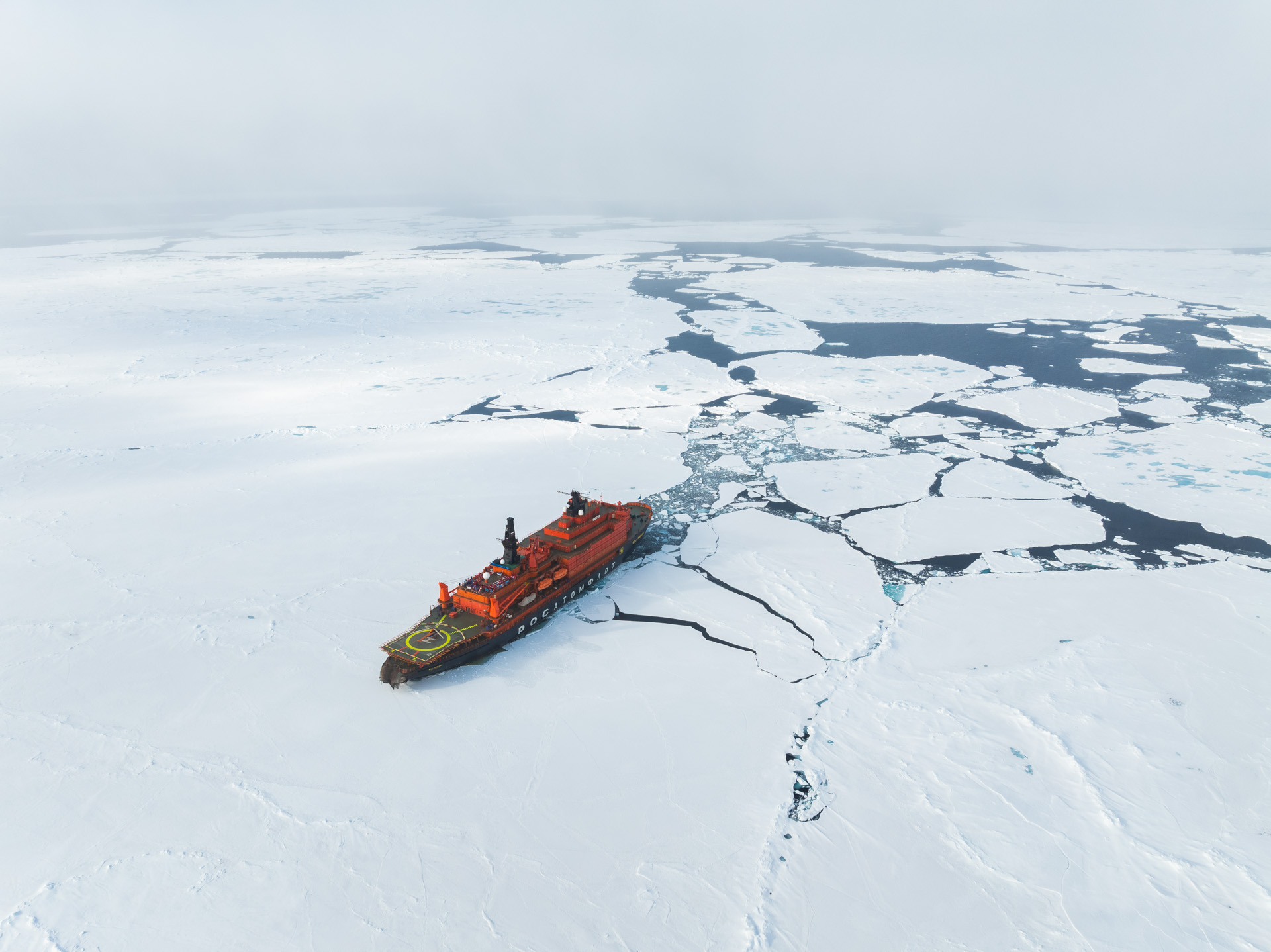
View of ship from the expedition drone
Breaking ice by the North Pole
View of massive chunks of ice breaking from my bedroom window
Close up of ice breaking
A Party in the Arctic Ice
On the night before we reached the North Pole, 50 Years of Victory stopped among the Arctic ice floes for an enormous outdoor barbecue and dance party on deck.
The crew prepared a feast, and the supply of alcohol seemed bottomless. Wine and vodka flowed freely as Russian music played from loudspeakers across the frozen Arctic Ocean.
Passengers who had spent the previous days attending lectures, watching the ice and quietly exploring the ship suddenly filled the deck. Everyone ate, drank and danced beneath the midnight sun, surrounded by an endless landscape of ice.
A Night Without Darkness
During the Arctic summer, the sun never sets. There was no darkness to signal that the party should end and almost no visible difference between late evening and the middle of the night.
Time became strangely difficult to judge. Even as the hours passed, sunlight continued reflecting from the ice while music carried across a place normally defined by silence and isolation.
Surrounded by ice near the top of the world, we continued celebrating far later than most of us had planned.
We had a blast. The festivities lasted deep into the night—and for some passengers, the hangovers lasted even longer.
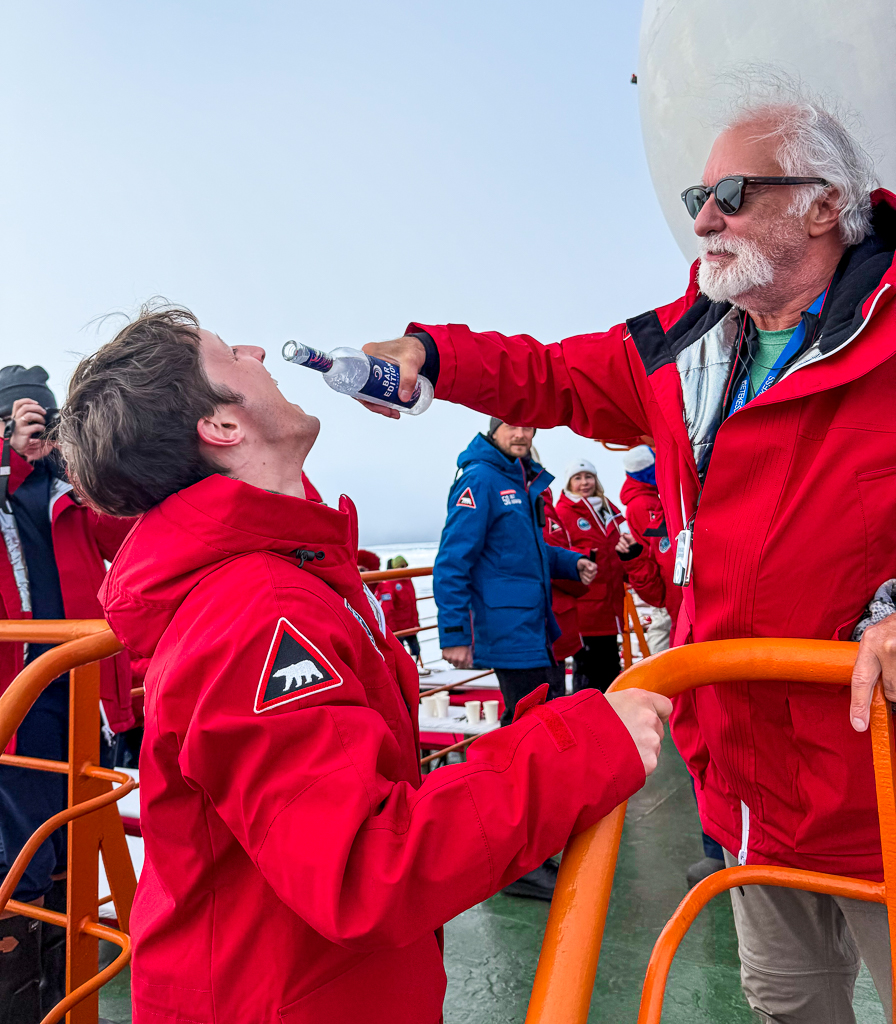
Vodka pours
Dance party on deck with a polar bear
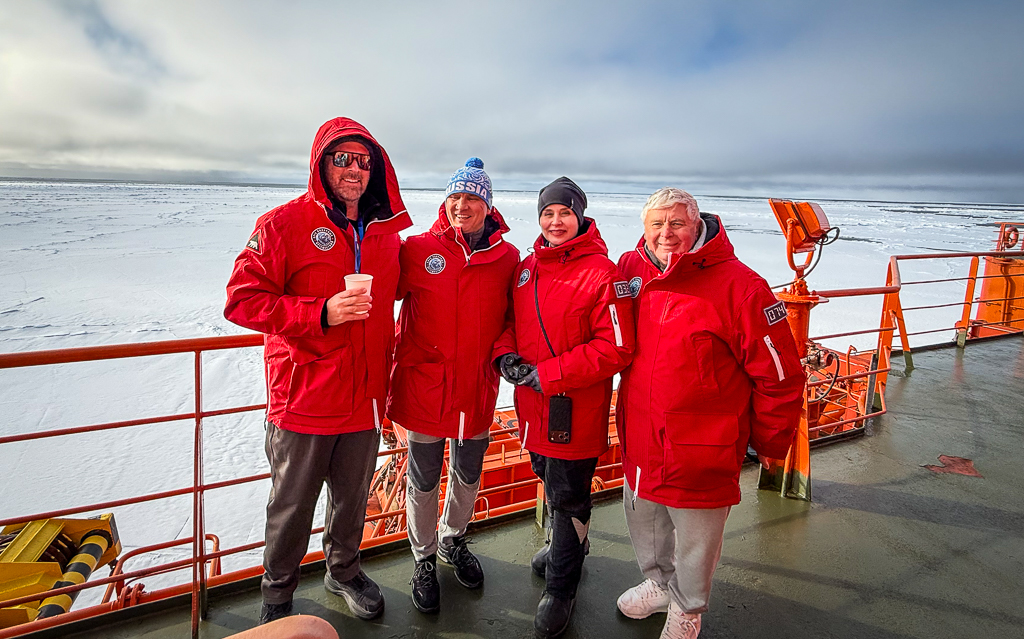
Me with new Russian friends
Reaching the North Pole
On the fifth day of the expedition, we finally reached the top of the world.
Since departing Murmansk on Monday afternoon, we had traveled almost 1,500 miles—sailing through Kola Bay, crossing the Barents Sea, passing through Franz Josef Land and continuing north through the frozen High Arctic.
Now we had arrived at 90 degrees north: the geographic North Pole.
Finding 90 Degrees North
Reaching the exact North Pole was more complicated than simply steering toward a fixed point.
The geographic coordinate of 90° north never moves, but the sea ice covering it is constantly drifting. Wind and ocean currents carry the ice beneath the ship, making it difficult for the crew to hold 50 Years of Victory directly over the exact position.
The officers carefully maneuvered the ship while continuously monitoring its coordinates. When we finally reached 90° north, the ship’s enormous horn blasted across the frozen Arctic Ocean.
The Russian national anthem played, champagne glasses were raised and passengers celebrated our arrival at the North Pole.
After everything required to reach this place, the moment felt almost unreal.
Calling My Family From the Top of the World
During the celebration, Bill allowed me to use his satellite phone to call Paula and Indie.
I still could not believe that he had managed to bring the phone into Russia and then through security aboard a nuclear-powered icebreaker. He was not the only one; several Russian passengers had satellite phones as well.
Being able to hear the voices of my wife and daughter while aboard a ship at the North Pole became one of the most meaningful moments of the entire expedition.
I had traveled to one of the most isolated places on Earth, yet for a few minutes, the satellite phone connected me directly to home.
Finding Safe Ice to Land On
Although the ship had reached 90° north, we could not simply walk outside and stand on the exact coordinate.
There is no land at the North Pole—only drifting sea ice floating over an ocean more than two miles deep. The crew needed to find an ice floe thick and stable enough to support the passengers, expedition equipment and activities planned for the following day.
Because the ice was continually moving, any marker placed at the North Pole would immediately begin drifting away from 90° north. The geographic point remained fixed, but the surface beneath our feet did not.
The captain and expedition team therefore planned to position the ship as close to the geographic pole as safety allowed.
Not Alone at the North Pole
One thing we had not expected to see when we reached the North Pole was another ship in the distance.
It was Le Commandant Charcot, the French expedition vessel and the only other passenger ship regularly making the journey to the North Pole.
Part of me had imagined arriving in complete isolation, so seeing another ship initially diminished that feeling. At the same time, its presence was comforting. In this remote part of the world, there were almost no other vessels capable of reaching us if something went seriously wrong.
We were told that the French crew felt much the same way about having 50 Years of Victory nearby. Our nuclear icebreaker was larger and more powerful, and Le Commandant Charcot sometimes followed the channel it opened through particularly heavy ice.
According to members of our expedition staff, 50 Years of Victory had even helped guide the French vessel out through difficult ice several years earlier. They said the Russian and French captains and crews had been on good terms and cooperated despite the increasingly hostile relationship between their governments following Russia’s invasion of Ukraine.
The Russian staff also told us that French news reports later portrayed that encounter very differently, suggesting that the Russian icebreaker had behaved aggressively toward the French vessel rather than assisting it.
Whether something had been lost in translation or the story had simply become entangled in wartime politics, the Russian crew felt betrayed—not by their French counterparts, but by how the encounter had reportedly been presented in France. According to our expedition staff, the experience ended further cooperation between the two vessels.
That resentment apparently remained during our visit. We were told that the French crew had asked whether some of their passengers could walk across the ice to see 50 Years of Victory more closely. Many were curious to see the enormous nuclear icebreaker, but our captain denied the request—apparently still angry over the earlier controversy.
It would have been interesting to meet the passengers from the French ship. Unlike our predominantly Russian group, many of them were probably Western Europeans or Americans. At the same time, I did not mind preserving our privacy and experiencing the North Pole separately.
For several hours, we could see the French passengers walking on the ice around their vessel. Later that evening, Le Commandant Charcot sailed past us and disappeared into the distance.
There was no exchange of horn salutes between the two ships.
Once the French vessel was gone, we were alone at the North Pole. We would remain there through the night and into the following day, when it would finally be our turn to walk on the ice.
Preparing for Polar Bears
The following morning, members of the expedition team would be the first to leave the ship.
Armed guards would establish a security perimeter and watch for polar bears before passengers were allowed onto the ice. According to the crew, polar bears had appeared during two North Pole visits over the previous decade.
During one of those encounters, a drone captured an extraordinary image of a polar bear standing in front of the ship and chewing on the expedition’s North Pole sign.
It was a vivid reminder that despite the champagne, music and celebrations, we were still visitors in the domain of the Arctic’s largest predator.
Once the area was declared secure, the crew would establish the North Pole marker and prepare a heated sauna tent and barbecue on the ice.
For the rest of the night, however, we remained aboard the ship and continued celebrating.
We had reached the North Pole—and that night, we would sleep at the top of the world.

Moment we reached the north pole
North Pole celebration
A Day at the Geographic North Pole
The highlight of the expedition was finally upon us.
For the first time in nearly a week, we would leave the ship and walk freely outside. What looked like firm ground, however, was actually a drifting sheet of sea ice between four and eight feet thick.
Beneath it lay almost 14,000 feet of dark, freezing Arctic Ocean.
Two Different North Poles
There are two different North Poles.
The magnetic North Pole is the constantly changing point toward which compass needles are drawn. Its movement is caused by changes in Earth’s magnetic field generated by molten iron flowing within the planet’s liquid outer core.
At the time of our expedition, the magnetic pole was located roughly 300 miles from the geographic North Pole and continued to drift toward Siberia.
This is one reason an ordinary magnetic compass cannot reliably guide someone to the geographic North Pole. Near the magnetic pole, the horizontal force directing the needle becomes extremely weak, causing compass readings to become unstable.
The geographic North Pole is entirely different. It is the fixed point at 90° north where Earth’s rotational axis meets the surface and where every line of longitude converges.
That was the North Pole we had come to reach.
Onto the Frozen Ocean
That morning, we descended the ship’s gangway and stepped onto the ice.
After days aboard the icebreaker, it felt wonderful to walk freely again. Turning around revealed 50 Years of Victory towering above us.
The immense vessel appeared to be resting on the ice like a jumbo jet that had somehow landed in the middle of the Arctic Ocean. Seeing its steel hull from below gave me an entirely new appreciation for the ship’s size and power.
Thick fog surrounded us, sometimes hiding much of the vessel from view. The poor visibility also concerned the expedition staff, who needed to watch for polar bears approaching across the ice.
The floe beneath us formed part of the vast Arctic ice pack, which expands during the dark winter and shrinks beneath the summer sun.
I learned that the disappearance of Arctic sea ice is not simply caused by warmer summers. Warmer winters delay freezing and prevent the ice from becoming as thick and strong as it once did. When summer returns, the younger, thinner ice melts more easily.
For hundreds of miles in every direction, the frozen surface was interrupted only by narrow channels of open water known as leads. Wind and ocean currents pushed the floes together and pulled them apart, almost like enormous tectonic plates. Their movement opened dark cracks of seawater that would eventually freeze again.
Despite its solid appearance, nothing around us was truly stationary.
A North Pole That Would Not Stay Still
During the night, the ship and its surrounding floe had drifted away from the geographic North Pole and then moved closer to it again.
By morning, we remained near 90° north, but we were no longer directly over the exact coordinate.
That was the strange reality of visiting the North Pole. The geographic location remained fixed, but the ice covering it was always moving.
The crew erected a North Pole sign in front of the ship, where we took some of the most iconic photographs of the expedition. The marker was symbolic. As soon as it was placed on the ice, it began drifting with everything around it.
Every Direction Was South
I realized something incredible while looking out across the ice: no matter which direction I traveled, I would be heading south.
There was no farther north. I could not take another step toward “up.”
Growing up in Minnesota, my family treasured vacations along Lake Superior. Like most Minnesotans, we referred to the northern part of the state simply as “Up North.”
As a child, it seemed like the far north of the world—a cooler, forested and remote place beside Canada.
But northern Minnesota was now thousands of miles south of us.
This was the true Up North.
There was no place more “Up North” than this.
The realization also made home feel strangely closer. In a straight line, San Diego was nearer than it would have been if I retraced our long route through Russia and Istanbul.
In theory, I needed only to travel south across the Arctic and North America. In reality, that would require crossing an impossible distance of shifting ice, open ocean and wilderness. Returning through Russia remained the slightly more practical option.
Still, thinking about the geography made Paula and Indie feel a little less distant.
A Week Alone at the North Pole
The crew told us about a previous passenger who had wanted to experience the isolation of the North Pole in an even more extreme way.
He reportedly paid for two consecutive voyages so that the ship could leave him behind with his camping equipment and collect him when it returned approximately one week later.
I tried to imagine watching 50 Years of Victory disappear into the fog and realizing that I was completely alone on a drifting sheet of ice, surrounded by thousands of feet of ocean and hundreds of miles of frozen emptiness.
The silence and desolation must have been almost impossible to comprehend.
The idea would have appealed to a younger version of me. There was something extraordinary about the thought of spending a week alone at the top of the world, with no cities, roads or other people anywhere in sight.
Now, however, I missed my family too much. A week alone at the North Pole sounded less like an adventure and more like seven additional days away from Paula and Indie.
I was content to experience the isolation for a few hours—and to know that the ship would still be there when I returned.
Hiking Across the Ice
We set off on a walk of approximately one mile.
Armed polar-bear guards accompanied us, carrying rifles over their shoulders and continually scanning the foggy horizon.
We did not encounter a polar bear. In fact, we saw no wildlife at all—not even a bird.
The absence of life reinforced the extreme isolation of the place. It felt like true desolation: an environment in which humans remained only temporary visitors.
At one point, I wandered away from the others, lay down alone in the snow and stared at the sky.
For several minutes, I remained there in silence, allowing the reality of where I was to sink in.
I was lying on a drifting sheet of ice at the geographic North Pole, with almost 14,000 feet of ocean beneath me.
After dreaming about this place for so many years, the realization overwhelmed me.
The Polar Plunge
After the hike, it was time for the polar plunge.
The ship had opened a channel beside its hull where passengers could enter the water. Several of us changed into swimsuits and prepared to jump into the Arctic Ocean.
The water was approximately 31 degrees Fahrenheit—below the normal freezing point of freshwater, but still liquid because of its salt content.
For safety, each swimmer was secured to a rope so the crew could pull us out if the cold caused us to become incapacitated or lose consciousness. The precaution made sense. Entering water that cold could trigger an immediate physical shock, and the possibility of suffering a heart problem was difficult to ignore.
I jumped in and completely submerged my body and head. For a few seconds, I was swimming above nearly 14,000 feet of Arctic Ocean, approximately 500 miles from the nearest land in Franz Josef Land.
The cold was immediate and overwhelming. There was no gradual adjustment. My body’s only message was to get out as quickly as possible, and once was more than enough for me.
Some of the Russians were far more ambitious. Several entered the water repeatedly, while others swam away from the entry point and toward the ship, remaining in the ocean for nearly five minutes.
Although they had safety ropes, they ventured so far from the people waiting at the edge that it seemed doubtful anyone could have reached them quickly if they had suffered a serious medical emergency. If one of them experienced cardiac trouble or became incapacitated, there would be only seconds to respond.
My friend Victor, who was 80 years old, put on a snorkel and swam farther than most of us dared. By the time he began returning, his skin had turned purple and he appeared to be becoming disoriented. Watching him struggle back was a frightening reminder of how quickly water that cold could overwhelm even a strong and determined swimmer.
Another passenger burst a small blood vessel in her eye during the plunge. Her eye remained visibly bloodshot for the rest of the expedition.
Once everyone was safely out of the water, we rushed into the heated sauna tent erected on the ice and followed the experience with shots of Russian vodka.
Barbecue at the Top of the World
Later, the crew served an enormous barbecue on the ice.
Within the guarded perimeter, we were free to walk around, take photographs and absorb the strangeness of our surroundings. The icebreaker towered above us while armed guards continued watching the fog for polar bears.
We spent most of the day on the drifting floe before finally returning to the ship.
Soon, 50 Years of Victory would turn south toward Franz Josef Land.
But for one extraordinary day, I had hiked across the frozen ocean, eaten a barbecue, taken a sauna and plunged into the water at the very top of the world.
I had reached the geographic North Pole. Now it was time to go back south.
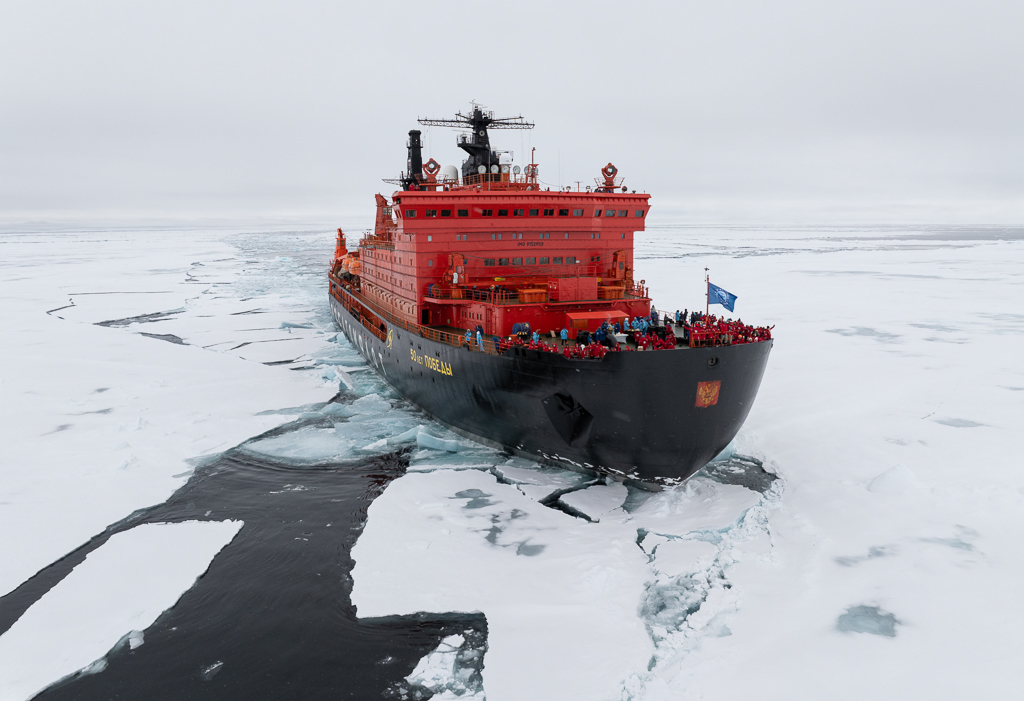
Parked at the north pole
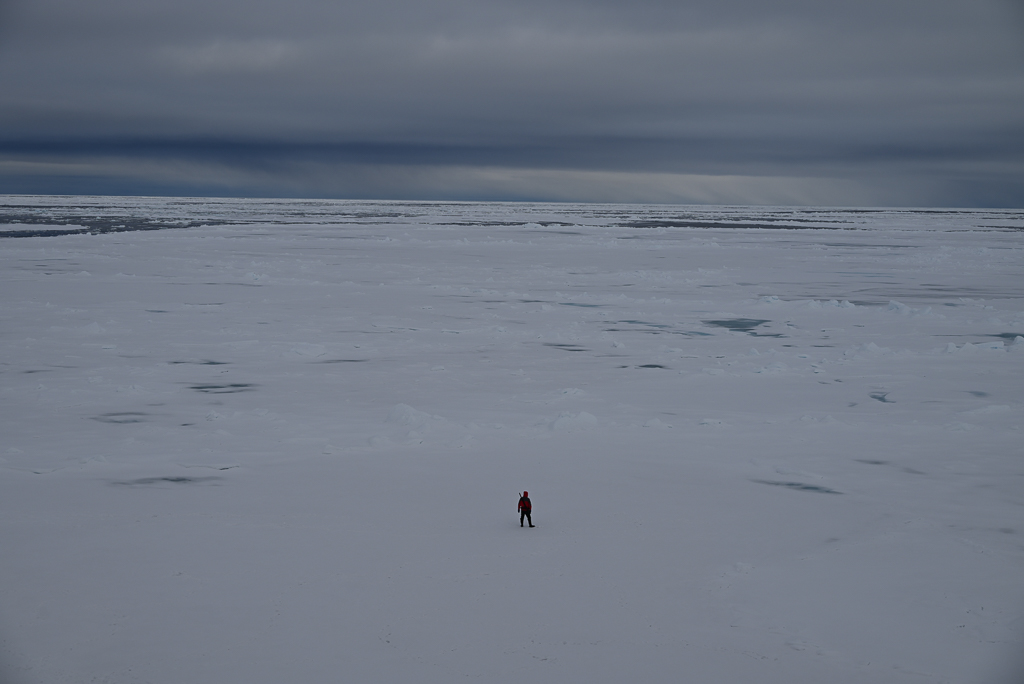
Lone rifleman standing guard for polar bears
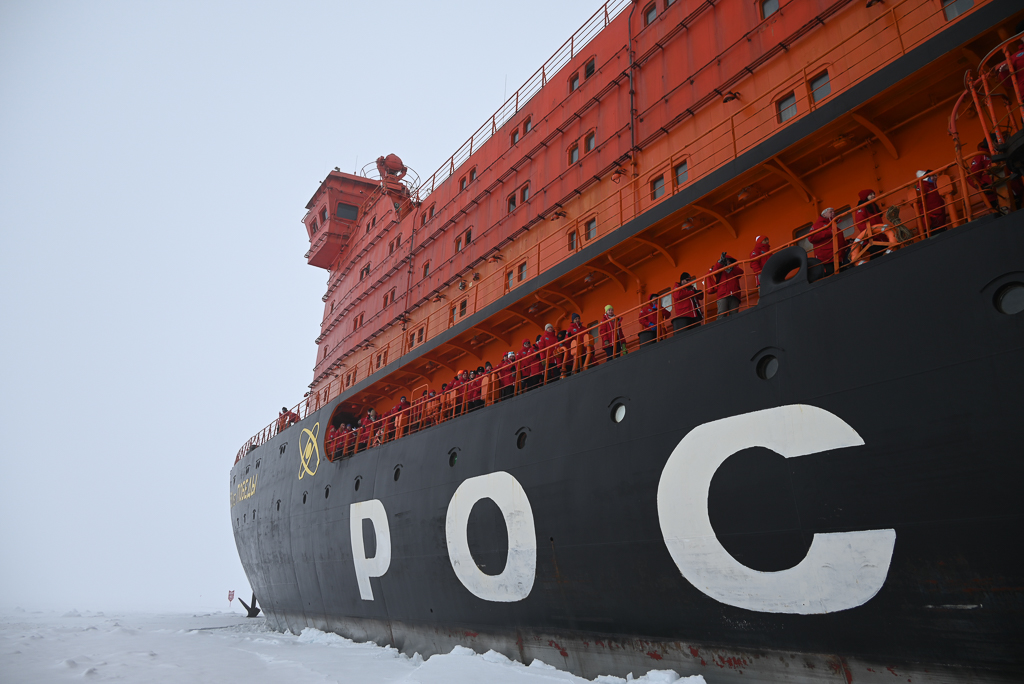
View of the ship when I disembarked at the north pole
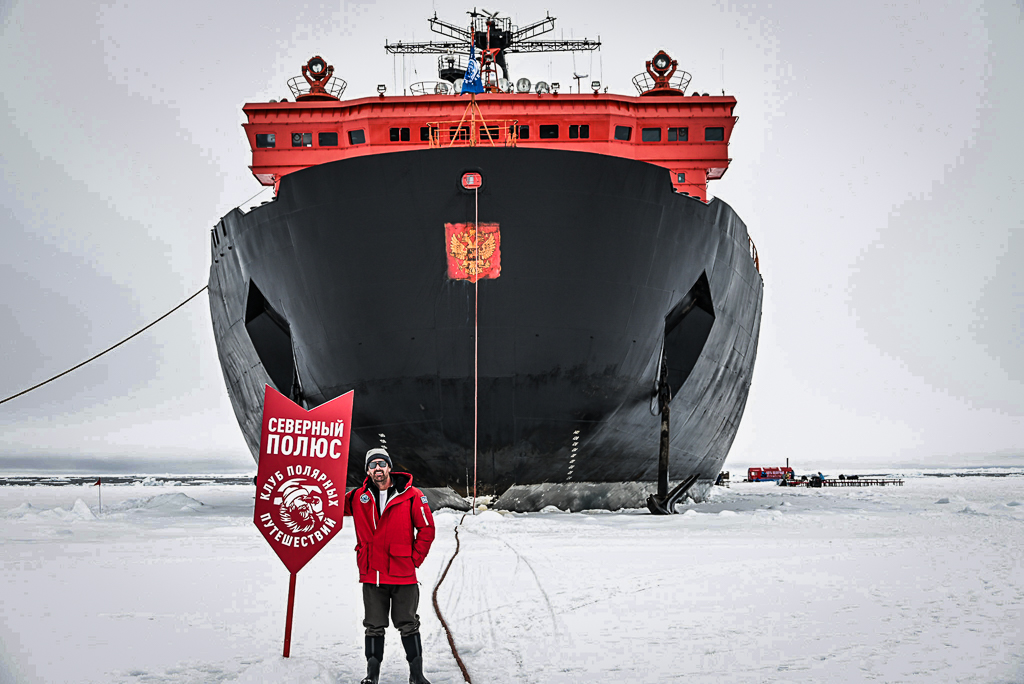
Me in front of the ship at the north pole
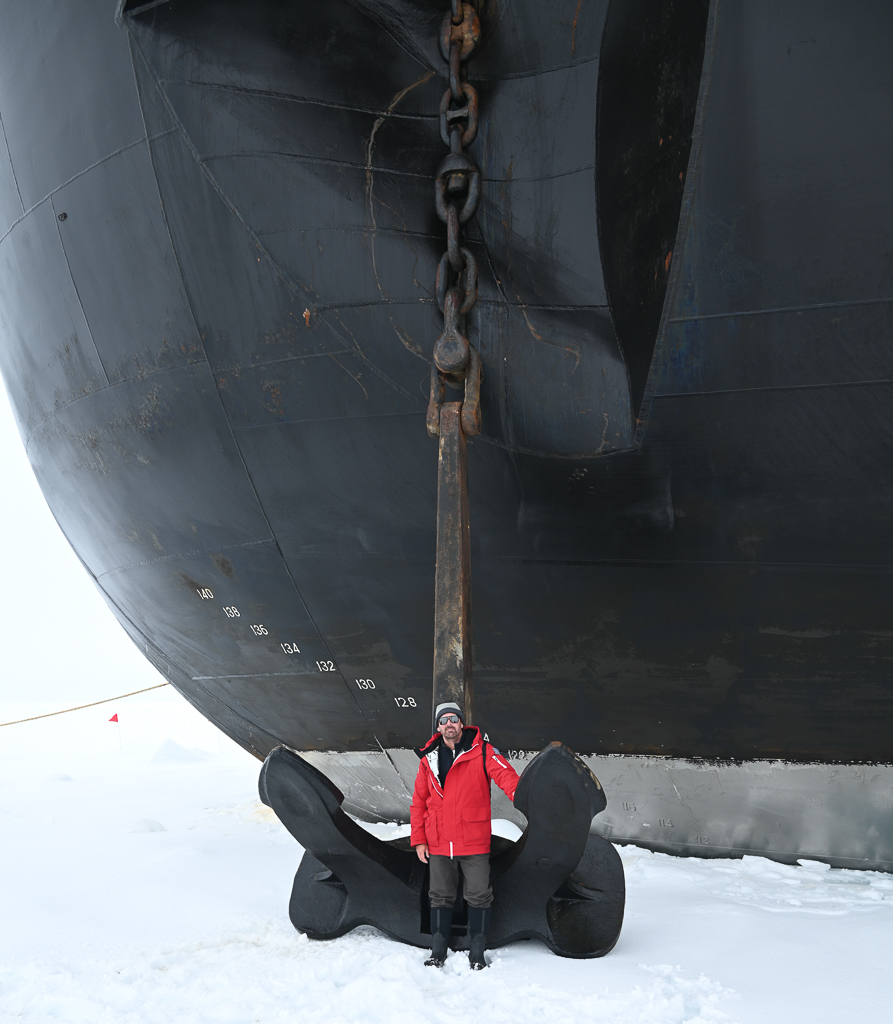
Me in front of the ships anchor
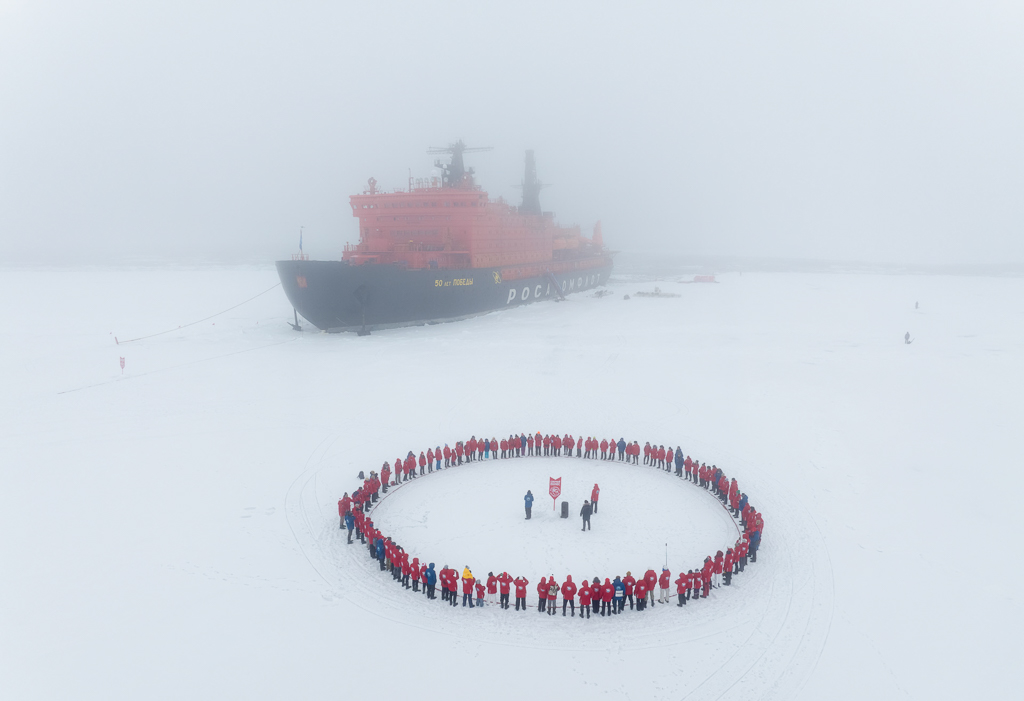
Drone photo at north pole
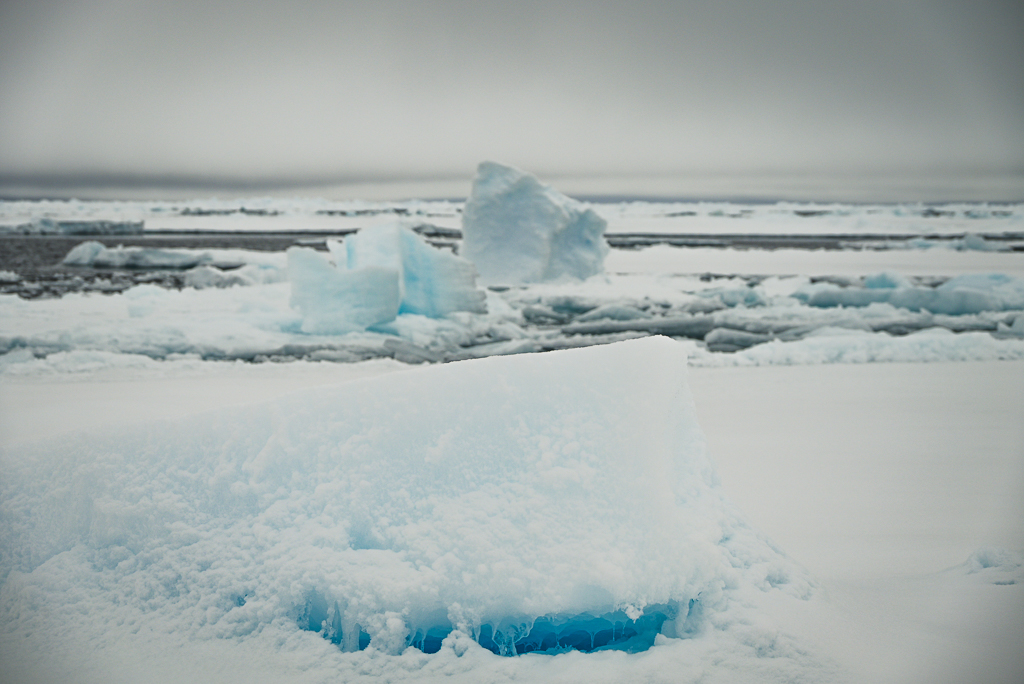
Ice formations
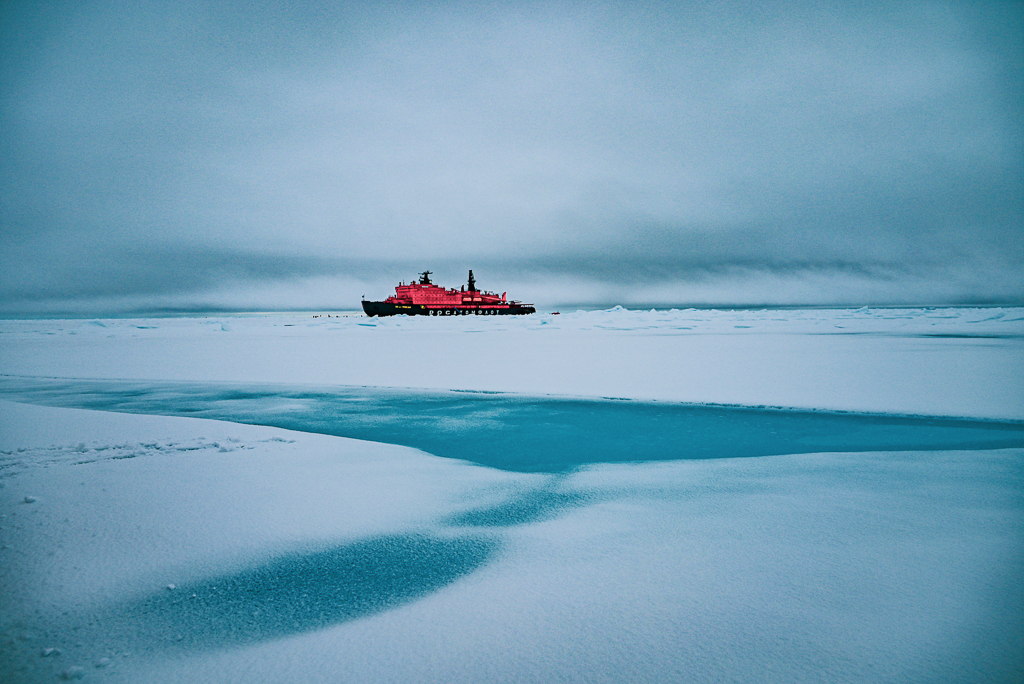
View of the ship from the hike on the ice
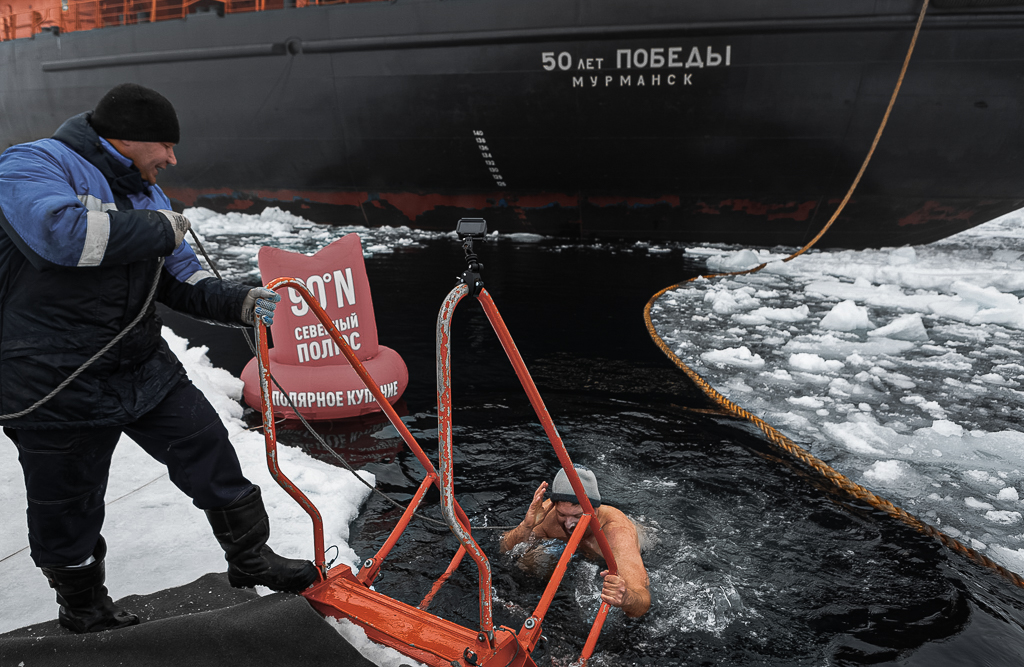
Me doing a polar plunge in North Pole
Victor snorkeling at the North Pole
Our First Polar Bear
As we headed south from the North Pole, the sea ice gradually became thinner and less continuous.
Dark channels of open water appeared between the floes, and the enormous unbroken sheets of ice gave way to smaller, pancake-shaped pieces scattered across the ocean.
Where Was the Wildlife?
By this point, we were disappointed by how little wildlife we had seen.
We had encountered no beluga whales or narwhals, and I had seen only one bearded seal. After traveling so far into the High Arctic, I had expected the frozen ocean to feel more alive.
The crew assured us that animals were present, even when we could not see them. Most were easily frightened by the tremendous noise and size of the icebreaker. Seals resting on the ice often slipped into the water long before the ship approached, while whales could hear us coming from miles away.
The crew was especially surprised that we had not yet seen a polar bear. Passengers aboard the previous week’s expedition had reportedly seen six, while we had traveled all the way to the North Pole without encountering a single one.
Then, during an afternoon lecture, an announcement came over the ship’s speakers:
A polar bear had been spotted on the ice.
A Bear Beside the Ship
The lecture ended immediately, and everyone hurried outside.
The ship slowed and eventually paused as passengers crowded onto the bow. Just off the side of the icebreaker stood a lone polar bear patiently searching the ice for seals.
It was our first polar bear of the expedition—and by far our most exciting wildlife encounter since entering the frozen High Arctic.
The bear appeared surprisingly unconcerned by the enormous red-and-black ship approaching it. 50 Years of Victory towered above the ice like a mechanical beast, yet the polar bear stood its ground.
It lifted its head, sniffed the air and watched us, apparently trying to understand what we were.
For nearly an hour, we observed one another—the passengers staring down from the ship and the polar bear looking back from its frozen world.
Eventually, the icebreaker continued south, leaving the bear alone on the ice to resume its hunt.
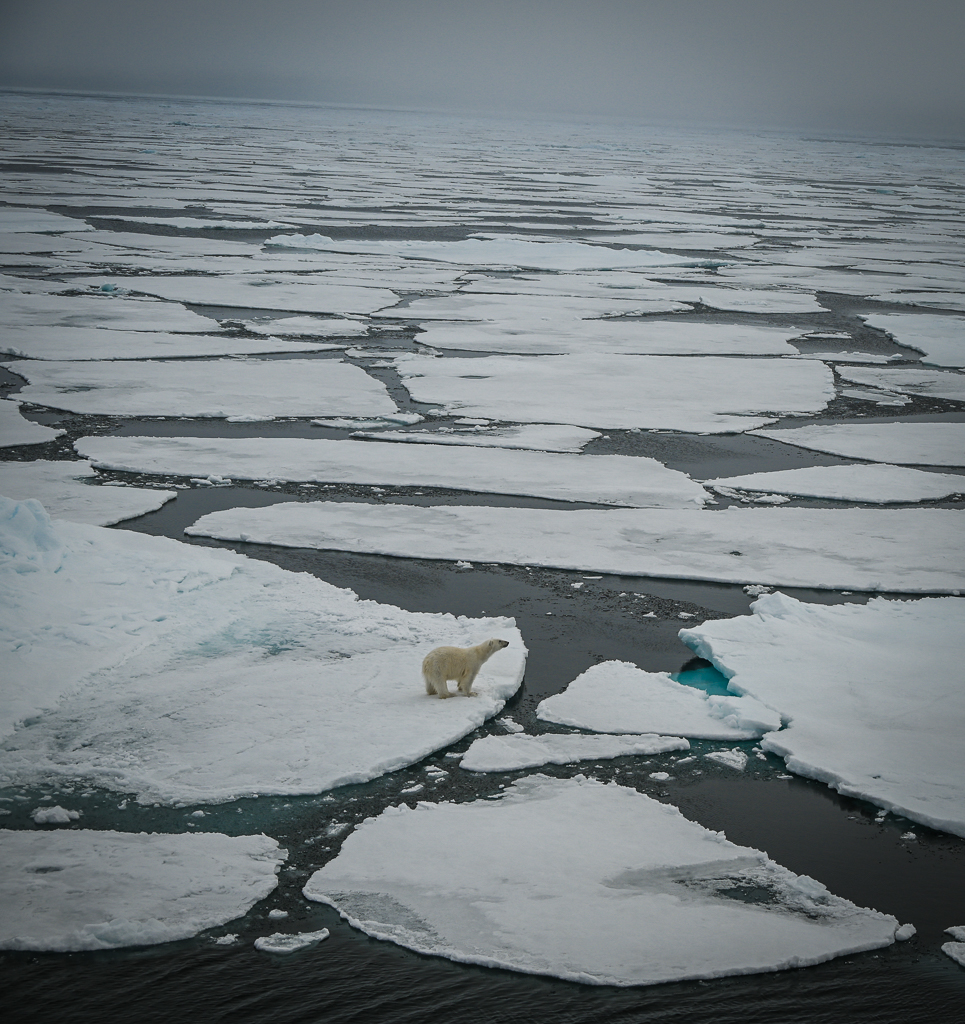
Polar bear hunting on the vast Arctic sea ice
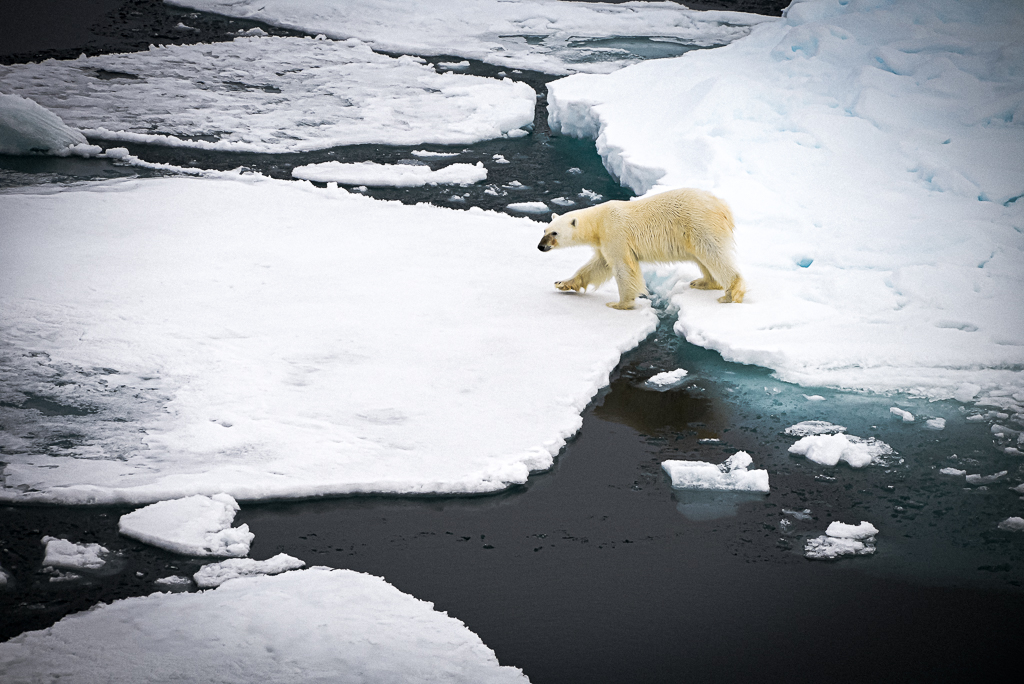
Hopping across the open water
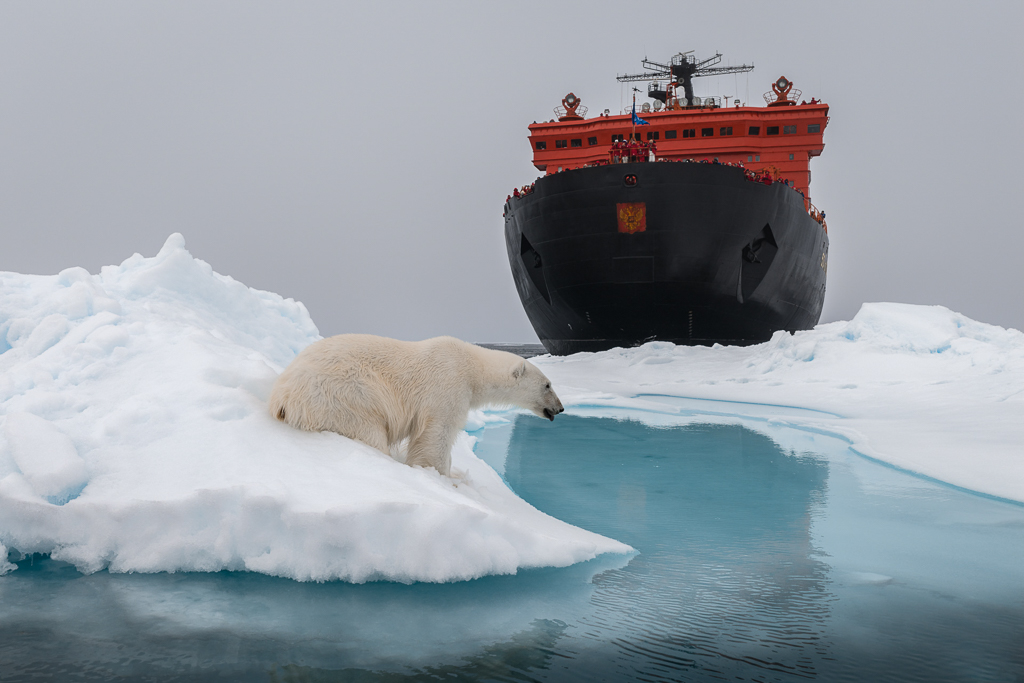
Ship drone footage of polar bear on sea ice
Arriving in Franz Josef Land
We reached the islands of Franz Josef Land on Sunday night and would spend the next two days exploring the archipelago.
At first glance, it appeared almost completely lifeless. Rolling mountains rose from the ocean, their slopes draped in glaciers, snow and exposed rock. Very little ground remained uncovered by ice.
After days surrounded by the nearly featureless sea ice of the High Arctic, it was exciting to see land again. Yet Franz Josef Land possessed a stark and forbidding beauty.
It was not as dramatic as eastern Greenland, nor did it resemble the Antarctic Peninsula, with its jagged mountains and brilliant white glaciers cascading toward the sea. The landscape here was more austere—cold, barren and almost entirely without frills.
It looked like a place that did not particularly want us there.
An Archipelago Named for an Emperor
Franz Josef Land was formally introduced to the outside world by the Austro-Hungarian North Pole Expedition of 1872–1874.
After their ship became trapped in the ice, expedition leaders Julius von Payer and Karl Weyprecht sighted the previously uncharted islands in 1873. They named the archipelago in honor of Franz Joseph I, the emperor of Austria-Hungary.
The islands later became associated with some of the most remarkable survival stories in the history of Arctic exploration.
Among those who endured the archipelago was the great Norwegian explorer Fridtjof Nansen. After leaving his ship Fram in an attempt to reach the North Pole, Nansen and his companion Hjalmar Johansen eventually retreated south to Franz Josef Land.
Unable to find a way home before winter, the two men constructed a primitive shelter on Jackson Island using stones, moss and walrus hides. They survived there through the winter of 1895–1896 before continuing south.
Their rescue came through an extraordinary coincidence. Nansen unexpectedly encountered British explorer Frederick Jackson at Cape Flora. In an archipelago covering thousands of square miles, two explorers had somehow crossed paths in the frozen wilderness.
Jackson helped Nansen and Johansen return to civilization.
A Remote Soviet Outpost
For years, Franz Josef Land remained largely unclaimed. During the early 20th century, Norway and the newly formed Soviet Union competed for influence over the archipelago.
The Soviet Union formally annexed the islands in 1926. It later established weather stations, scientific outposts, airfields and military installations throughout the archipelago. At times, small communities of scientists, workers and military personnel lived there year-round.
Franz Josef Land never supported a substantial civilian population. The environment was simply too harsh. The surrounding waterways remained frozen for much of the year, and the long polar night brought months without sunlight.
Today, the only people living among the islands are primarily Russian scientists, border guards and military personnel stationed at a small number of isolated outposts.
The rest of the archipelago belongs almost entirely to the ice and its wildlife.
Searching for Arctic Wildlife
Despite its barren appearance, Franz Josef Land is an important habitat for polar bears and other Arctic wildlife.
We knew that every landing would require caution. Armed guards would go ashore first, establish a security perimeter and continually watch for polar bears while we explored.
The surrounding waters also supported walruses, seals, belugas and narwhals. One of the ship’s biologists told me about a protected inlet where hundreds of narwhals were known to congregate.
Unfortunately, the inlet was close to a Russian naval installation and therefore off-limits to us.
For hours, we scanned the water and shorelines, hoping to see some sign of life. Nothing appeared.
Then an announcement came from the bridge.
Walruses had been spotted resting on the ice.
Walruses on the Ice Floes
The ship slowed and eventually stopped, allowing everyone to come outside and watch.
Several small ice floes were scattered across the water, each carrying approximately five walruses. Their enormous brown bodies were crowded together on the ice, with long ivory tusks extending from their faces.
Some remained where they were and allowed the ship to approach. Others appeared nervous and slipped into the water as the enormous icebreaker drew closer.
Walrus tusks are elongated canine teeth that continue growing throughout their lives. They help the animals pull themselves onto the ice, maintain breathing holes and defend themselves. Unfortunately, the ivory also made walruses valuable targets for hunters.
Centuries of commercial hunting for their tusks, hides and blubber devastated Atlantic walrus populations. Although they are now protected from commercial hunting across much of their range, their numbers remain far below their historic levels in parts of the Arctic.
We listened to the strange grunts, bellows and other noises coming from the animals as they rested together on the ice. After seeing so little wildlife during the expedition, the encounter felt especially rewarding.
Eventually, 50 Years of Victory resumed its journey through the islands.
Ahead of us, the crew was preparing the ship’s helicopter for a flight over one of Franz Josef Land’s immense glaciers.
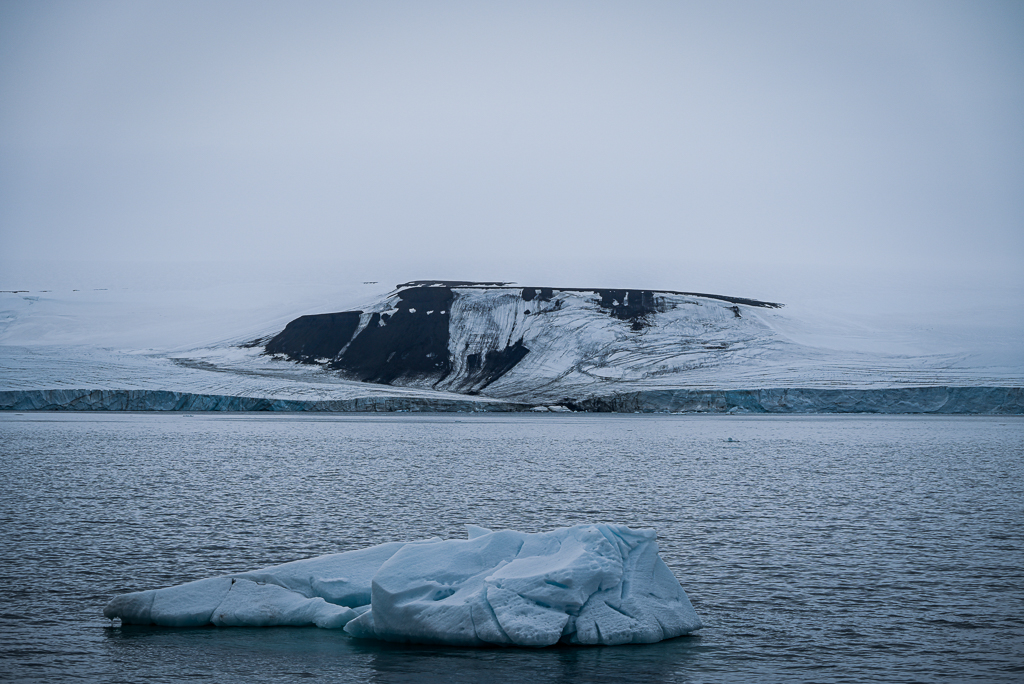
Typical scene in Franz Josef Land of glacier covered land
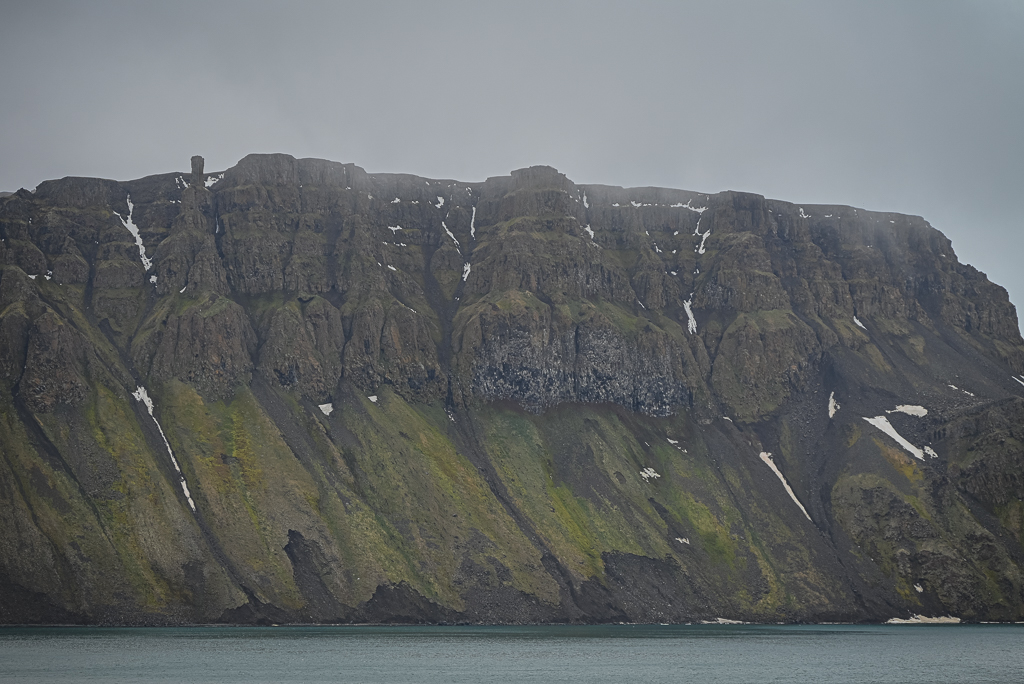
The most dramatic cliffs I saw in Franz Josef Land
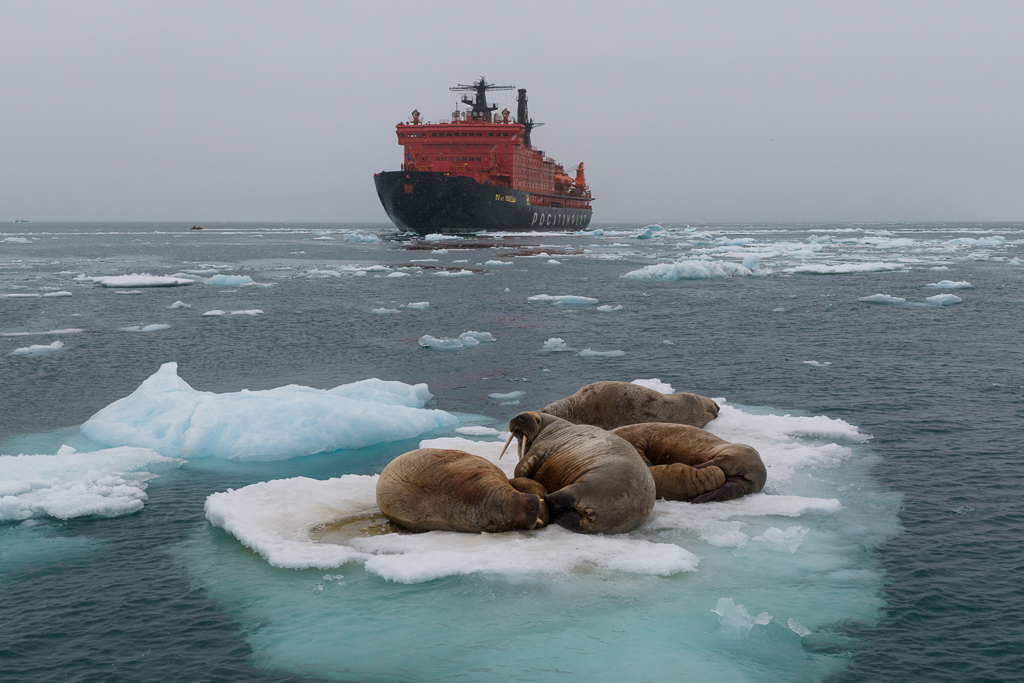
Walrus drone shot
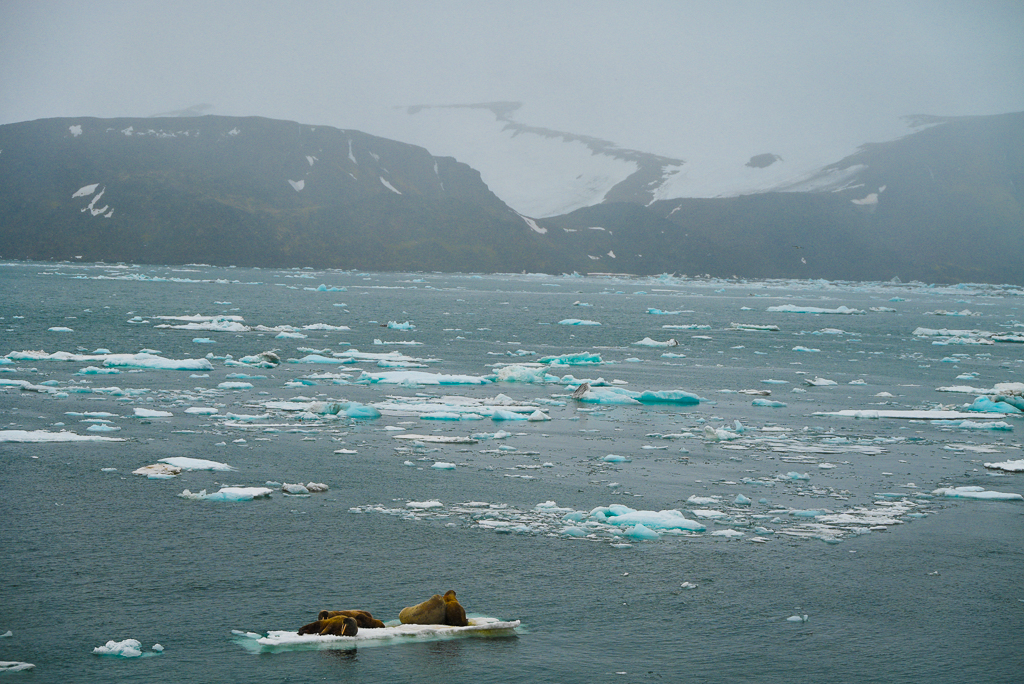
Walrus floating on a small ice floe
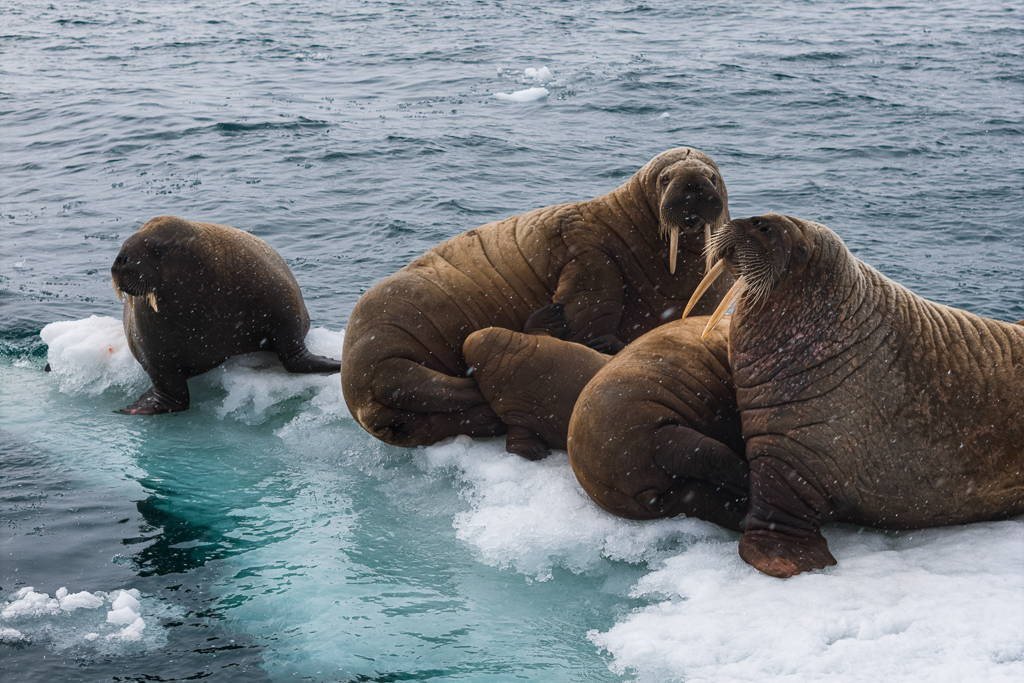
Walrus
Flying Over Franz Josef Land
As part of the expedition, every passenger had been promised one helicopter flight aboard the Russian Mi-8 secured on the rear deck of 50 Years of Victory.
The helicopter itself was much larger and more powerful than a five-passenger aircraft, but we were divided into small groups of approximately five for the sightseeing flights.
The original plan had been to fly above the icebreaker while it traveled through the dense ice floes of the High Arctic. From the air, we would have watched the ship drive its massive bow onto the ice and crush a path through the frozen ocean.
Persistent fog made that plan too dangerous.
Instead, the expedition team arranged for us to fly over one of the immense glaciers of Franz Josef Land. I was not disappointed. The opportunity to see the archipelago from the air sounded even more interesting and scenic than watching the ship break ice.
Lifting From the Icebreaker
On our first full day in Franz Josef Land, after hours of waiting for our turn, my group climbed into the Mi-8 and prepared for takeoff.
The rotors gathered speed above us, filling the cabin with noise and vibration. Moments later, we lifted from the rear deck of 50 Years of Victory and flew toward the surrounding islands.
From above, the archipelago appeared even more remote and inhospitable. Glaciers covered nearly everything, flowing between dark mountains before ending in towering walls above the Arctic Ocean.
We approached a glacier that rose approximately 1,000 feet above the sea. For about ten minutes, the pilot carried us alongside its immense frozen walls, climbing and descending before banking sharply through turns that pressed us into our seats.
It felt less like a gentle sightseeing flight and more like an Arctic roller coaster. It was a little nerve wracking to think about what would happen if the helicopter went down in the frigid waters but thankfully this didn’t happen.
The flight was short, but it was exhilarating. Before returning to the deck, we circled 50 Years of Victory from above, giving us a rare view of the enormous red-and-black icebreaker surrounded by glaciers, broken ice and dark Arctic water.
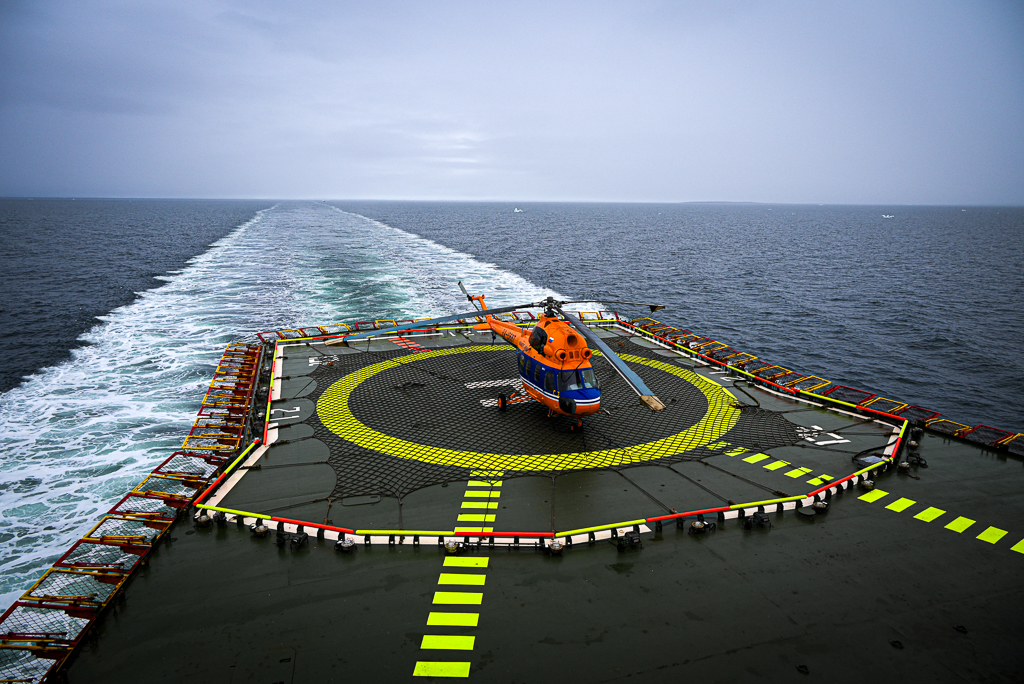
Helicopter on the rear of the ship
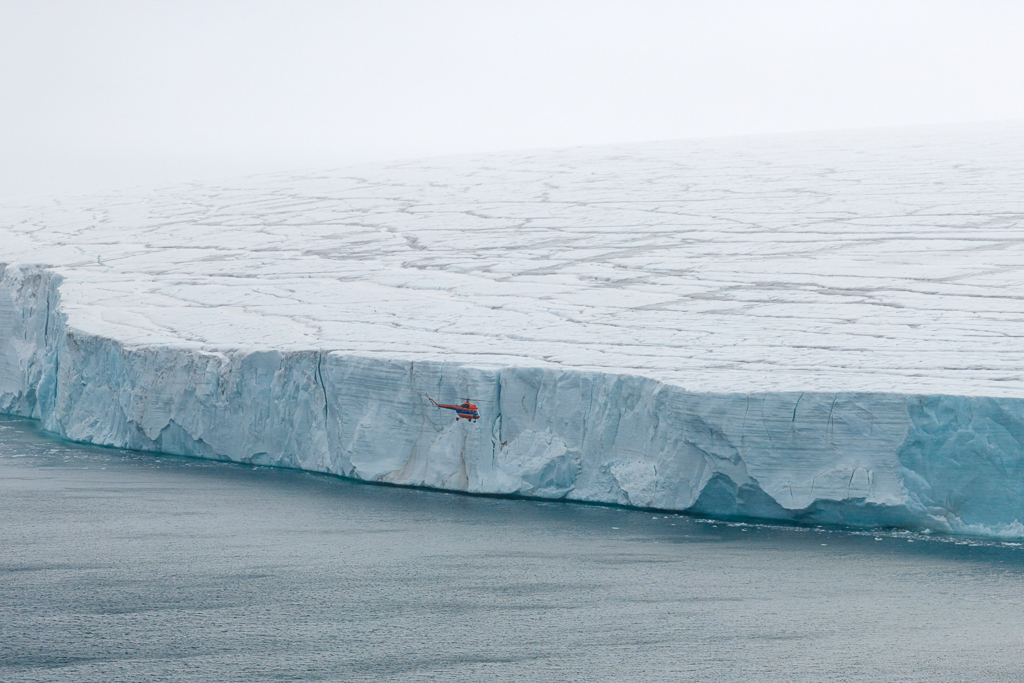
Helicopter flying near the glacier
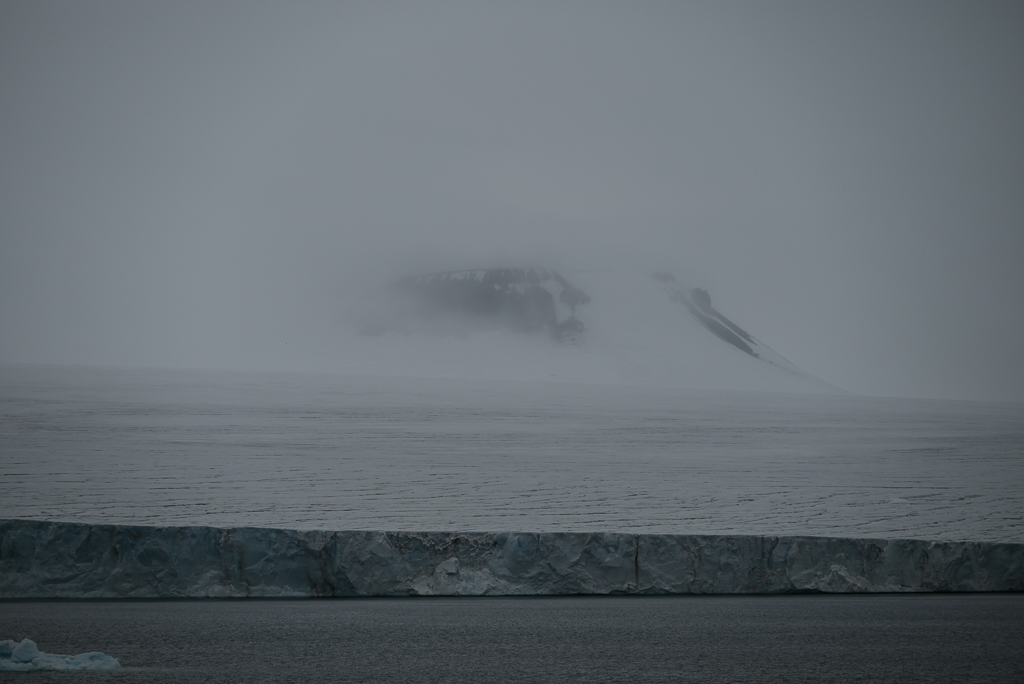
View of glacier
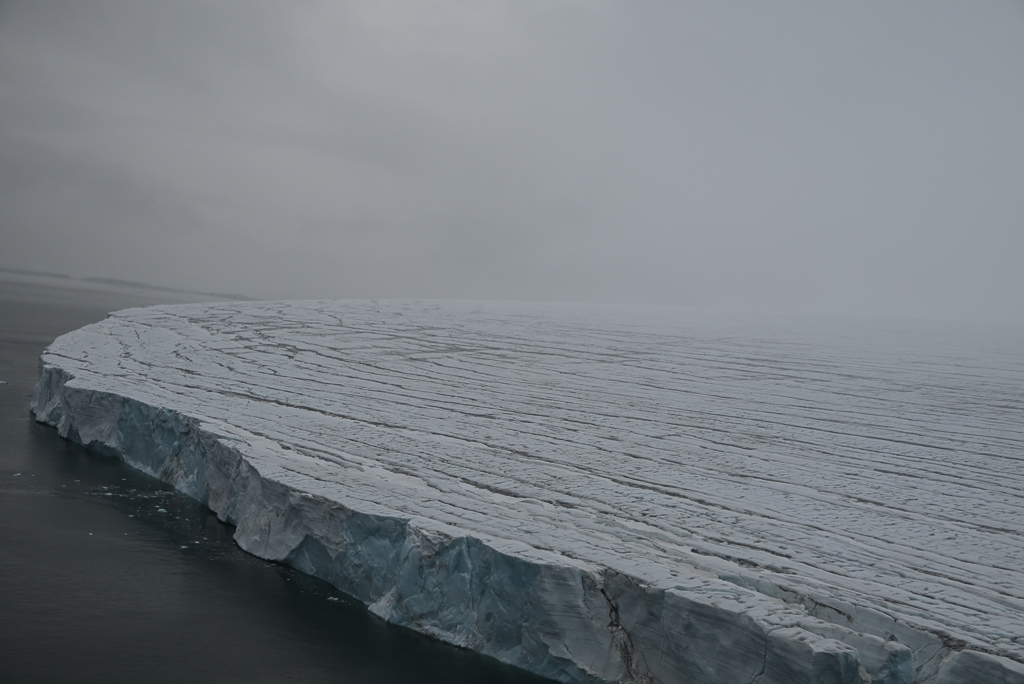
View from helicoptor
View from helicoptor
The Optional Polar Station Flight
Later that day, passengers who had paid an additional $1,300 flew by helicopter to a working Russian polar station, where a small group of scientists lived in extreme isolation.
My group decided not to go.
We had not realized before arriving that the flight required an additional payment. Because American bank and credit cards did not work in Russia, we could not withdraw more cash and needed to preserve our remaining foreign currency for emergencies.
I was disappointed, but traveling this far into the Russian Arctic required making practical choices.
The passengers who visited the station returned with stories about how difficult life was for the scientists. They lived in aging buildings under harsh conditions and reportedly earned very little money for their work.
Even communication with the outside world was severely limited. We were told that the station received internet access for only a few hours when a satellite passed overhead. For the rest of the time, the scientists remained largely disconnected from their families and the outside world.
Several Russian passengers were especially troubled by what they saw. They felt that scientists performing important work in one of the most isolated and demanding environments on Earth deserved better accommodations, better equipment and far better wages.
A Soviet Aircraft Wreck
Although I did not visit the station, I could see it in the distance from my cabin window.
Several dilapidated buildings stood along the barren shoreline, all appearing to need significant maintenance. Near them lay the damaged remains of a Soviet-era aircraft—another relic from Russia’s long history of Arctic aviation and polar exploration.
The Russian passengers who visited the station told me that they had not been permitted to approach the wreck. According to the scientists, a polar bear had recently been lingering in that area.
I photographed the station and aircraft from the ship. At the time, I did not notice anything unusual.
Only later, while examining the photograph more closely, did I discover a polar bear walking near the wreckage.
The animal blended so perfectly into the pale landscape that I had completely missed it while taking the picture.
Living Among Polar Bears
In this part of the Arctic, polar bears could appear near the station without warning. The scientists had to remain alert every time they stepped outside, especially when poor visibility allowed a bear to disappear against the snow.
We were told about a scientist who had been killed there approximately a decade earlier after failing to notice a polar bear camouflaged in the surrounding landscape.
His colleagues reportedly heard a dog barking and rushed outside with flare guns, hoping to frighten the animal away. By the time they reached him, however, it was already too late.
A polar bear would need very little time to kill a person.
For us, seeing one was an exciting highlight of the expedition. For the scientists living at the station, the same animal represented a constant and potentially fatal danger.
Their lives combined scientific work, extreme isolation, limited communication, inadequate facilities and the continual possibility of encountering one of the Arctic’s most powerful predators.
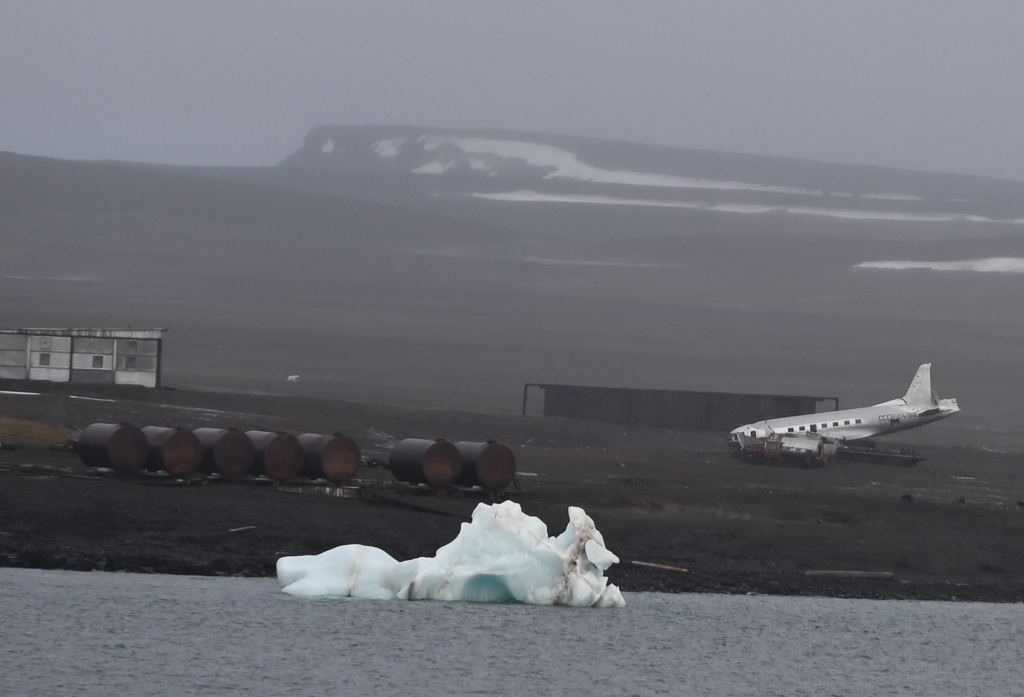
Polar station with a polar bear wandering in the background-see small white dot
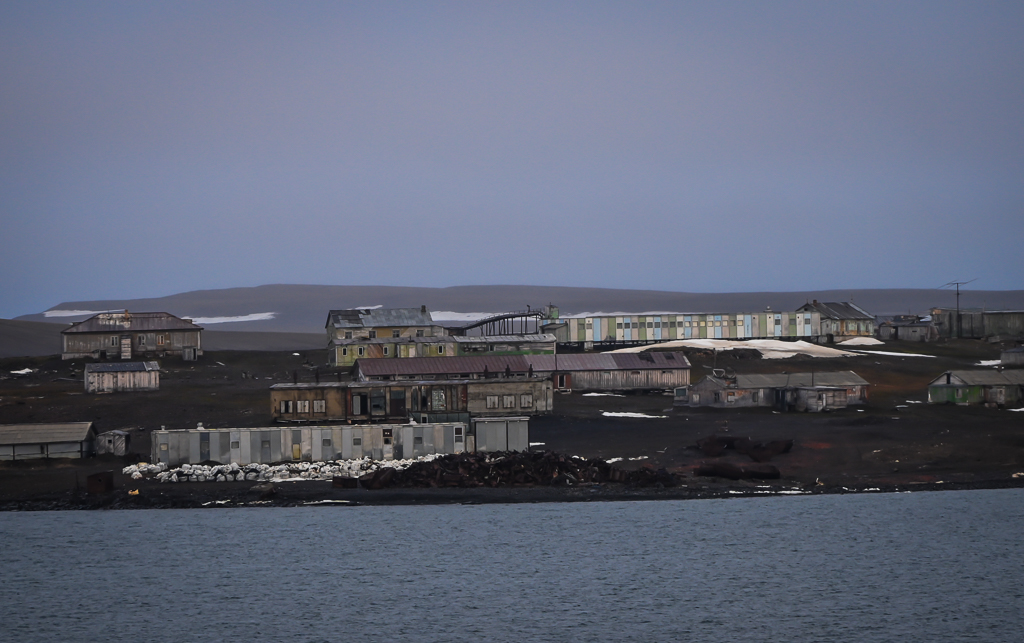
Polar Station
The Abandoned Station at Tikhaya Bay
On our final day in Franz Josef Land, we visited Tikhaya Bay on Hooker Island.
Before landing at the abandoned Soviet polar station, however, we sailed past one of the archipelago’s most remarkable natural landmarks.
The Bird Cliffs of Rubini Rock
Rubini Rock was an immense formation of dark, columnar basalt rising almost vertically from the Arctic Ocean.
Its volcanic walls were fractured by countless cracks, ledges and narrow crevices. Nearly every available space appeared to be occupied by nesting seabirds.
There were so many that they seemed to number in the millions. Birds crowded together across the rock face while thousands more circled overhead, filling the air with their cries. From a distance, the cliffs themselves seemed to move with wings.
The continuous noise carried across the water toward our ship.
After sailing through so much barren ice and seemingly lifeless terrain, this incredible concentration of wildlife was astonishing. Rubini Rock resembled a vast Arctic apartment building, with birds packed into every crack that offered protection and a place to nest.
The cliffs supported one of the largest seabird colonies in Franz Josef Land. During the brief Arctic summer, birds came here in enormous numbers to breed and raise their young before the darkness and severe winter returned.
The spectacle was a vivid reminder that, despite its hostile appearance, the archipelago supported an extraordinary amount of life.
After sailing past Rubini Rock, we continued into Tikhaya Bay and prepared to go ashore.
An Abandoned Soviet Outpost
Tikhaya Bay was home to a Soviet polar station founded in 1929. For three decades, it served as one of the Soviet Union’s most important scientific outposts in the High Arctic.
Scientists, radio operators and other workers endured brutal winters, months of darkness and almost complete isolation from the outside world. Some brought their wives and children, creating a tiny community at the edge of the habitable world.
This was pioneer life in the Arctic. People lived—and sometimes died—on the margins of survival, with very little help available from the outside world.
Life at a Soviet Polar Station
Living at Tikhaya Bay required a pioneer mentality.
Supplies arrived only during the short summer season, and residents had to survive the remainder of the year with whatever had been delivered. They endured violent storms, extreme cold, polar bears and the psychological strain of prolonged darkness and isolation.
Fresh water was another constant challenge. The settlement relied heavily on melting snow and ice, making even something as basic as obtaining drinking water difficult.
We saw an extraordinary old photograph of a family with baby polar bears on leashes. The cubs appeared to be tethered like dogs, apparently as part of an attempt to raise them as pets.
It was a startling image—not only because of how dangerous and inappropriate that would seem today, but because it illustrated how unusual life had become in such an isolated place. The boundary between the human settlement and the surrounding Arctic wilderness was remarkably thin.
Some residents died at the station, and their graves remained as reminders of the dangers faced by those who lived there. If someone became seriously ill or suffered an accident during winter, outside assistance could be months away—or might never arrive in time.
In 1959, the Soviet Union closed Tikhaya Bay and transferred its scientific operations to the newer Krenkel Observatory on Hayes Island.
Protected as Part of the Arctic National Park
The former polar station is now protected as part of the Russian Arctic National Park.
Most of the old buildings had deteriorated badly after decades of exposure to snow, wind and ice. Many were filled with snow and had become too unstable to enter safely.
A few structures, however, had been cleared of snow and partially restored. The purpose was not to make them look new again, but to stabilize the buildings and prevent them from collapsing completely.
One member of our expedition team had played an important role in this restoration work. For several years, he had spent months of each Arctic summer living at Tikhaya Bay and helping preserve the station.
His connection to the settlement made our visit feel more personal. These were not simply abandoned ruins to him. He had invested years of work in keeping them from disappearing.
Living there also meant confronting the same danger that had faced the station’s earlier residents. He told us that on several occasions he had been forced to fend off polar bears that approached the buildings.
For visitors, a polar-bear sighting was an exciting event. For someone living and working at Tikhaya Bay for months at a time, it could become an immediate threat to survival.
Walking Through the Abandoned Buildings
We spent much of the day wandering among the station’s aging buildings and imagining what life must have been like.
Inside and around them were fragments of ordinary existence—rooms where families had slept, laboratories where scientists had worked and structures that had protected generations of residents from the Arctic weather.
Peeling paint covered the walls, broken timbers protruded from damaged structures and decades of snow had accumulated inside many of the rooms. Some buildings looked as though one more severe winter might bring them down completely.
We could enter only those structures that had been cleared and made reasonably safe. The others remained closed, their interiors still packed with snow or weakened beyond repair.
Although Russian Arctic National Park workers now maintain a small seasonal presence at Tikhaya Bay, most of the old Soviet settlement remains empty.
The isolation was difficult to comprehend. We were visiting during the relatively mild Arctic summer, with a powerful nuclear icebreaker waiting nearby. The station’s permanent residents had remained here throughout the polar winter, when the bay was locked in ice and darkness covered the islands for months.
They could not simply leave if the conditions became unbearable.
Reclaimed by Arctic Wildlife
With the permanent residents gone, wildlife had begun reclaiming the station.
Arctic foxes wandered among the abandoned houses and sometimes used the old structures for shelter. Polar bears also investigated the buildings in search of food or anything carrying an unfamiliar scent.
On one building, I saw a large section of insulation that appeared to have been bitten away by a polar bear.
The people had left, but the Arctic had moved back in.
Exploring Tikhaya Bay felt like walking through a frozen ghost town. It was both a historic monument to Soviet polar exploration and a reminder of how quickly nature reclaims even the most determined human outposts.
The people who once lived there had attempted to establish a permanent foothold in one of the harshest environments on Earth. They built homes, raised families, conducted scientific research and survived years of cold and isolation.
Today, preservation workers were fighting to keep part of that history from collapsing into the snow.
But ultimately, Tikhaya Bay still belonged to the Arctic.
A Postcard From the World’s Northernmost Post Office
Tikhaya Bay is also said to contain the northernmost post office in the world.
Before our landing, I bought a postcard aboard the ship, added Russian polar postage and wrote a letter to Indie.
The postal system at Tikhaya Bay was not quite as official as the title suggested. No postal worker remained at the abandoned station to collect or process the mail. There were only polar bears to eat it.
Instead, visitors placed their postcards in the station’s mailbox. Members of the expedition team later collected them, carried them aboard the ship to Murmansk and mailed them from there.
Even after the postcard reached Murmansk, I was warned that it had only about a 50 percent chance of completing the long journey to San Diego.
Whether it eventually reaches Indie or disappears somewhere between the Russian Arctic and home, I will find out.
We boarded the zodiac to our ship, trying not to get wet in the waves along the way, and said goodbye to Franz Josef Land.
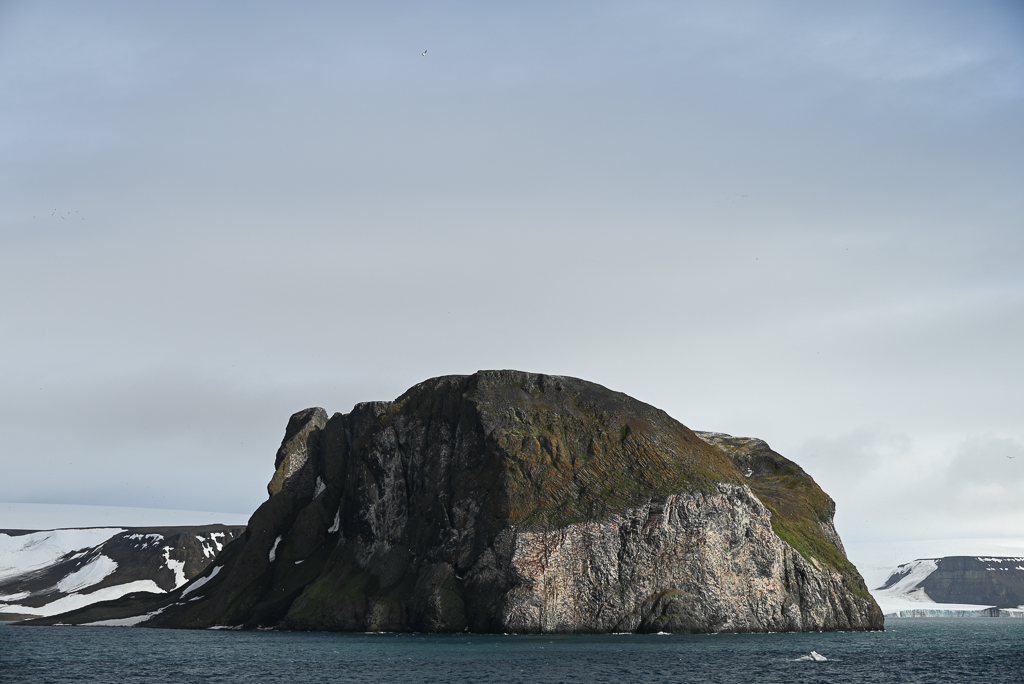
Rubini Bird Rock
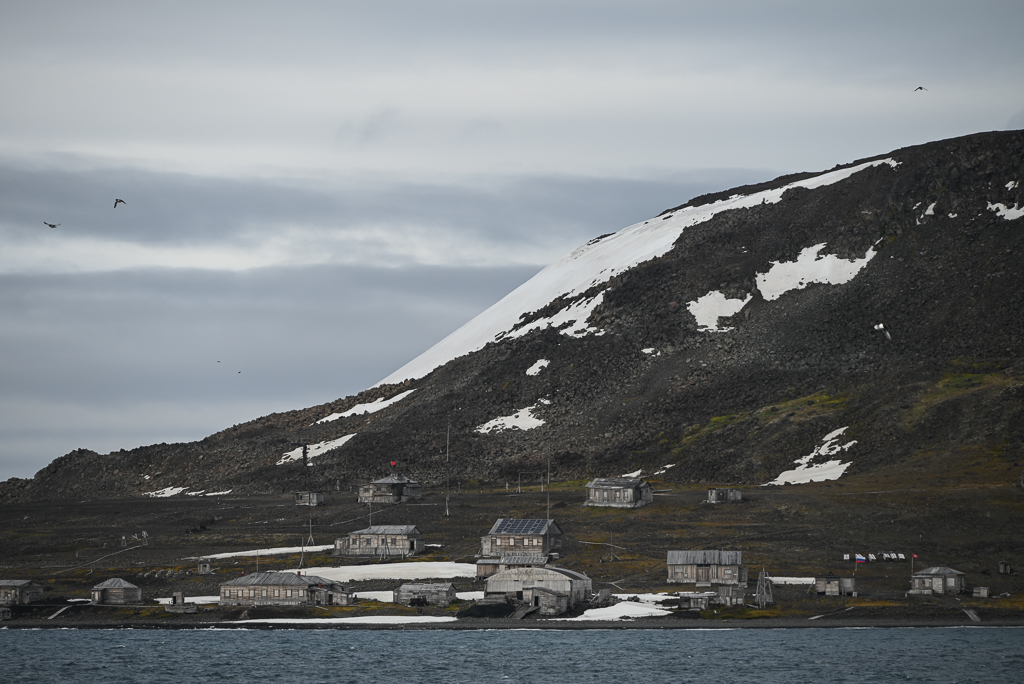
Tikhaya Bay on Hooker Island
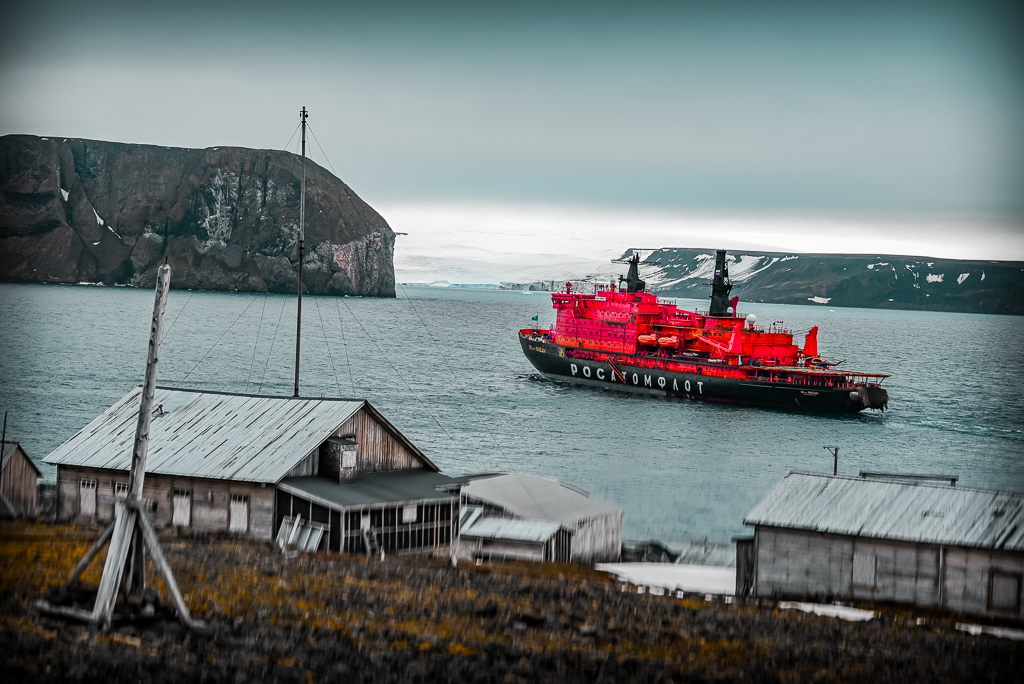
Tikhaya Bay on Hooker Island
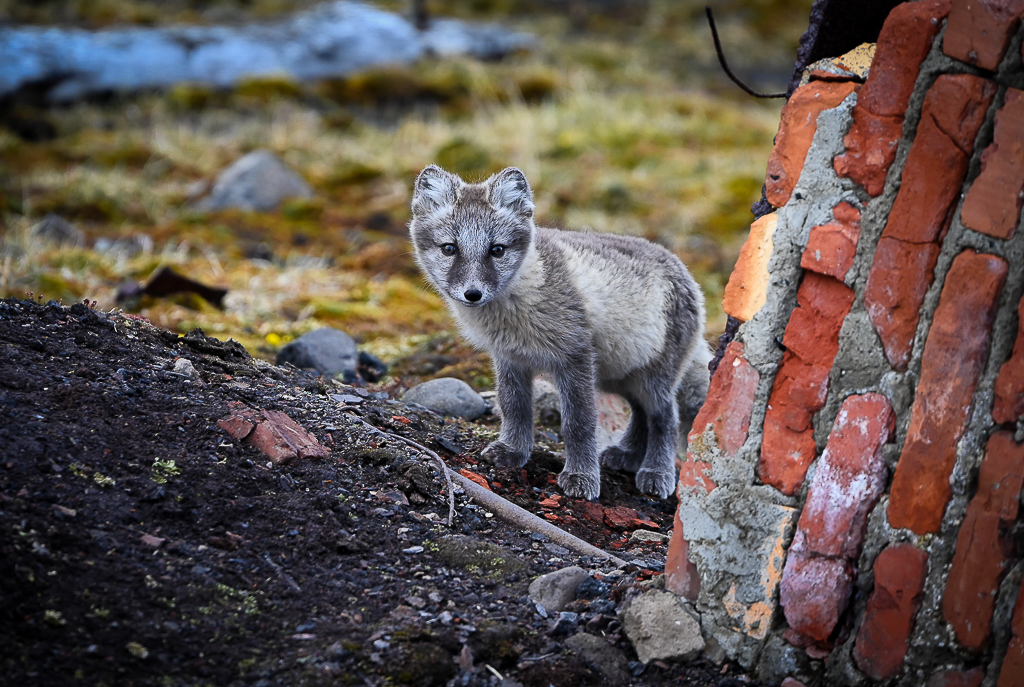
Curious Arctic Fox
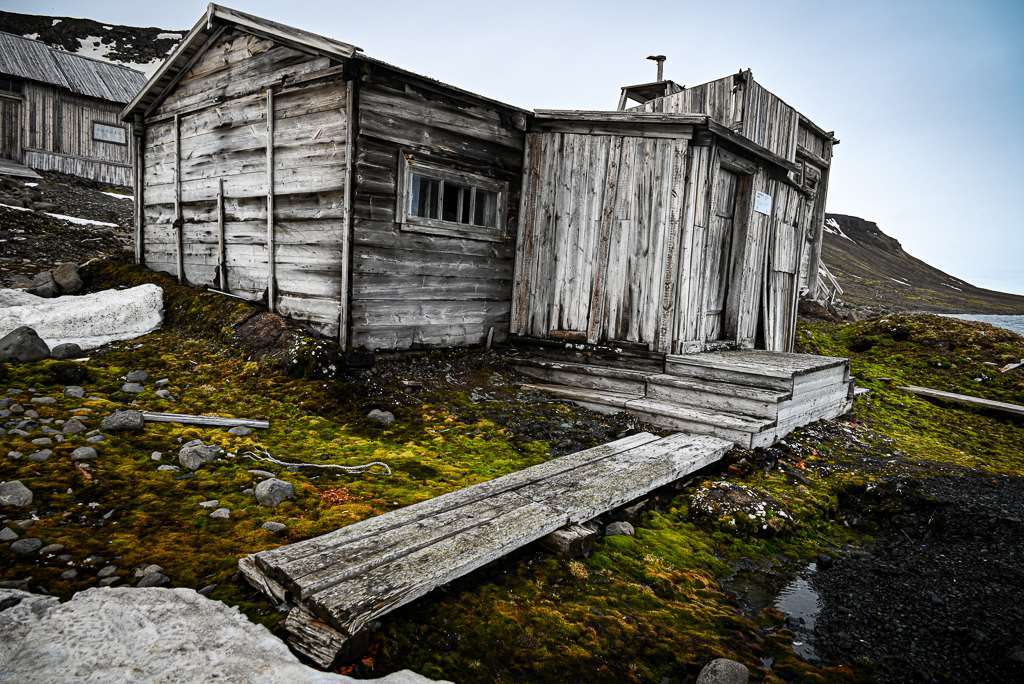
Tikhaya Bay on Hooker Island
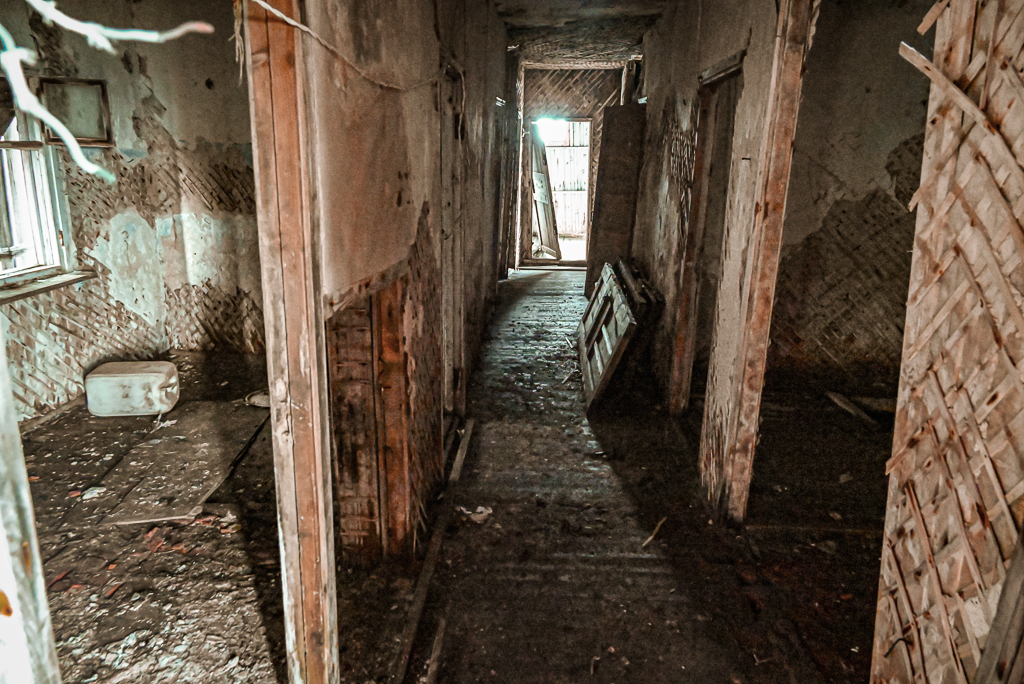
Inside one of the houses where people once lived
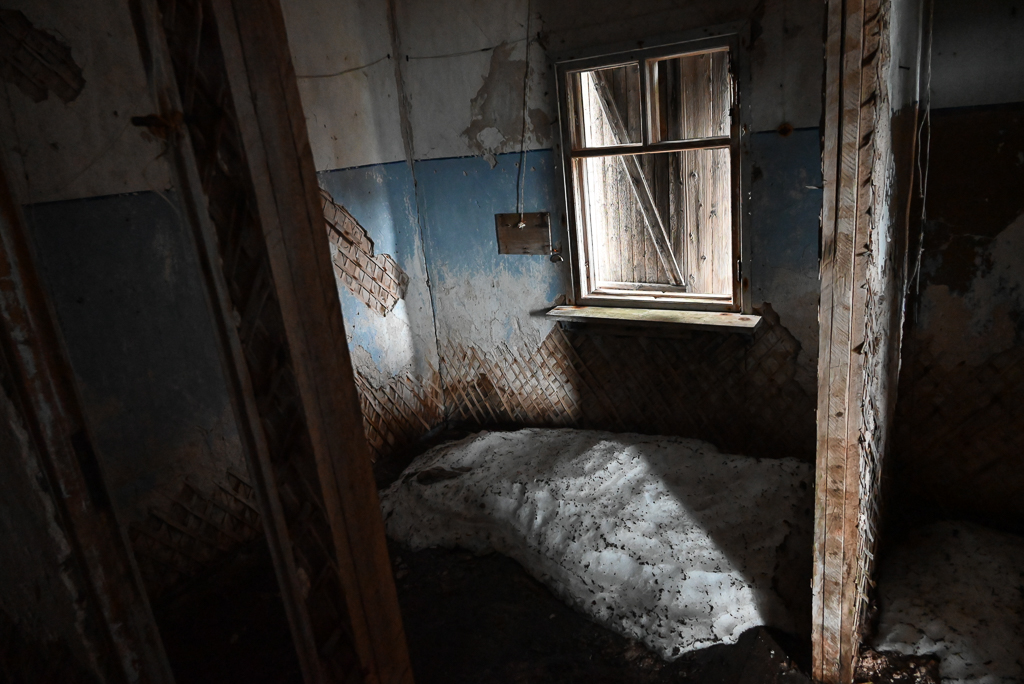
Abandoned house

Old items from life on the station

Work Room
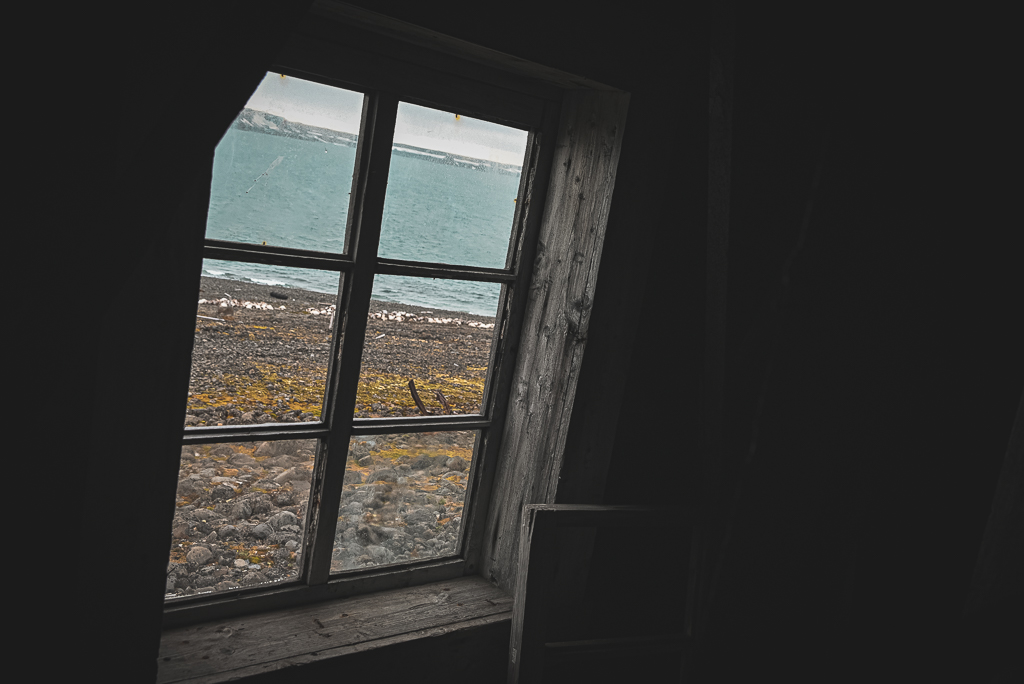
Old Window
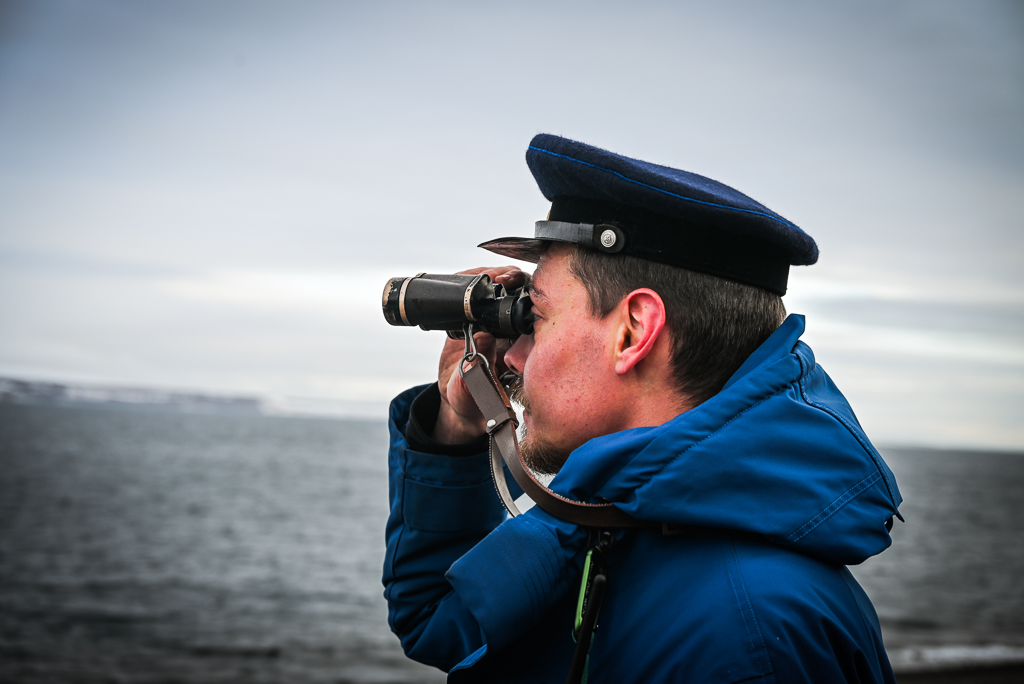
Our Russian english translator with his German binoculars that his grandpa pulled from a Nazi soldier that was invading Russia during WWII
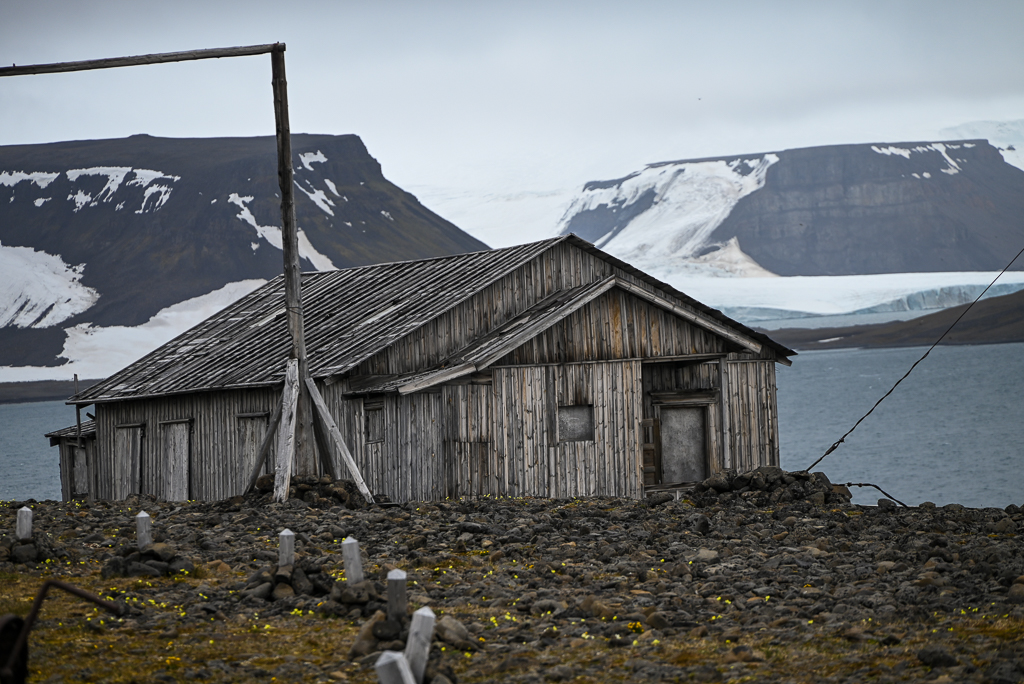
Wooden structure
The Long Journey Home
Leaving Franz Josef Land
Late that night, we departed the Franz Josef Land archipelago and began the nearly two-day crossing of the Barents Sea back to Murmansk.
I was disappointed that we had not made more landings among the islands. I had especially hoped to visit Champ Island, famous for its mysterious, almost perfectly spherical stones. Some are enormous, and their strange appearance has inspired legends involving lost civilizations and even aliens, although geologists identify them as naturally formed concretions.
During our 12-day expedition, we made only two landings and left the ship on three occasions if the helicopter flight was included.
This was not my usual style of travel. I preferred to be outside exploring, hiking and experiencing as much of a destination as possible—not watching it pass from a ship.
At the same time, I understood the limitations. Reaching the North Pole required traveling an enormous distance, and 50 Years of Victory was a working nuclear icebreaker rather than a conventional expedition ship designed for frequent Zodiac landings.
Its purpose was to break through the Arctic ice and carry us safely to one of the most inaccessible places on Earth. Everything else had to fit around that primary objective.
We had not seen as much of Franz Josef Land as I had hoped, but we had reached the North Pole, flown over an Arctic glacier, observed polar bears and walruses, and walked through an abandoned Soviet polar station.
Few journeys could offer even that much.
A Rough Crossing of the Barents Sea
The return voyage was considerably rougher than our northbound crossing.
Large waves crashed across the deck, and the crew ordered everyone inside to prevent anyone from being swept overboard. After days of relatively calm conditions, the violent motion of the ship was a reminder that the Barents Sea could be every bit as dangerous as its reputation suggested.
By this point, I was anxious to leave the ship and return home to my family.
I knew, however, that a long journey still lay ahead—and that plenty could go wrong. We could be detained while leaving Russia. Our flights could be delayed or canceled. Drone attacks could close the airspace, and severe weather could disrupt everything.
As it turned out, we would experience some of those problems.
A Farewell Party
During the two-day voyage back to Murmansk, the crew organized a farewell party with food, music and still more alcohol.
After almost two weeks together in one of the most isolated places on Earth, the atmosphere aboard the ship had become much more relaxed. The party gave me additional time to speak with some of the Russian passengers, several of whom began discussing subjects that had largely been avoided earlier in the expedition.
A few of those conversations turned cautiously toward politics and war.
Before entering Russia, I had decided that I would not initiate political discussions.
On previous visits, Russians had often told me that discussing politics was considered impolite. That reluctance was understandable in a country with a long history of punishing political dissent—from the gulags of the Soviet era to modern laws restricting what people could say publicly about the war in Ukraine.
Those earlier conversations had also occurred before the invasion, when relations between Russia and the United States were considerably better. Now, I did not want to make anyone uncomfortable, pressure someone into expressing a potentially dangerous opinion or create trouble for either them or myself.
If another passenger raised a political subject, I listened—but I did not push for more than the person appeared willing to share.
What Russians Told Me About the Wars
Some passengers expressed anger toward the United States over its actions involving Iran. They made it clear that Russia was unhappy with America’s role in that conflict.
Others told me simply that they wanted the war in Ukraine to end.
I could not always determine exactly what that meant. Wanting peace did not necessarily reveal whether someone opposed the invasion, supported Russia’s objectives or merely wanted the fighting and deaths to stop.
I deliberately avoided asking them to clarify.
One young woman told me:
“Russians are not bad people, like many people in the West think.”
She then gestured toward the man standing beside her and added:
“My husband is Ukrainian.”
He quietly nodded in agreement.
A Speech That Silenced the Room
Another passenger later told me about something that had occurred during one of the birthday celebrations aboard the ship.
A few days earlier, members of the crew had entered the dining room carrying a cake and singing “Happy Birthday” to a prominent Moscow attorney traveling with us.
She then stood and delivered a short speech in Russian. Those of us relying on English translation did not understand what she said at the time.
According to the passenger who later explained it to me, she ended her remarks by declaring:
“Let’s end this war now.”
The room reportedly fell silent.
The man who told me about the speech said that many Russians wanted the war to end, but added:
“In Russia, we do not talk openly about things like this.”
His explanation helped me understand why the silence mattered. It did not necessarily indicate disagreement. In an environment where public statements about the war could carry consequences, silence could reflect fear, caution or quiet agreement.
Hopes for Trump—and Disappointment
Several passengers also discussed President Donald Trump.
They told me that some Russians had hoped his return to the presidency—and his comparatively friendly approach toward Vladimir Putin—would help Russia negotiate an end to the war or improve relations with the United States.
So far, they said, they were disappointed.
These comments did not represent all Russians, or even necessarily most passengers aboard the ship. They were individual opinions offered during rare private conversations.
Still, they provided a glimpse into how some Russians viewed American politics—not simply as something happening far away, but as a force that could directly affect their own country and the war.
The America They Remembered
More than a few passengers told me that many Russians, particularly those who had grown up during the Cold War, felt a deep fascination with the United States.
They had admired American movies, music and popular culture from a distance. To them, America had represented freedom, prosperity and a modern world that often seemed unreachable from behind the Iron Curtain.
One man explained that the United States had changed considerably during the previous decade. It was no longer the America that many Russians of his generation had grown up longing to experience.
These political conversations were rare, cautious and sometimes ambiguous. No one provided a simple explanation of how Russians felt about the war, because no such single explanation existed.
Yet they were among the most insightful conversations of the expedition. Beneath the official rhetoric and hostility between our governments were ordinary people—some supportive, some doubtful, some frightened and many simply hoping the war would end.
Returning to Murmansk
On our final day aboard, the ship entered Kola Bay and proceeded very slowly so that we would arrive in Murmansk early Friday morning as scheduled.
After disembarking, we returned to the hotel where we had stayed before the expedition. Our flight to Saint Petersburg was not scheduled to depart until that afternoon, so we spent most of the day sitting in the lobby and using the Wi-Fi.
After nearly two weeks with almost no communication, I was finally able to check in properly with Paula and Indie.
Simply being able to see and speak with them again made home feel much closer.
I also discovered that Richard’s return ticket had been canceled and that he would be stuck in Murmansk unless we acted quickly.
Almost every flight was sold out, and we scrambled to find another way for him to reach Saint Petersburg. I eventually secured what appeared to be the final available seat that day, although the flight would not depart until late that evening.
An agent affiliated with our expedition came to the hotel to complete the purchase, and we had to pay for the replacement ticket entirely in cash.
It was not cheap, but the experience confirmed why I had insisted on keeping emergency money in reserve. American credit cards were useless in Russia, and without that cash, Richard might have been stranded in Murmansk.
Drone Attacks and a Closed Airport
Our own flight from Murmansk to Saint Petersburg was soon delayed by four hours, with the possibility that it might be canceled entirely.
We were told that a major Ukrainian drone attack near Saint Petersburg had forced authorities to close the surrounding airspace. Reports indicated that a large distribution warehouse had been struck or damaged, producing a massive fire near the city.
Thankfully, our flight was eventually cleared to depart.
The journey was uneventful until we approached Saint Petersburg. During our descent, the aircraft made a series of steep, spiraling turns.
I had no way of knowing whether the unusual approach was connected to the drone activity, temporary airspace restrictions or an ordinary instruction from air-traffic control. From inside the aircraft, however, it certainly felt different from a normal landing.
Through the window, I could see enormous plumes of dark smoke billowing into the sky from the burning warehouse below.
During this single journey, I had experienced two events unlike anything that had happened during my previous 1.5 million miles of flying.
On the way to Europe, a passenger had died aboard my plane. Now, as I returned from the North Pole, I was landing beside the visible aftermath of a wartime attack.
Ukrainian drone attack at warehouse near airport in Saint Peterburg
Leaving Russia
From the window of my airport hotel, I could still see smoke rising as the fire continued to burn.
We had arrived late and needed to leave again early the following morning, so there was little time to do anything except sleep.
Richard eventually reached Saint Petersburg aboard his replacement flight. By the time he entered his hotel room, he had only about two hours before he needed to turn around and return to the airport.
After everything we had worried about before entering Russia, leaving the country proved surprisingly easy.
Immigration officials gave us no trouble, and our flight departed for Istanbul without incident.
Our Russian adventure was over, but there was still a long journey ahead before I would reach home.
One Final Detour—and More Delays
I was not heading directly to San Diego quite yet.
Before returning home, I had planned a quick two-night stop in Albania to visit Sazan Island, a former Cold War military stronghold filled with abandoned buildings, bunkers and underground tunnels.
Even that short journey did not go according to plan.
Bad weather in Istanbul disrupted my original itinerary, forcing the airline to reroute me onto a different flight to Albania. Despite the delay, I eventually arrived and was still able to visit Sazan Island before continuing home.
I wanted to explore its abandoned military ruins while they remained in their neglected state. Plans were advancing for a luxury resort project linked to Jared Kushner and Ivanka Trump, which could transform the once-secret military island forever.
After exploring its tunnels and deteriorating buildings, I continued to Rome for my flight back to the United States.
I thought the difficult part of the journey was finally behind me.
I was wrong.
Eight Hours Trapped on the Runway
The greatest travel ordeal of the entire journey came during my flight home from Rome.
Storms around Chicago prevented our aircraft from landing at O’Hare, forcing us to divert to Minneapolis–Saint Paul.
After an already long transatlantic flight, we remained trapped aboard the aircraft on the runway for approximately eight additional hours. I repeatedly asked to leave the plane, but the passengers were not allowed to disembark.
I no longer wanted to continue to Chicago. I wanted to get off the aircraft in Minneapolis and find another way home, but that option was not given to me.
By the time a replacement crew arrived and we finally continued to Chicago, I had missed my connecting flight to San Diego. Widespread weather disruptions had left me without another confirmed way home, so I spent the night sleeping on the airport floor.
After being separated from Paula and Indie for nearly three weeks, sleeping inside another airport while waiting for an uncertain flight was the last thing I wanted to do.
Scrambling for a Way Home
The following morning, I scrambled like hell to find a way home.
Flights were full, passengers were stranded throughout the airport and every available seat seemed to have someone competing for it.
I eventually secured a seat on a United standby flight to San Diego. My United Premier Gold status probably helped move me high enough on the standby list to make that possible.
When I finally boarded, the relief was overwhelming.
At last, I was going home.